Churruca Kate, Mitchell Rebecca
Australian Institute of Health Innovation, Macquarie University, Level 6, 75 Talavera Road, North Ryde, Sydney, NSW, 2109, Australia.
BMC Public Health. 2017 Aug 1;18(1):83. doi: 10.1186/s12889-017-4633-9.
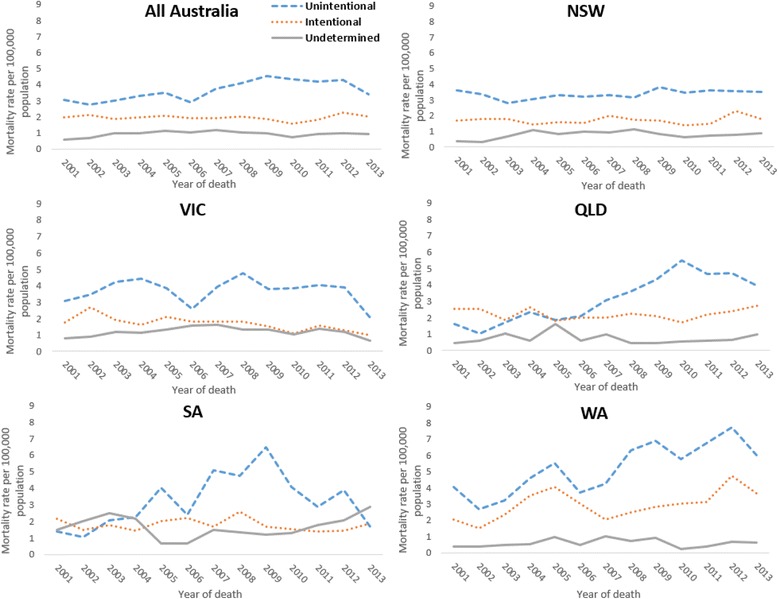
In countries like the United States and the United Kingdom, systematic variation in the classification of intent in pharmaceutical poisoning deaths have been identified between jurisdictions. This study aimed to explore whether the coronial determination of intent (unintentional, intentional, undetermined) for pharmaceutical-related poisoning deaths may have affected death rates over time and by jurisdiction in Australia.
A retrospective examination of mortality records in the National Coronial Information System (NCIS) during 1 January 2001 to 31 December 2013 was conducted. The NCIS is a national internet-based data storage and retrieval system for deaths that were notified to a coroner. Pharmaceutical deaths due to unintentional, intentional or undetermined intent were identified using the NCIS classification. Proportions of the different intent classifications and the mortality rates by intent over time were compared between jurisdictions.
There were 17,895 pharmaceutical-related poisoning deaths in Australia between 2001 and 2013 that had closed cases in the NCIS. Proportions of deaths classified as unintentional (48.3-66.3%), intentional (24.7-35.9%) and undetermined (6.7-24.7%) varied significantly among Australian jurisdictions. There were significant increases in the rate of classification of unintentional poisoning for some states, and significant increases in intentional poisoning classification in Western Australia, and decreases in New South Wales and Victoria. There was no significant change in classification of undetermined intent.
Significant variation in classifications of intent, both between state jurisdictions and over time, may be the result of regional differences in demographics and increases in prescription drug misuse. However, the inconsistent use of 'undetermined' intent between state jurisdictions suggests coroners may experience varying difficulty in retrospectively ruling on intent in the equivocal circumstances of pharmaceutical poisoning. The widespread use of psychological autopsy may assist coroners to classify intent, while the implementation of new classifications for pharmaceutical poisoning death may overcome some of the inherent difficulty in intent classification and improve the potential for injury surveillance irrespective of intent.
在美国和英国等国家,已发现不同司法管辖区在药物中毒死亡意图分类方面存在系统性差异。本研究旨在探讨澳大利亚死因裁判官对药物相关中毒死亡意图(无意、有意、未确定)的判定是否可能随时间推移以及因司法管辖区不同而影响死亡率。
对2001年1月1日至2013年12月31日期间国家死因裁判信息系统(NCIS)中的死亡率记录进行回顾性审查。NCIS是一个基于互联网的全国性数据存储和检索系统,用于存储向死因裁判官通报的死亡信息。使用NCIS分类确定无意、有意或未确定意图导致的药物死亡。比较不同司法管辖区之间不同意图分类的比例以及随时间推移按意图划分的死亡率。
2001年至2013年期间,澳大利亚有17,895例药物相关中毒死亡案件在NCIS中结案。在澳大利亚各司法管辖区中,被归类为无意(48.3 - 66.3%)、有意(24.7 - 35.9%)和未确定(6.7 - 24.7%)的死亡比例差异显著。一些州无意中毒分类率显著上升,西澳大利亚州有意中毒分类率显著上升,新南威尔士州和维多利亚州则下降。未确定意图的分类没有显著变化。
无论是在州司法管辖区之间还是随时间推移,意图分类的显著差异可能是人口统计学区域差异和处方药滥用增加的结果。然而,州司法管辖区之间对“未确定”意图的不一致使用表明,在药物中毒这种模棱两可的情况下,死因裁判官在追溯判定意图时可能会遇到不同程度的困难。广泛使用心理解剖可能有助于死因裁判官对意图进行分类,而实施药物中毒死亡的新分类可能克服意图分类中一些固有的困难,并提高无论意图如何的伤害监测潜力。