Chang Shih-Sheng, Sung Fung-Chang, Lin Cheng-Li, Hu Wei-Syun
Division of Cardiovascular Medicine, Department of Medicine, China Medical University Hospital Graduate Institute of Clinical Medical Science, China Medical University Management Office for Health Data, China Medical University Hospital Department of Health Services Administration School of Medicine, College of Medicine, China Medical University, Taichung, Taiwan.
Medicine (Baltimore). 2017 Aug;96(31):e7662. doi: 10.1097/MD.0000000000007662.
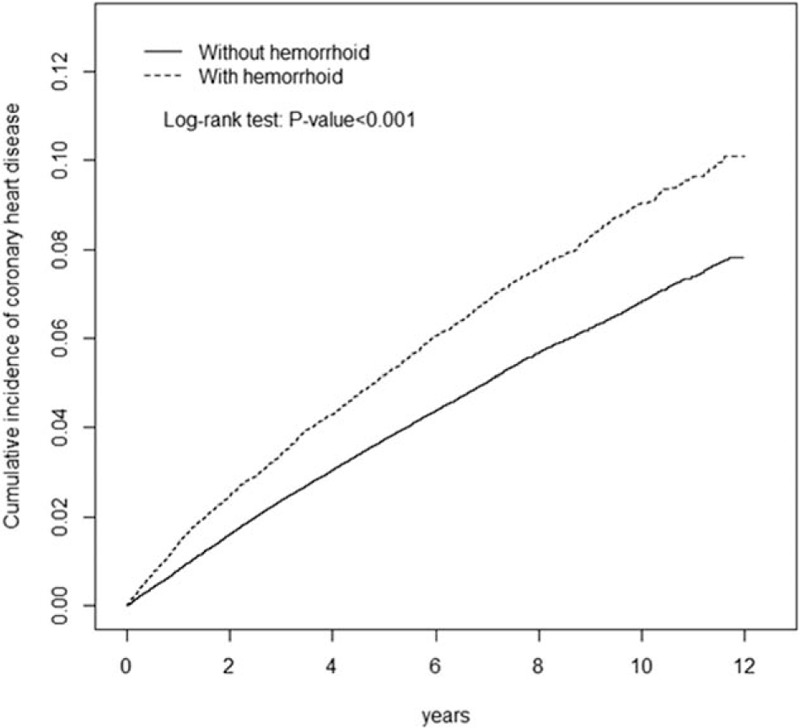
The purpose of the study was to address the association between hemorrhoid and the subsequent risk of coronary heart disease (CHD) development.This retrospective cohort study used reimbursement claims data from the Longitudinal Health Insurance Database 2000 in Taiwan. Thirty-three thousand thirty-four patients with hemorrhoids and 132,136 age-, gender-, and index year matched controls between 2000 and 2010 were identified. Cox model was performed to estimate the hazard ratios (HRs) and 95% confidence intervals (CIs) of CHD development for the hemorrhoid cohort compared with the nonhemorrhoid cohort.During a follow-up period of 12 years, the overall incidence rate of CHD was 9.91 per 1000 person-years in the hemorrhoid patients and was 1.36-fold higher than in the nonhemorrhoid cohort (7.28 per 1000 person-years) with an adjusted hazard ratio (aHR) of 1.27 (95% CI = 1.21-1.34). Moreover, compared with the nonhemorrhoid patients without these comorbidities, among patients with hemorrhoids, those with any 2 comorbidities were at a significantly increased risk of CHD (HR = 7.12, 95% CI = 6.61-7.67; P < .001), followed by those with any 1 comorbidity (HR = 3.23, 95% CI = 2.94-3.54; P < .001).We found that hemorrhoid patients had a 1.27-fold higher risk of CHD compared with those without hemorrhoids after adjusting for the potential confounding factors.
本研究的目的是探讨痔疮与随后发生冠心病(CHD)风险之间的关联。这项回顾性队列研究使用了台湾2000年纵向健康保险数据库中的报销索赔数据。确定了2000年至2010年间33034例痔疮患者以及132136例年龄、性别和索引年份相匹配的对照。采用Cox模型估计痔疮队列与非痔疮队列发生CHD的风险比(HRs)和95%置信区间(CIs)。在12年的随访期内,痔疮患者中CHD的总体发病率为每1000人年9.91例,比非痔疮队列(每1000人年7.28例)高1.36倍,调整后的风险比(aHR)为1.27(95%CI = 1.21 - 1.34)。此外,与没有这些合并症的非痔疮患者相比,在痔疮患者中,有任何2种合并症的患者发生CHD的风险显著增加(HR = 7.12,95%CI = 6.61 - 7.67;P <.001),其次是有任何1种合并症的患者(HR = 3.23,95%CI = 2.94 - 3.54;P <.001)。我们发现,在调整潜在混杂因素后,痔疮患者发生CHD的风险比无痔疮患者高1.27倍。