Lipczyńska Magdalena, Szymański Piotr, Kumor Magdalena, Klisiewicz Anna, Hoffman Piotr
Adult Congenital Heart Disease Department, Institute of Cardiology, Warsaw, Poland.
Acquired Valve Disease Department, Institute of Cardiology, Warsaw, Poland.
PLoS One. 2017 Aug 2;12(8):e0180629. doi: 10.1371/journal.pone.0180629. eCollection 2017.
Myocardial fibrosis is a potential pathophysiological mechanism leading to systemic right ventricular (SRV) deterioration. We hypothesize that circulating levels of collagen deposition markers are elevated in patients with SRV remodeling and this elevation may have a predictive value.
We prospectively evaluated 56 patients with D-TGA after the atrial switch procedure (mean age 25.6 ± 4.8, range 18-37 years; 67% males). Serum levels of procollagen type III amino-terminal propeptide (PIIINP), collagen type I carboxy-terminal telopeptide (CITP), procollagen type I N-terminal propeptide (PINP), matrix metalloproteinase (MMP 1, MMP 9) and a tissue inhibitor of matrix metalloproteinase (TIMP 1) and N-terminal pro-brain natriuretic peptide (NT-pro-BNP) were measured and compared with healthy controls. The relationship between these serum markers, echocardiographic and cardiac magnetic resonance parameters and the outcome at a follow-up of 61 months (range, 24-85 months) was determined.
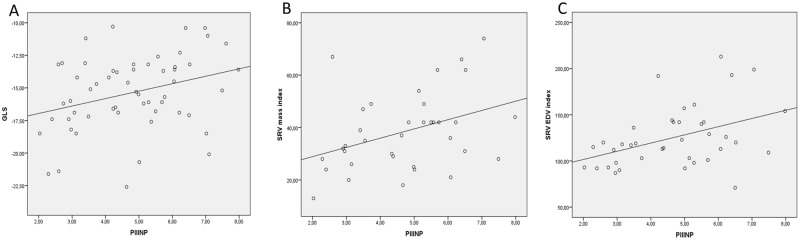
Compared with the healthy control group, the study group had significantly higher levels of TIMP1, PIIINP, CITP, PINP and NT-pro-BNP (p<0.05, each). The levels of PIIINP and CITP were significantly higher among patients with an SRV mass index above the mean value. The level of PIIINP was significantly higher among patients with an SRV EDV index above the mean value. CITP was significantly elevated in SRV late gadolinium enhanced (LGE) positive patients, compared to patients without SRV LGE. MMP9 and TIMP1 predicted an adverse clinical outcome on univariate Cox proportional hazard survival analysis in addition to well proven predictors of outcome (SRV EF and NYHA).
We demonstrated a pattern of altered collagen turnover adversely related with the indices of SRV remodeling and an adverse clinical outcome in patients with SRV.
心肌纤维化是导致系统性右心室(SRV)功能恶化的潜在病理生理机制。我们假设,SRV重构患者循环中的胶原沉积标志物水平升高,且这种升高可能具有预测价值。
我们前瞻性评估了56例接受心房调转术的完全性大动脉转位(D-TGA)患者(平均年龄25.6±4.8岁,范围18 - 37岁;67%为男性)。检测了血清III型前胶原氨基端前肽(PIIINP)、I型胶原羧基端肽(CITP)、I型前胶原N端前肽(PINP)、基质金属蛋白酶(MMP 1、MMP 9)和基质金属蛋白酶组织抑制剂(TIMP 1)以及N端前脑钠肽(NT-pro-BNP)水平,并与健康对照组进行比较。确定了这些血清标志物、超声心动图和心脏磁共振参数与61个月(范围24 - 85个月)随访结果之间的关系。
与健康对照组相比,研究组的TIMP1、PIIINP、CITP、PINP和NT-pro-BNP水平显著更高(均p<0.05)。SRV质量指数高于平均值的患者中,PIIINP和CITP水平显著更高。SRV舒张末期容积指数高于平均值的患者中,PIIINP水平显著更高。与无SRV延迟钆增强(LGE)的患者相比,SRV LGE阳性患者的CITP显著升高。除了已充分证实的预后预测指标(SRV射血分数和纽约心脏协会心功能分级)外,MMP9和TIMP1在单变量Cox比例风险生存分析中也预测了不良临床结局。
我们证明了胶原代谢改变模式与SRV重构指标及SRV患者不良临床结局呈负相关。