van der Heiden Marieke, Boots Annemieke M H, Bonacic Marinovic Axel A, de Rond Lia G H, van Maurik Marjan, Tcherniaeva Irina, Berbers Guy A M, Buisman Anne-Marie
Centre for Infectious Disease Control (Cib), National Institute for Public Health and the Environment (RIVM), Bilthoven, Netherlands.
Department of Rheumatology and Clinical Immunology, University of Groningen, University Medical Centre Groningen, Groningen, Netherlands.
Front Immunol. 2017 Jul 19;8:817. doi: 10.3389/fimmu.2017.00817. eCollection 2017.
Vaccine responses are often reduced in the elderly, leaving part of the elderly population vulnerable to infectious diseases. Timely vaccination may offer a solution for strengthening memory immunity before reaching old age, which classifies middle-aged persons as a target age group for vaccine interventions. However, knowledge regarding the immunogenicity of primary immunizations in middle-aged adults is lacking. We determined the immunogenicity of a primary meningococcal vaccine towards which no or (very) low pre-vaccination immunity exists in middle-aged adults (NTR4636).
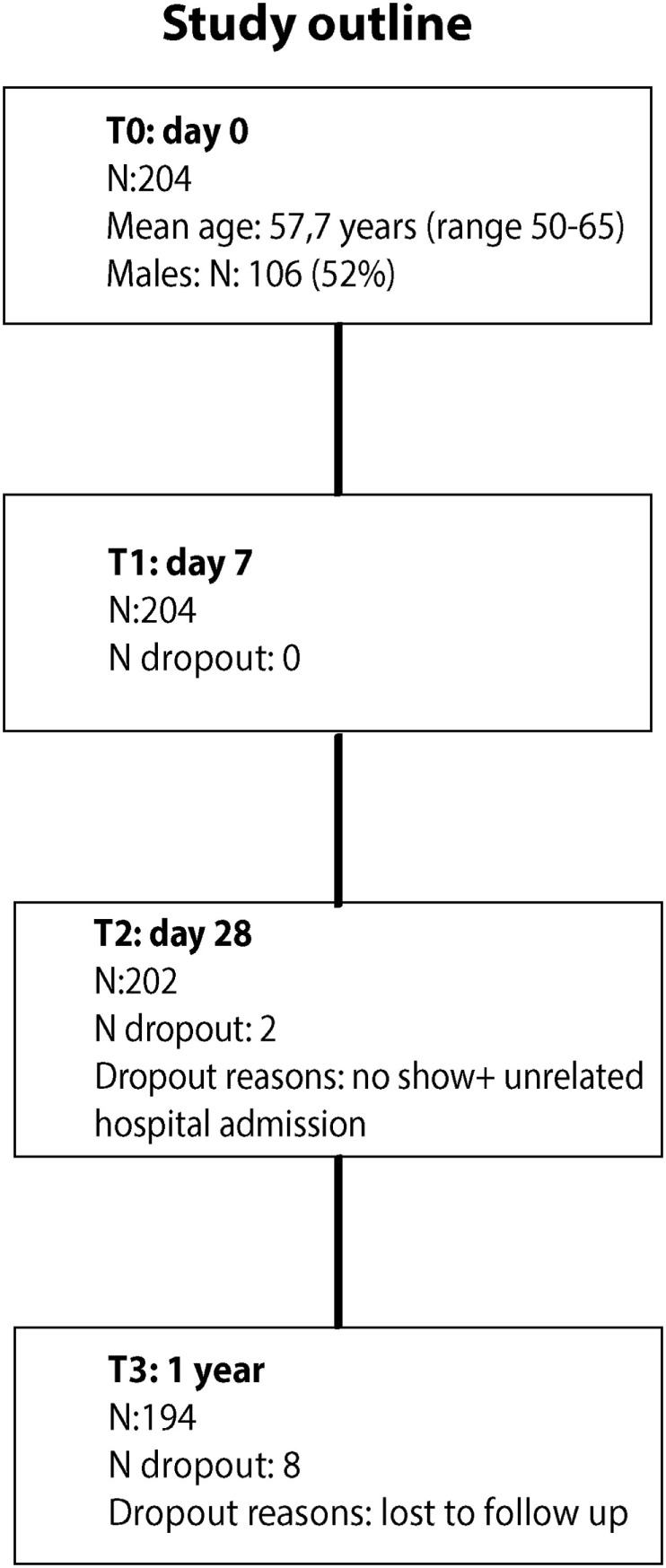
A vaccine containing multiple meningococcal groups (tetravalent) conjugated to tetanus toxoid (MenACWY-TT) was administered to middle-aged adults (50-65 years of age, = 204) in a phase IV single-center and open-label study. Blood samples were taken pre-, 7 days, 28 days, and 1 year post-vaccination. Functional antibody titers were measured with the serum bactericidal assay (SBA). Meningococcal- and tetanus-specific antibody responses were determined with a fluorescent bead-based multiplex immunoassay. A bi-exponential decay model was used to estimate long-term protection.
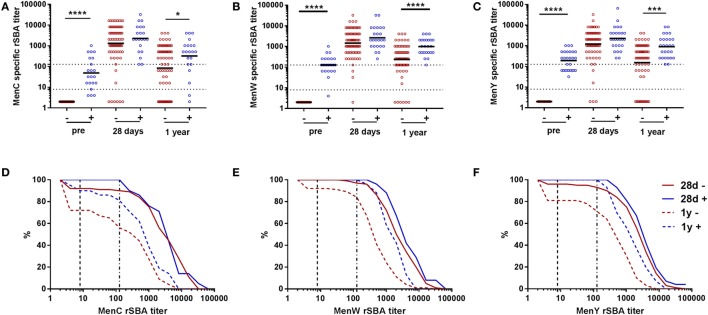
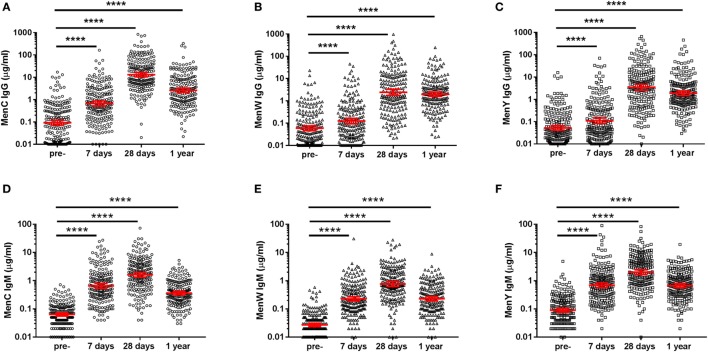
In the majority of the participants, the meningococcal vaccine clearly induced naïve responses to meningococci W (MenW) and meningococci Y (MenY) as compared to a booster response to meningococci C (MenC). After 28 days, 94, 99, and 97% of the participants possessed a protective SBA titer for MenC, MenW, and MenY, respectively, which was maintained in 76, 94, and 86% 1 year post-vaccination. At this 1-year time point, significantly lower SBA titers were found in participants without a pre-vaccination SBA titer. Overall, protective antibody titers were predicted to persist after 10 years in 40-60% of the participants. The SBA titers correlated well with the meningococcal-specific IgM responses, especially for MenW and MenY. Interestingly, these IgM responses were negatively correlated with age.
Primary immunization with a tetravalent meningococcal vaccine was highly immunogenic in middle-aged adults, inducing protective antibody titers in the vast majority of the participants lasting for at least 1 year. The age-related decrease in highly functional IgM responses argues in favor of vaccination against antigens before reaching old age and, hence, middle-aged persons are an age group of interest for future vaccine interventions to protect the aging population.
老年人的疫苗反应通常会降低,使得部分老年人群体易受传染病影响。及时接种疫苗可能为在步入老年之前增强记忆免疫提供一种解决方案,这将中年人列为疫苗干预的目标年龄组。然而,关于中年成年人初次免疫的免疫原性的知识尚缺。我们确定了一种在中年成年人(NTR4636)中不存在或(非常)低预接种免疫力的脑膜炎球菌疫苗的初次免疫原性。
在一项IV期单中心开放标签研究中,将一种与破伤风类毒素结合的包含多个脑膜炎球菌群(四价)疫苗(MenACWY-TT)接种于中年成年人(50 - 65岁,n = 204)。在接种前、接种后7天、28天和1年采集血样。用血清杀菌试验(SBA)测量功能性抗体滴度。用基于荧光微球的多重免疫测定法测定脑膜炎球菌特异性和破伤风特异性抗体反应。使用双指数衰减模型估计长期保护作用。
与针对脑膜炎球菌C(MenC)的加强反应相比,在大多数参与者中,脑膜炎球菌疫苗明显诱导了对脑膜炎球菌W(MenW)和脑膜炎球菌Y(MenY)的初次反应。接种28天后,分别有94%、99%和97%的参与者针对MenC、MenW和MenY具有保护性SBA滴度,接种1年后分别有76%、94%和86%的参与者保持该滴度。在这个1年时间点,在没有接种前SBA滴度的参与者中发现SBA滴度显著较低。总体而言,预计40 - 60%的参与者在10年后保护性抗体滴度仍会持续存在。SBA滴度与脑膜炎球菌特异性IgM反应相关性良好,尤其是对于MenW和MenY。有趣的是,这些IgM反应与年龄呈负相关。
四价脑膜炎球菌疫苗的初次免疫在中年成年人中具有高度免疫原性,在绝大多数参与者中诱导出持续至少1年的保护性抗体滴度。高功能性IgM反应随年龄增长而下降,这支持在步入老年之前针对这些抗原进行疫苗接种,因此,中年人群体是未来疫苗干预以保护老年人群体的一个重要年龄组。