Bilican Doga, Fornell Jordina, Sort Jordi, Pellicer Eva
Departament de Física, Facultat de Ciències, Universitat Autònoma de Barcelona, E-08193 Bellaterra, Spain.
Institució Catalana de Recerca i Estudis Avançats (ICREA), Pg. Lluís Companys 23, E-08010 Barcelona, Spain.
Materials (Basel). 2017 Jan 6;10(1):43. doi: 10.3390/ma10010043.
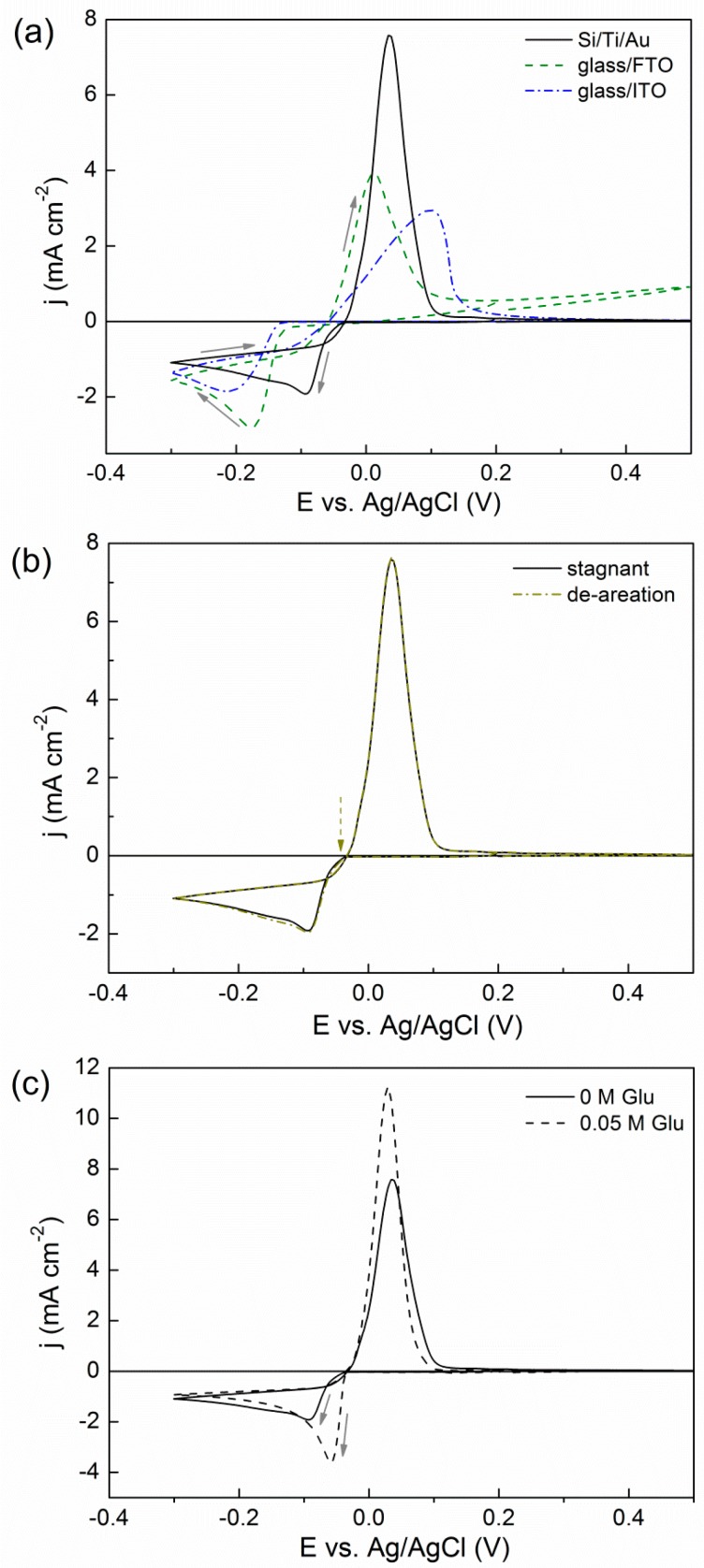
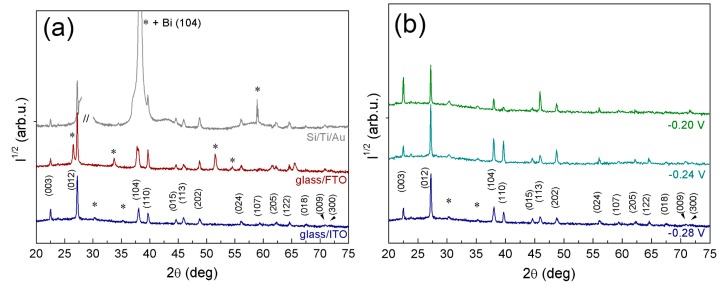
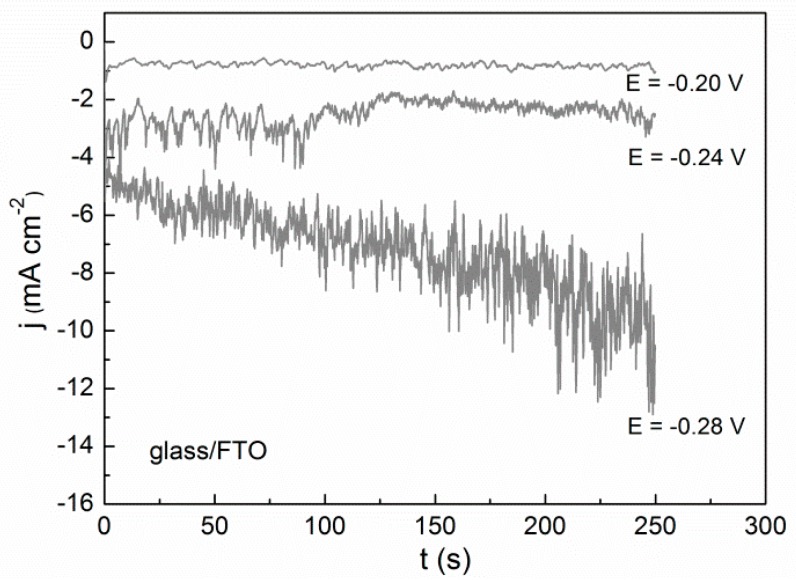
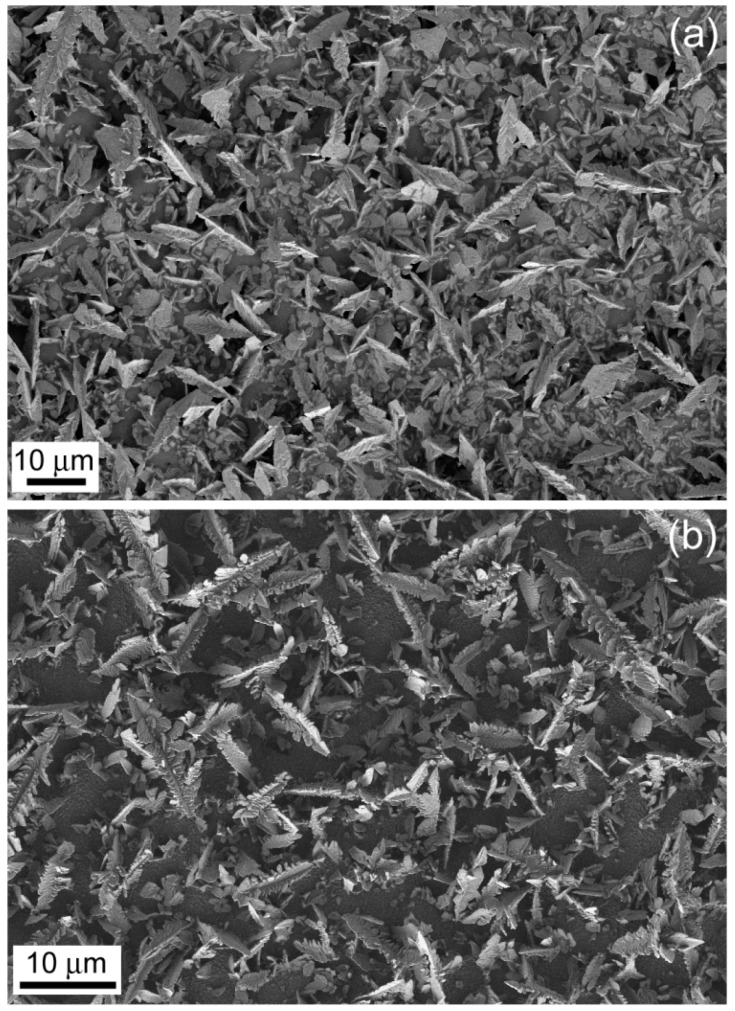
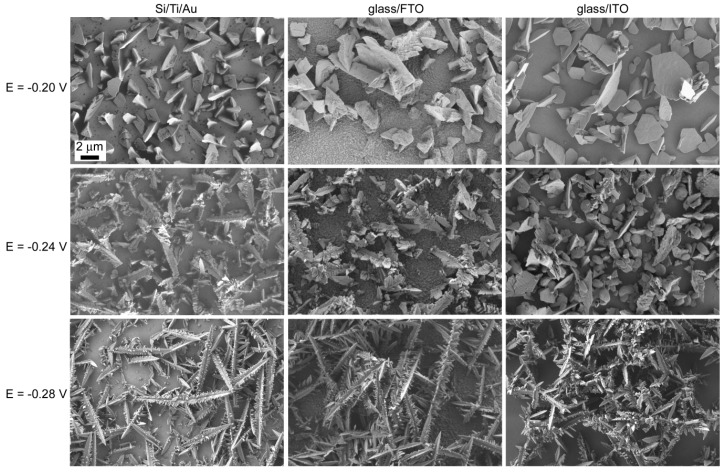
Bismuth (Bi) electrodeposition was studied on Si/Ti/Au, FTO-, and ITO-coated glasses from acidic nitrate solutions with and without gluconate within a narrow potential window (ΔE = 80 mV). This potential range was sufficient to observe a change in particle shape, from polyhedrons (including hexagons) to dendrites, the trend being slightly different depending on substrate activity. In all cases, though, the formation of dendrites was favoured as the applied potential was made more negative. Bi particles were more uniformly distributed over the substrate when sodium gluconate was added to the electrolyte. X-ray diffraction analyses of dendrites grown at -0.28 V indicated that they exhibit the rhombohedral phase of Bi and are predominantly oriented along the (003) plane. This orientation is exacerbated at the lowest applied potential (-0.20 V vs. Ag|AgCl) on glass/ITO substrate, for which completed and truncated hexagons are observed from the top view scanning electron microscopy images.
在狭窄的电位窗口(ΔE = 80 mV)内,研究了铋(Bi)在涂覆有Si/Ti/Au、FTO和ITO的玻璃上,从含和不含葡萄糖酸盐的酸性硝酸盐溶液中进行的电沉积。该电位范围足以观察到颗粒形状从多面体(包括六边形)到树枝状的变化,根据基底活性的不同,变化趋势略有差异。不过,在所有情况下,随着施加的电位变得更负,树枝状的形成更受青睐。当向电解质中添加葡萄糖酸钠时,Bi颗粒在基底上分布得更均匀。对在-0.28 V下生长的树枝状晶体进行的X射线衍射分析表明,它们呈现Bi的菱面体相,并且主要沿(003)平面取向。在玻璃/ITO基底上施加的最低电位(-0.20 V vs. Ag|AgCl)下,这种取向更加明显,从顶视图扫描电子显微镜图像中可以观察到完整的和截断的六边形。