
碳化钢筋混凝土结构修复后材料碳化的预测模型
Prediction Model for the Carbonation of Post-Repair Materials in Carbonated RC Structures.
作者信息
Lee Hyung-Min, Lee Han-Seung, Singh Jitendra Kumar
机构信息
Department of Architectural Engineering, Hanyang University, 1271 Sa 3-dong, Sangrok-gu, Ansan 15588, Korea.
出版信息
Materials (Basel). 2017 May 3;10(5):492. doi: 10.3390/ma10050492.
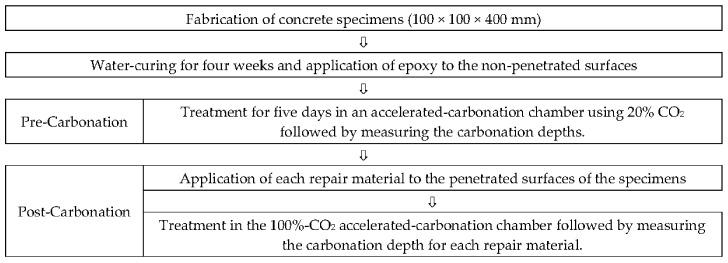
Concrete carbonation damages the passive film that surrounds reinforcement bars, resulting in their exposure to corrosion. Studies on the prediction of concrete carbonation are thus of great significance. The repair of pre-built reinforced concrete (RC) structures by methods such as remodeling was recently introduced. While many studies have been conducted on the progress of carbonation in newly constructed buildings and RC structures fitted with new repair materials, the prediction of post-repair carbonation has not been considered. In the present study, accelerated carbonation was carried out to investigate RC structures following surface layer repair, in order to determine the carbonation depth. To validate the obtained results, a second experiment was performed under the same conditions to determine the carbonation depth by the Finite Difference Method (FDM) and Finite Element Method (FEM). For the accelerated carbonation experiment, FDM and FEM analyses, produced very similar results, thus confirming that the carbonation depth in an RC structure after surface layer repair can be predicted with accuracy. The specimen repaired using inhibiting surface coating (ISC) had the highest carbonation penetration of 19.81, while this value was the lowest for the corrosion inhibiting mortar (IM) with 13.39 mm. In addition, the carbonation depth predicted by using the carbonation prediction formula after repair indicated that that the analytical and experimental values are almost identical if the initial concentration of Ca(OH)₂ is assumed to be 52%.
混凝土碳化会破坏围绕钢筋的钝化膜,导致钢筋暴露于腐蚀环境中。因此,对混凝土碳化预测的研究具有重要意义。最近引入了通过重塑等方法对预制钢筋混凝土(RC)结构进行修复。虽然已经对新建建筑和使用新型修复材料的RC结构中的碳化进展进行了许多研究,但尚未考虑修复后碳化的预测。在本研究中,进行了加速碳化试验,以研究表层修复后的RC结构,从而确定碳化深度。为了验证所得结果,在相同条件下进行了第二个实验,通过有限差分法(FDM)和有限元法(FEM)确定碳化深度。对于加速碳化试验、FDM和FEM分析,产生了非常相似的结果,从而证实了表层修复后RC结构中的碳化深度可以准确预测。使用抑制性表面涂层(ISC)修复的试件碳化穿透率最高,为19.81,而使用防腐砂浆(IM)修复的试件该值最低,为13.39毫米。此外,修复后使用碳化预测公式预测的碳化深度表明,如果假设Ca(OH)₂的初始浓度为52%,则分析值和实验值几乎相同。



 Zotero 插件