Yin Min, Yang Fang, Wang Zhaojie, Zhu Miao, Liu Ming, Xu Xiuru, Li Zhenyu
Changchun Institute of Applied Chemistry, Chinese Academy of Sciences, 5625 Renmin Street, Changchun 130022, China.
Institute of Chemical Materials, China Academy of Engineering Physics, Mianyang 621900, China.
Materials (Basel). 2017 May 16;10(5):535. doi: 10.3390/ma10050535.
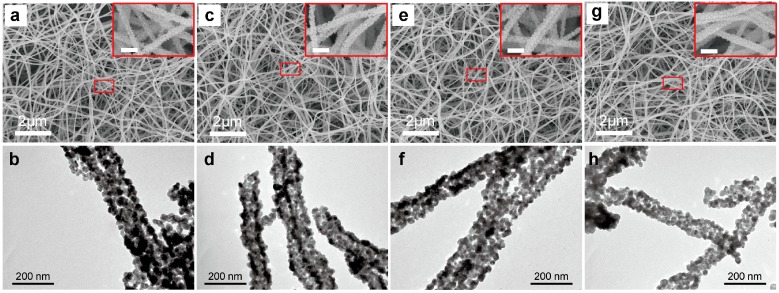
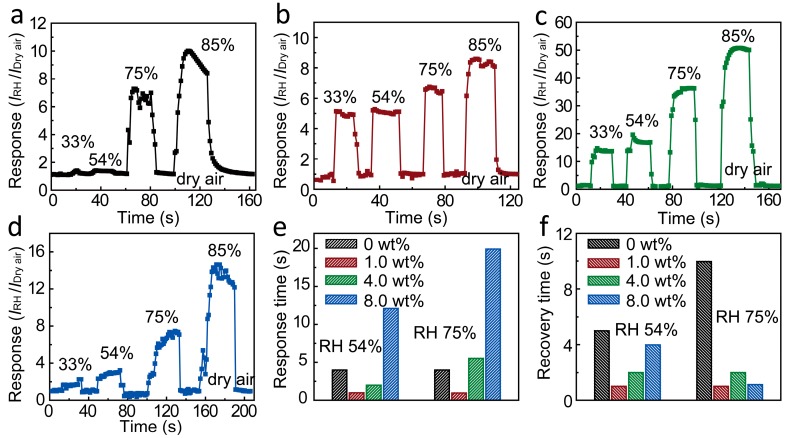
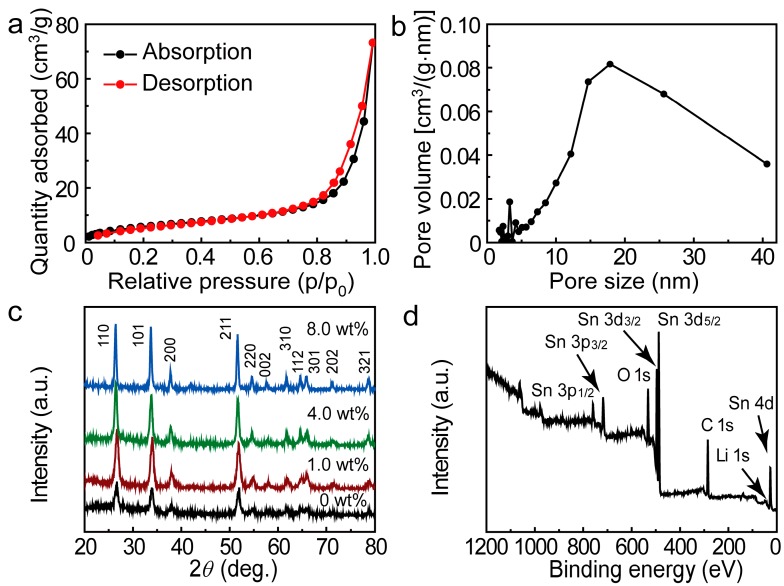
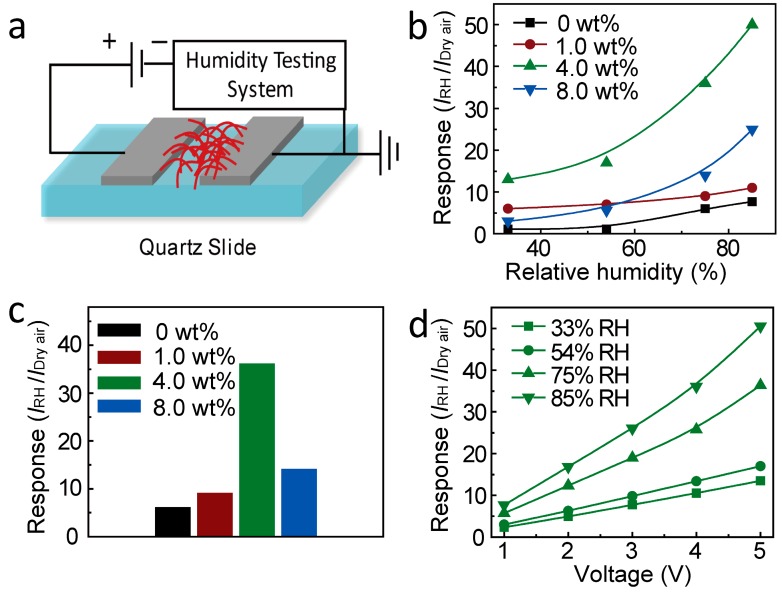
One-dimensional SnO₂- and Li⁺-doped SnO₂ porous nanofibers were easily fabricated via electrospinning and a subsequent calcination procedure for ultrafast humidity sensing. Different Li dopant concentrations were introduced to investigate the dopant's role in sensing performance. The response properties were studied under different relative humidity levels by both statistic and dynamic tests. The best response was obtained with respect to the optimal doping of Li⁺ into SnO₂ porous nanofibers with a maximum 15 times higher response than that of pristine SnO₂ porous nanofibers, at a relative humidity level of 85%. Most importantly, the ultrafast response and recovery time within 1 s was also obtained with the 1.0 wt % doping of Li⁺ into SnO₂ porous nanofibers at 5 V and at room temperature, benefiting from the co-contributions of Li-doping and the one-dimensional porous structure. This work provides an effective method of developing ultrafast sensors for practical applications-especially fast breathing sensors.
通过静电纺丝和后续的煅烧程序,可轻松制备出一维SnO₂和Li⁺掺杂的SnO₂多孔纳米纤维,用于超快湿度传感。引入不同的Li掺杂浓度以研究掺杂剂在传感性能中的作用。通过统计和动态测试研究了在不同相对湿度水平下的响应特性。在相对湿度为85%时,Li⁺对SnO₂多孔纳米纤维的最佳掺杂获得了最佳响应,其响应比原始SnO₂多孔纳米纤维高出15倍。最重要的是,在5 V和室温下,Li⁺对SnO₂多孔纳米纤维进行1.0 wt%掺杂时,也能在1 s内获得超快响应和恢复时间,这得益于Li掺杂和一维多孔结构的共同作用。这项工作为开发用于实际应用的超快传感器——尤其是快速呼吸传感器,提供了一种有效的方法。