Rangel-Cárdenas Angie L, Koper Ger J M
Chemical Engineering, Delft University of Technology, 2629 HZ Delft, The Netherlands.
Materials (Basel). 2017 May 25;10(6):576. doi: 10.3390/ma10060576.
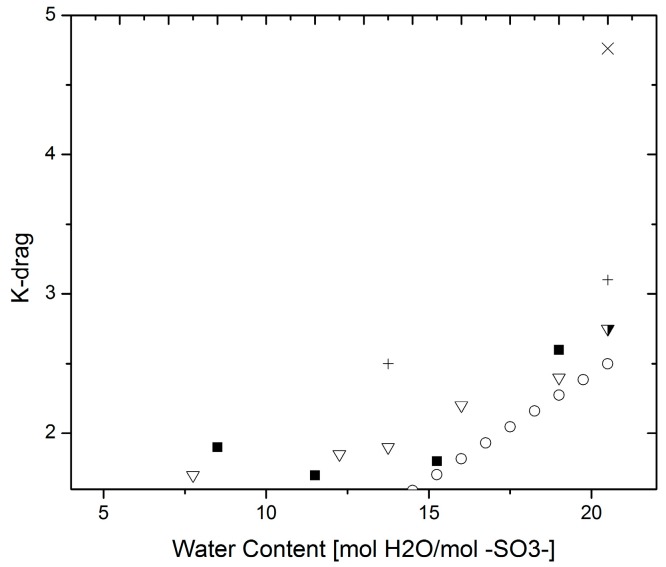
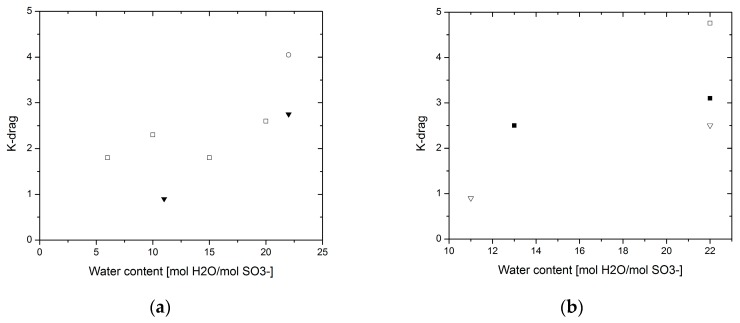
We hypothesize that the properties of proton-exchange membranes for fuel cell applications cannot be described unambiguously unless interface effects are taken into account. In order to prove this, we first develop a thermodynamically consistent description of the transport properties in the membranes, both for a homogeneous membrane and for a homogeneous membrane with two surface layers in contact with the electrodes or holder material. For each subsystem, homogeneous membrane, and the two surface layers, we limit ourselves to four parameters as the system as a whole is considered to be isothermal. We subsequently analyze the experimental results on some standard membranes that have appeared in the literature and analyze these using the two different descriptions. This analysis yields relatively well-defined values for the homogeneous membrane parameters and estimates for those of the surface layers and hence supports our hypothesis. As demonstrated, the method used here allows for a critical evaluation of the literature values. Moreover, it allows optimization of stacked transport systems such as proton-exchange membrane fuel cell units where interfacial layers, such as that between the catalyst and membrane, are taken into account systematically.
我们假设,除非考虑界面效应,否则无法明确描述用于燃料电池应用的质子交换膜的性能。为了证明这一点,我们首先对膜中的传输特性进行了热力学上一致的描述,包括均质膜以及与电极或支架材料接触的具有两个表面层的均质膜。对于每个子系统,即均质膜和两个表面层,由于整个系统被视为等温的,我们将自己限制在四个参数。随后,我们分析了文献中出现的一些标准膜的实验结果,并使用两种不同的描述对这些结果进行分析。该分析得出了均质膜参数的相对明确的值以及表面层参数的估计值,从而支持了我们的假设。如所示,这里使用的方法允许对文献值进行批判性评估。此外,它允许对堆叠传输系统进行优化,例如质子交换膜燃料电池单元,其中系统地考虑了界面层,如催化剂和膜之间的界面层。