Dzimitrowicz Anna, Jamroz Piotr, Nyk Marcin, Pohl Pawel
Department of Analytical Chemistry and Chemical Metallurgy, Faculty of Chemistry, Wroclaw University of Technology, Wybrzeze St. Wyspianskiego 27, 50-370 Wroclaw, Poland.
Department of Advanced Materials Engineering and Modelling, Faculty of Chemistry, Wroclaw University of Technology, Wybrzeze Stanislawa Wyspianskiego 27, 50-370 Wroclaw, Poland.
Materials (Basel). 2016 Apr 6;9(4):268. doi: 10.3390/ma9040268.
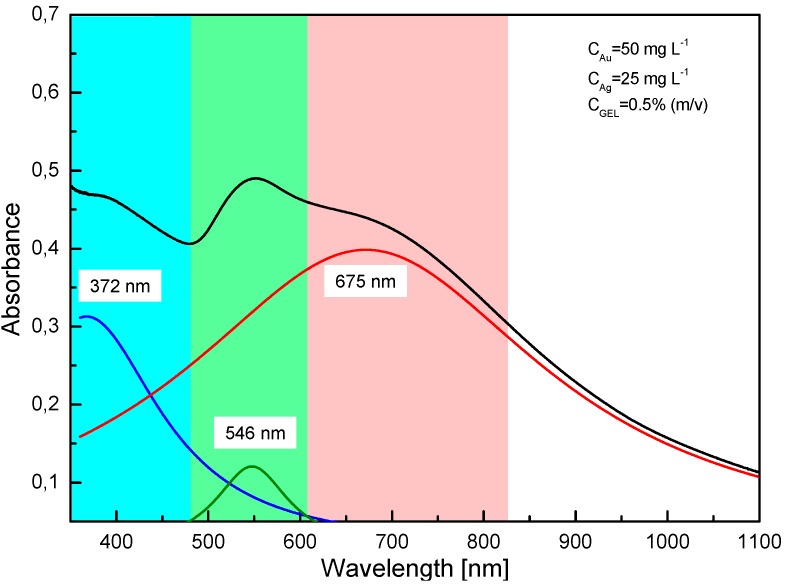
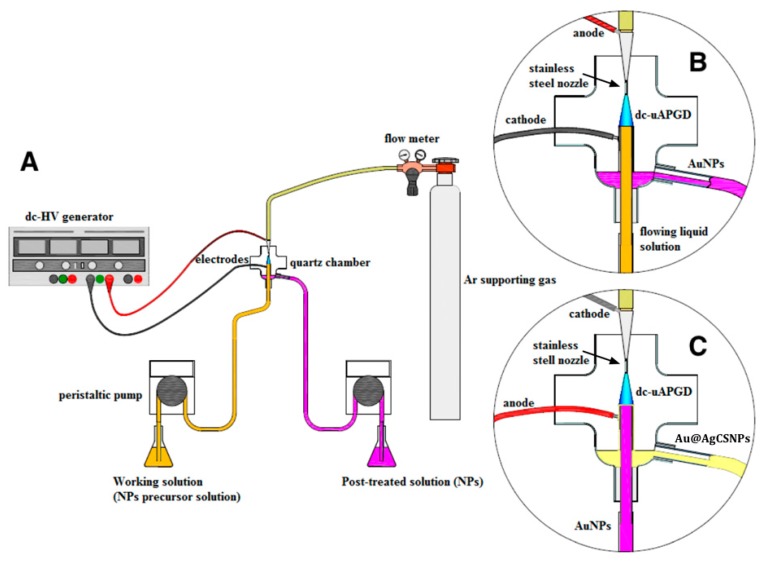
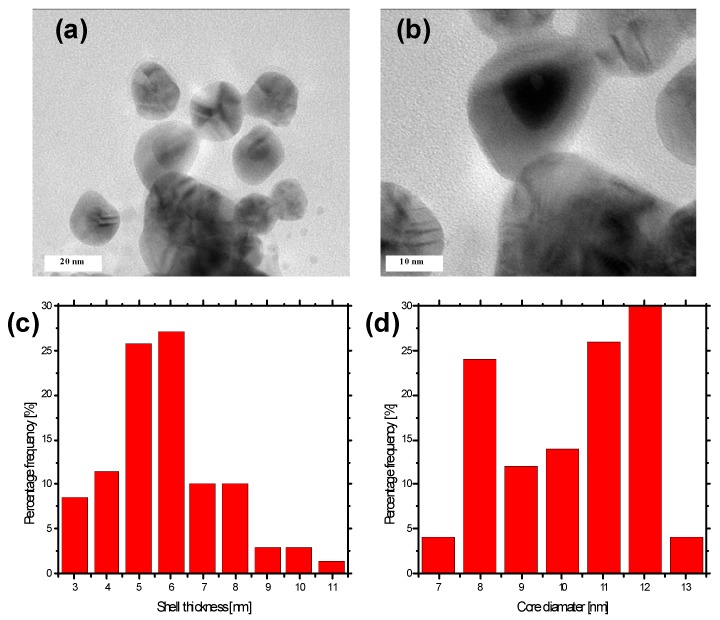
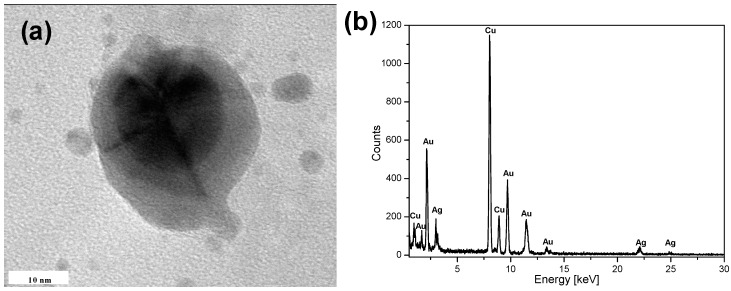
A direct current atmospheric pressure glow microdischarge (dc-μAPGD) generated between an Ar nozzle microjet and a flowing liquid was applied to produce Au-Ag core-shell nanoparticles (Au@AgCSNPs) in a continuous flow system. Firstly, operating dc-μAPGD with the flowing solution of the Au(III) ions as the cathode, the Au nanoparticles (AuNPs) core was produced. Next, to produce the core-shell nanostructures, the collected AuNPs solution was immediately mixed with an AgNO₃ solution and passed through the system with the reversed polarity to fabricate the Ag nanoshell on the AuNPs core. The formation of Au@AgCSNPs was confirmed using ultraviolet-visible (UV-Vis) absorbance spectrophotometry, transmission electron microscopy (TEM), and energy-dispersive X-ray spectroscopy (EDS). Three localized surface plasmon resonance absorption bands with wavelengths centered at 372, 546, and 675 nm were observed in the UV-Vis spectrum of Au@AgCSNPs, confirming the reduction of both the Au(III) and Ag(I) ions. The right configuration of metals in Au@AgCSNPs was evidenced by TEM. The Au core diameter was 10.2 ± 2.0 nm, while the thickness of the Ag nanoshell was 5.8 ± 1.8 nm. The elemental composition of the bimetallic nanoparticles was also confirmed by EDS. It is possible to obtain 90 mL of a solution containing Au@AgCSNPs per hour using the applied microdischarge system.
在氩气喷嘴微射流与流动液体之间产生的直流大气压辉光微放电(dc-μAPGD)被应用于在连续流动系统中制备金-银核壳纳米颗粒(Au@AgCSNPs)。首先,以Au(III)离子的流动溶液作为阴极运行直流μAPGD,制备出金纳米颗粒(AuNPs)核。接下来,为了制备核壳纳米结构,将收集到的AuNPs溶液立即与硝酸银溶液混合,并以相反极性通过该系统,在AuNPs核上制备银纳米壳。使用紫外可见(UV-Vis)吸光光度法、透射电子显微镜(TEM)和能量色散X射线光谱(EDS)确认了Au@AgCSNPs的形成。在Au@AgCSNPs的紫外可见光谱中观察到三个波长分别位于372、546和675 nm的局域表面等离子体共振吸收带,证实了Au(III)和Ag(I)离子均被还原。TEM证明了Au@AgCSNPs中金属的正确构型。Au核直径为10.2±2.0 nm,而银纳米壳的厚度为5.8±1.8 nm。双金属纳米颗粒的元素组成也通过EDS得到了确认。使用所应用的微放电系统,每小时可以获得90 mL含有Au@AgCSNPs的溶液。