Baker Qanita Bani, Podgorski Gregory J, Vargis Elizabeth, Flann Nicholas S
Jordan University of Science and Technology, Irbid, Jordan.
Biology Department, Utah State University, Logan, 84322 USA.
J Biol Eng. 2017 Aug 2;11:26. doi: 10.1186/s13036-017-0063-6. eCollection 2017.
The configuration of necrotic areas within the retinal pigmented epithelium is an important element in the progression of age-related macular degeneration (AMD). In the exudative (wet) and non-exudative (dry) forms of the disease, retinal pigment epithelial (RPE) cells respond to adjacent atrophied regions by secreting vascular endothelial growth factor (VEGF) that in turn recruits new blood vessels which lead to a further reduction in retinal function and vision. In vitro models exist for studying VEGF expression in wet AMD (Vargis et al., Biomaterials 35(13):3999-4004, 2014), but are limited in the patterns of necrotic and intact RPE epithelium they can produce and in their ability to finely resolve VEGF expression dynamics.
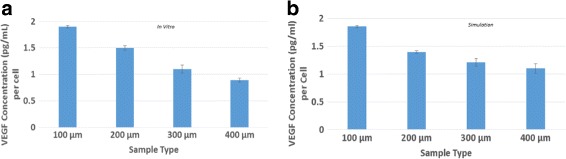
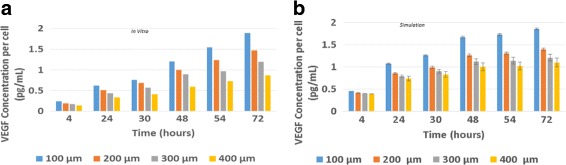
In this work, an in silico hybrid agent-based model was developed and validated using the results of this cell culture model of VEGF expression in AMD. The computational model was used to extend the cell culture investigation to explore the dynamics of VEGF expression in different sized patches of RPE cells and the role of negative feedback in VEGF expression. Results of the simulation and the cell culture studies were in excellent qualitative agreement, and close quantitative agreement.
The model indicated that the configuration of necrotic and RPE cell-containing regions have a major impact on VEGF expression dynamics and made precise predictions of VEGF expression dynamics by groups of RPE cells of various sizes and configurations. Coupled with biological studies, this model may give insights into key molecular mechanisms of AMD progression and open routes to more effective treatments.
视网膜色素上皮内坏死区域的形态是年龄相关性黄斑变性(AMD)进展的一个重要因素。在该疾病的渗出性(湿性)和非渗出性(干性)形式中,视网膜色素上皮(RPE)细胞通过分泌血管内皮生长因子(VEGF)对相邻的萎缩区域作出反应,而VEGF反过来会募集新血管,进而导致视网膜功能和视力进一步下降。目前存在用于研究湿性AMD中VEGF表达的体外模型(Vargis等人,《生物材料》35(13):3999 - 4004,2014),但它们在所能产生的坏死和完整RPE上皮形态以及精细解析VEGF表达动态的能力方面存在局限性。
在这项研究中,开发了一种基于计算机的混合代理模型,并利用AMD中VEGF表达的细胞培养模型结果进行了验证。该计算模型用于扩展细胞培养研究,以探索不同大小RPE细胞斑块中VEGF表达的动态以及负反馈在VEGF表达中的作用。模拟结果与细胞培养研究结果在定性上高度一致,在定量上也非常接近。
该模型表明坏死区域和含RPE细胞区域的形态对VEGF表达动态有重大影响,并对不同大小和形态的RPE细胞群的VEGF表达动态做出了精确预测。结合生物学研究,该模型可能有助于深入了解AMD进展的关键分子机制,并为更有效的治疗开辟途径。