Jahja Rianne, van Spronsen Francjan J, de Sonneville Leo M J, van der Meere Jaap J, Bosch Annet M, Hollak Carla E M, Rubio-Gozalbo M Estela, Brouwers Martijn C G J, Hofstede Floris C, de Vries Maaike C, Janssen Mirian C H, van der Ploeg Ans T, Langendonk Janneke G, Huijbregts Stephan C J
University of Groningen, University Medical Center Groningen, Beatrix Children's Hospital, Groningen, The Netherlands.
Department of Clinical Child and Adolescent Studies & Leiden Institute for Brain and Cognition, Leiden University, Leiden, The Netherlands.
Behav Genet. 2017 Sep;47(5):486-497. doi: 10.1007/s10519-017-9863-1. Epub 2017 Aug 3.
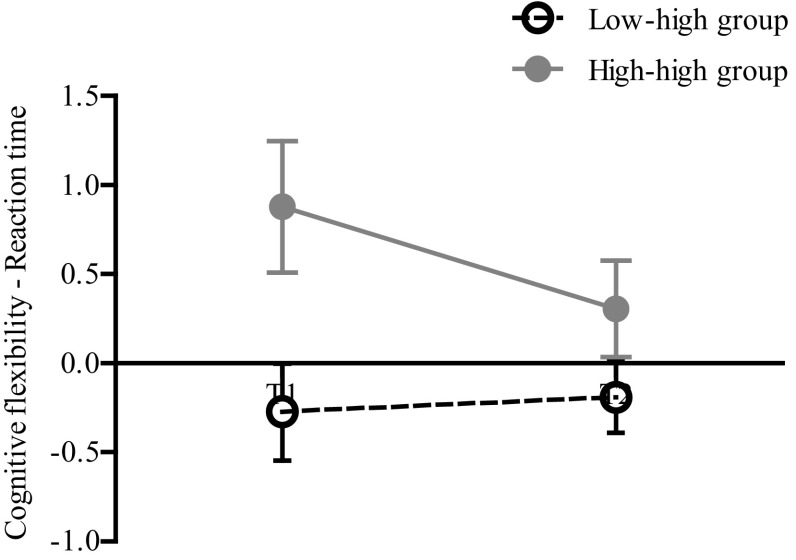
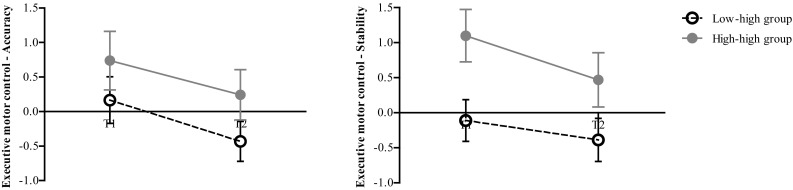
Cognitive and mental health problems in individuals with the inherited metabolic disorder phenylketonuria (PKU) have often been associated with metabolic control and its history. For the present study executive functioning (EF) was assessed in 21 PKU patients during childhood (T1, mean age 10.4 years, SD = 2.0) and again in adulthood (T2, mean age 25.8 years, SD = 2.3). At T2 additional assessments of EF in daily life and mental health were performed. Childhood (i.e. 0-12 years) blood phenylalanine was significantly related to cognitive flexibility, executive motor control, EF in daily life and mental health in adulthood (i.e. at T2). Patients with a greater increase in phenylalanine levels after the age of 12 performed more poorly on EF-tasks at T2. Group-based analyses showed that patients with phenylalanine <360 µmol/L in childhood and phenylalanine ≥360 µmol/L from age 13 onwards (n = 11) had better cognitive flexibility and executive motor control than those who had phenylalanine ≥360 µmol/L throughout life (n = 7), supporting the notion that phenylalanine should be below the recommended upper treatment target of 360 µmol/L during childhood for better outcome in adulthood. Despite some results indicating additional influence of phenylalanine levels between 13 and 17 years of age, evidence for a continued influence of phenylalanine levels after childhood on adult outcomes was largely lacking. This may be explained by the fact that the patients in the present study had relatively low phenylalanine levels during childhood (mean: 330 µmol/L, range: 219-581 µmol/L) and thereafter (mean Index of Dietary Control at T2: 464 µmol/L, range: 276-743 µmol/L), which may have buffered against transitory periods of poor metabolic control during adolescence and early adulthood.
患有遗传性代谢疾病苯丙酮尿症(PKU)的个体出现的认知和心理健康问题,常常与代谢控制及其病史有关。在本研究中,对21名PKU患者在儿童期(T1,平均年龄10.4岁,标准差=2.0)和成年期(T2,平均年龄25.8岁,标准差=2.3)分别进行了执行功能(EF)评估。在T2时,还对日常生活中的EF和心理健康进行了额外评估。儿童期(即0至12岁)的血苯丙氨酸水平与成年期(即T2时)的认知灵活性、执行运动控制、日常生活中的EF以及心理健康显著相关。12岁后苯丙氨酸水平升高幅度较大的患者在T2时的EF任务表现更差。基于分组的分析表明,儿童期苯丙氨酸<360µmol/L且13岁及以后苯丙氨酸≥360µmol/L的患者(n=11),比那些一生苯丙氨酸≥360µmol/L的患者(n=7)具有更好的认知灵活性和执行运动控制,这支持了这样一种观点,即儿童期苯丙氨酸应低于推荐的360µmol/L的治疗上限目标,以便在成年期获得更好的结果。尽管一些结果表明13至17岁之间苯丙氨酸水平有额外影响,但儿童期后苯丙氨酸水平对成人结局持续影响的证据在很大程度上是缺乏的。这可能是由于本研究中的患者在儿童期(平均:330µmol/L,范围:219 - 581µmol/L)及之后(T2时饮食控制指数平均:464µmol/L,范围:276 - 743µmol/L)的苯丙氨酸水平相对较低,这可能缓冲了青春期和成年早期代谢控制不佳的过渡阶段。