Jahja Rianne, van Spronsen Francjan J, de Sonneville Leo M J, van der Meere Jaap J, Bosch Annet M, Hollak Carla E M, Rubio-Gozalbo M Estela, Brouwers Martijn C G J, Hofstede Floris C, de Vries Maaike C, Janssen Mirian C H, van der Ploeg Ans T, Langendonk Janneke G, Huijbregts Stephan C J
University of Groningen, University Medical Center Groningen, Beatrix Children's Hospital, Division of Metabolic Diseases CA33, PO Box 30.001, 9700 RB, Groningen, The Netherlands.
Department of Clinical Child and Adolescent Studies & Leiden Institute for Brain and Cognition, Leiden University, Leiden, The Netherlands.
J Inherit Metab Dis. 2016 May;39(3):355-362. doi: 10.1007/s10545-016-9918-0. Epub 2016 Feb 25.
Early treatment of phenylketonuria (ET-PKU) prevents mental retardation, but many patients still show cognitive and mood problems. In this study, it was investigated whether ET-PKU-patients have specific phenylalanine (Phe-)related problems with respect to social-cognitive functioning and social skills.
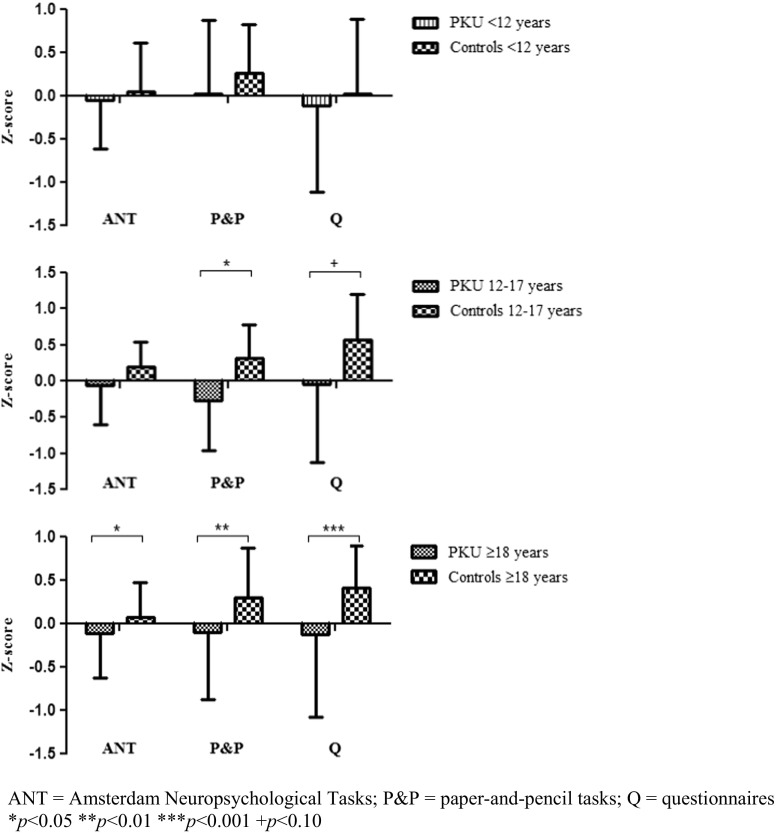
Ninety five PKU-patients (mean age 21.6 ± 10.2 years) and 95 healthy controls (mean age 19.6 ± 8.7 years) were compared on performance of computerized and paper-and-pencil tasks measuring social-cognitive abilities and on parent- and self-reported social skills, using multivariate analyses of variance, and controlling for general cognitive ability (IQ-estimate). Further comparisons were made between patients using tetrahydrobiopterin (BH4, N = 30) and patients not using BH4. Associations with Phe-levels on the day of testing, during childhood, during adolescence and throughout life were examined.
PKU-patients showed poorer social-cognitive functioning and reportedly had poorer social skills than controls (regardless of general cognitive abilities). Quality of social-cognitive functioning was negatively related to recent Phe-levels and Phe-levels between 8 and 12 years for adolescents with PKU. Quality of social skills was negatively related to lifetime phenylalanine levels in adult patients, and specifically to Phe-levels between 0 and 7, and between 8 and 12 years. There were no differences with respect to social outcome measures between the BH4 and non-BH4 groups.
PKU-patients have Phe-related difficulties with social-cognitive functioning and social skills. Problems seem to be more evident among adolescents and adults with PKU. High Phe-levels during childhood and early adolescence seem to be of greater influence than current and recent Phe-levels for these patients.
苯丙酮尿症的早期治疗(ET-PKU)可预防智力发育迟缓,但许多患者仍存在认知和情绪问题。本研究调查了ET-PKU患者在社会认知功能和社交技能方面是否存在特定的与苯丙氨酸(Phe-)相关的问题。
采用多变量方差分析,并控制一般认知能力(智商估计值),比较了95名PKU患者(平均年龄21.6±10.2岁)和95名健康对照者(平均年龄19.6±8.7岁)在测量社会认知能力的计算机化和纸笔任务中的表现,以及父母报告和自我报告的社交技能。对使用四氢生物蝶呤(BH4,N = 30)的患者和未使用BH4的患者进行了进一步比较。研究了测试当天、儿童期、青春期和一生中Phe水平的相关性。
PKU患者的社会认知功能较差,据报道其社交技能也比对照组差(无论一般认知能力如何)。PKU青少年的社会认知功能质量与近期Phe水平以及8至12岁之间的Phe水平呈负相关。成年患者的社交技能质量与终生苯丙氨酸水平呈负相关,特别是与0至7岁以及8至12岁之间的Phe水平呈负相关。BH4组和非BH4组在社会结局指标方面没有差异。
PKU患者在社会认知功能和社交技能方面存在与Phe相关的困难。这些问题在PKU青少年和成年人中似乎更为明显。对于这些患者来说,儿童期和青春期早期的高Phe水平似乎比当前和近期的Phe水平影响更大。