Baur Johannes, Büntemeyer Tjark-Ole, Megerle Felix, Deutschbein Timo, Spitzweg Christine, Quinkler Marcus, Nawroth Peter, Kroiss Matthias, Germer Christoph-Thomas, Fassnacht Martin, Steger Ulrich
Department of General, Visceral, Vascular and Pediatric Surgery, University Hospital, University of Wuerzburg, Wuerzburg, Germany.
Department of Internal Medicine I, Division of Endocrinology and Diabetes, University Hospital, University of Wuerzburg, Wuerzburg, Germany.
BMC Cancer. 2017 Aug 4;17(1):522. doi: 10.1186/s12885-017-3506-z.
Metastatic Adrenocortical Carcinoma (ACC) is a rare malignancy with a poor 5-year-survival rate (<15%). A surgical approach is recommended in selected patients if complete resection of distant metastasis can be achieved. To date there are only limited data on the outcome after surgical resection of hepatic metastases of ACC.
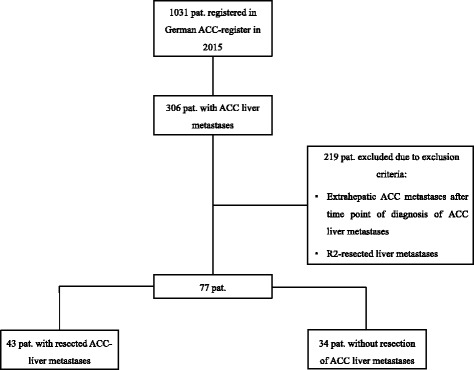
A retrospective analysis of the German Adrenocortical Carcinoma Registry was conducted. Patients with liver metastases of ACC but without extrahepatic metastases or incomplete tumour resection were included.
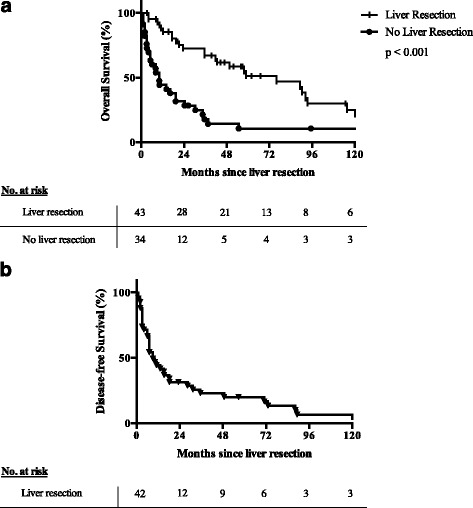
Seventy-seven patients fulfilled these criteria. Forty-three patients underwent resection of liver metastases of ACC. Complete tumour resection (R0) could be achieved in 30 (69.8%). Median overall survival after liver resection was 76.1 months in comparison to 10.1 months in the 34 remaining patients with unresected liver metastases (p < 0.001). However, disease free survival after liver resection was only 9.1 months. Neither resection status (R0/R1) nor extent of liver resection were significant predictive factors for overall survival. Patients with a time interval to the first metastasis/recurrence (TTFR) of greater than 12 months or solitary liver metastases showed significantly prolonged survival.
Liver resection in the case of ACC liver metastases can achieve long term survival with a median overall survival of more than 5 years, but disease free survival is short despite metastasectomy. Time to recurrence and single versus multiple metastases are predictive factors for the outcome.
转移性肾上腺皮质癌(ACC)是一种罕见的恶性肿瘤,5年生存率较低(<15%)。如果能实现远处转移灶的完整切除,建议对部分患者采取手术治疗。迄今为止,关于ACC肝转移灶手术切除后的预后数据有限。
对德国肾上腺皮质癌登记处进行回顾性分析。纳入患有ACC肝转移但无肝外转移或肿瘤切除不完全的患者。
77例患者符合这些标准。43例患者接受了ACC肝转移灶切除术。30例(69.8%)实现了肿瘤完整切除(R0)。肝切除术后的中位总生存期为76.1个月,相比之下,其余34例未切除肝转移灶的患者中位总生存期为10.1个月(p<0.001)。然而,肝切除术后的无病生存期仅为9.1个月。切除状态(R0/R1)和肝切除范围均不是总生存期的显著预测因素。首次转移/复发时间间隔(TTFR)大于12个月或孤立性肝转移的患者生存期显著延长。
ACC肝转移患者行肝切除可实现长期生存,中位总生存期超过5年,但尽管进行了转移灶切除,无病生存期仍较短。复发时间以及单发与多发转移是预后的预测因素。