Department of Molecular Medicine, The Scripps Research Institute, Jupiter, Florida; Department of Neuroscience, The Scripps Research Institute, Jupiter, Florida.
Behavioral Core, The Scripps Research Institute, Jupiter, Florida.
Biol Psychiatry. 2017 Dec 15;82(12):924-933. doi: 10.1016/j.biopsych.2017.06.030. Epub 2017 Jul 8.
The limited neurobiological understanding of posttraumatic stress disorder (PTSD) has been partially attributed to the need for improved animal models. Stress-enhanced fear learning (SEFL) in rodents recapitulates many PTSD-associated behaviors, including stress-susceptible and stress-resilient subgroups in outbred rats. Identification of subgroups requires additional behavioral phenotyping, a confound to mechanistic studies.
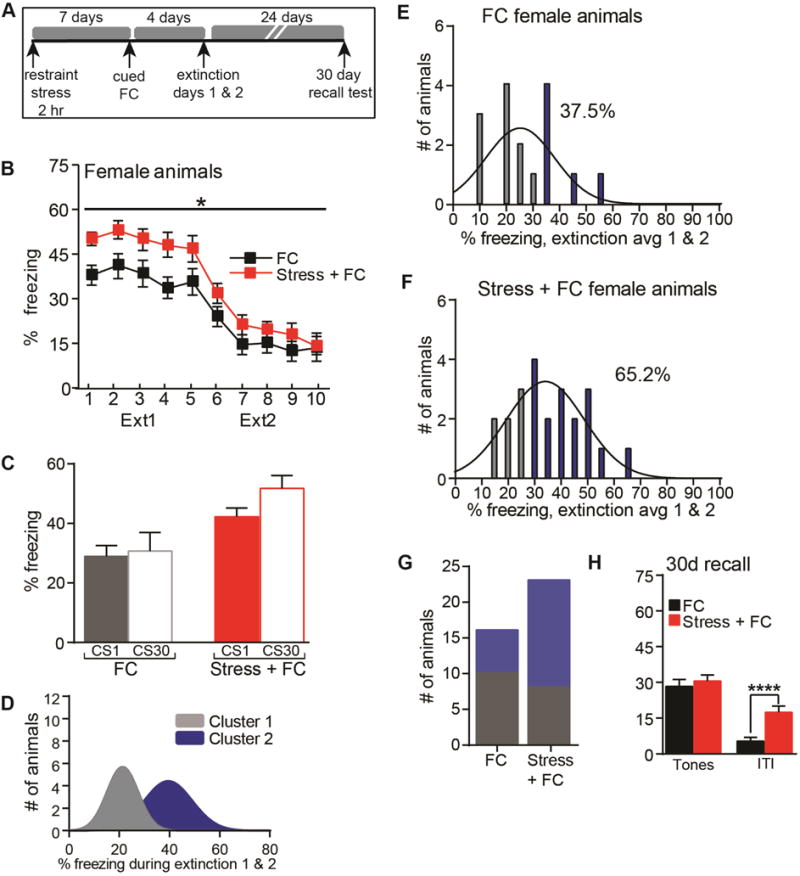
We employed a SEFL paradigm in inbred male and female C57BL/6 mice that combines acute stress with fear conditioning to precipitate traumatic-like memories. Extinction and long-term retention of extinction were examined after SEFL. Further characterization of SEFL effects on male mice was performed with additional behavioral tests, determination of regional activation by Fos immunofluorescence, and RNA sequencing of the basolateral amygdala.
Stressed animals displayed persistently elevated freezing during extinction. While more uniform in females, SEFL produced male subgroups with differential susceptibility that were identified without posttraining phenotyping. Additional phenotyping of male mice revealed PTSD-associated behaviors, including extinction-resistant fear memory, hyperarousal, generalization, and dysregulated corticosterone in stress-susceptible male mice. Altered Fos activation was also seen in the infralimbic cortex and basolateral amygdala of stress-susceptible male mice after remote memory retrieval. Key behavioral outcomes, including susceptibility, were replicated by two independent laboratories. RNA sequencing of the basolateral amygdala revealed transcriptional divergence between the male subgroups, including genes with reported polymorphic association to patients with PTSD.
This SEFL model provides a tool for development of PTSD therapeutics that is compatible with the growing number of mouse-specific resources. Furthermore, use of an inbred strain allows for investigation into epigenetic mechanisms that are expected to critically regulate susceptibility and resilience.
创伤后应激障碍(PTSD)的神经生物学理解有限,部分原因是需要改进动物模型。啮齿动物的应激增强恐惧学习(SEFL)重现了许多与 PTSD 相关的行为,包括在杂交大鼠中出现应激易感和应激耐受亚组。亚组的鉴定需要额外的行为表型分析,这是对机制研究的干扰。
我们在雄性和雌性 C57BL/6 近交系小鼠中采用 SEFL 范式,该范式将急性应激与恐惧条件反射相结合,引发类似创伤的记忆。在 SEFL 后检查消退和消退的长期保留。通过额外的行为测试、Fos 免疫荧光测定的区域激活以及外侧杏仁核的 RNA 测序,进一步表征 SEFL 对雄性小鼠的影响。
应激动物在消退期间表现出持续升高的冻结。虽然在雌性中更均匀,但 SEFL 产生了具有不同易感性的雄性亚组,而无需进行训练后表型分析即可识别。对雄性小鼠的进一步表型分析揭示了与 PTSD 相关的行为,包括消退抵抗的恐惧记忆、过度警觉、泛化和应激易感雄性小鼠的皮质酮失调。应激易感雄性小鼠在远程记忆检索后,其边缘下皮层和外侧杏仁核的 Fos 激活也发生改变。关键行为结果,包括易感性,在两个独立的实验室中得到了复制。外侧杏仁核的 RNA 测序显示雄性亚组之间存在转录差异,包括与 PTSD 患者报告的多态性相关的基因。
该 SEFL 模型为开发与不断增加的小鼠特异性资源兼容的 PTSD 治疗方法提供了工具。此外,使用近交系允许研究预期对易感性和弹性有重要调节作用的表观遗传机制。