Gruene Tina M, Flick Katelyn, Stefano Alexis, Shea Stephen D, Shansky Rebecca M
Department of Psychology, Northeastern University, Boston, United States.
Cold Spring Harbor Laboratories, Cold Spring Harbor, United States.
Elife. 2015 Nov 14;4:e11352. doi: 10.7554/eLife.11352.
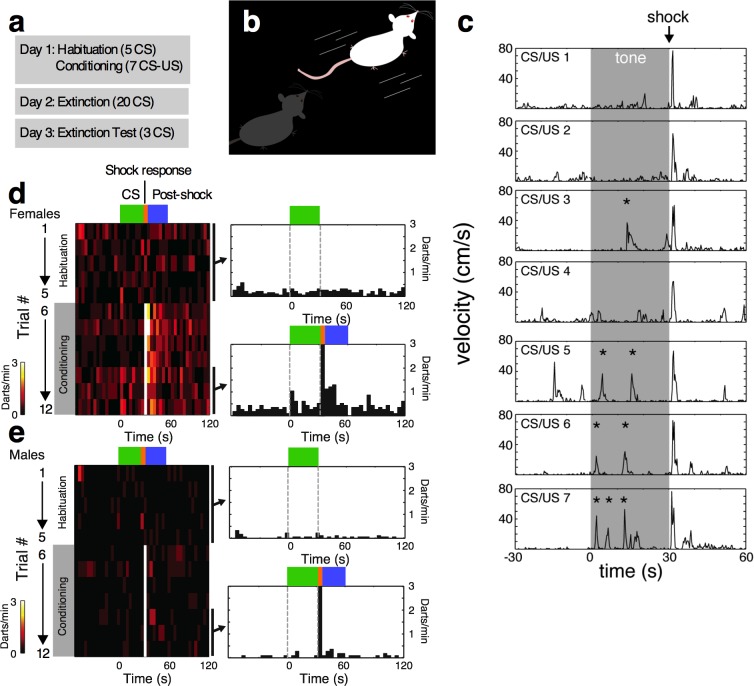
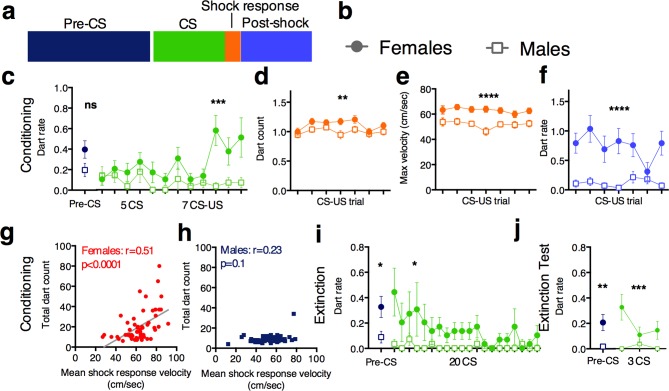
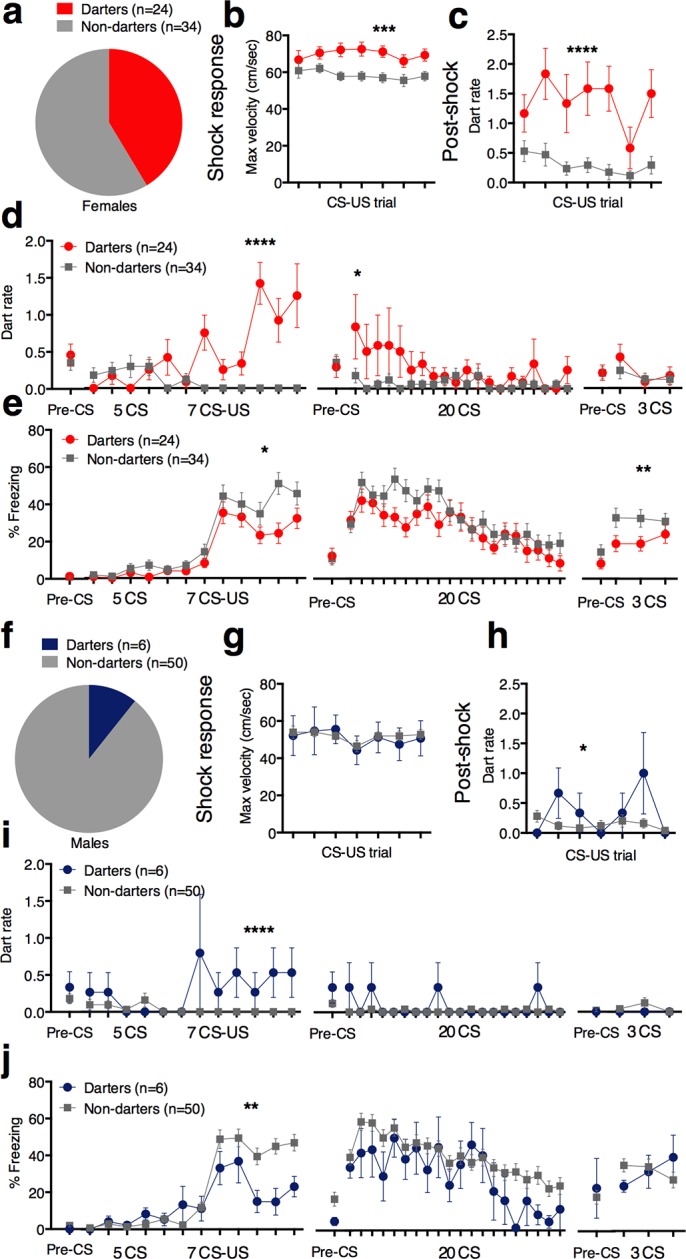
Traditional rodent models of Pavlovian fear conditioning assess the strength of learning by quantifying freezing responses. However, sole reliance on this measure includes the de facto assumption that any locomotor activity reflects an absence of fear. Consequently, alternative expressions of associative learning are rarely considered. Here we identify a novel, active fear response ('darting') that occurs primarily in female rats. In females, darting exhibits the characteristics of a learned fear behavior, appearing during the CS period as conditioning proceeds and disappearing from the CS period during extinction. This finding motivates a reinterpretation of rodent fear conditioning studies, particularly in females, and it suggests that conditioned fear behavior is more diverse than previously appreciated. Moreover, rats that darted during initial fear conditioning exhibited lower freezing during the second day of extinction testing, suggesting that females employ distinct and adaptive fear response strategies that improve long-term outcomes.
传统的巴甫洛夫恐惧条件反射啮齿动物模型通过量化僵住反应来评估学习强度。然而,仅依赖这一指标实际上包含了一个假设,即任何运动活动都反映出没有恐惧。因此,很少考虑联想学习的其他表现形式。在这里,我们识别出一种主要出现在雌性大鼠身上的新型主动恐惧反应(“飞奔”)。在雌性大鼠中,飞奔表现出习得性恐惧行为的特征,随着条件反射的进行,在条件刺激期间出现,并在消退过程中从条件刺激期间消失。这一发现促使人们重新解读啮齿动物恐惧条件反射研究,尤其是在雌性大鼠中,这表明条件性恐惧行为比之前认为的更加多样。此外,在初始恐惧条件反射期间飞奔的大鼠在消退测试的第二天表现出较低的僵住水平,这表明雌性大鼠采用了独特且适应性的恐惧反应策略,从而改善长期结果。