Institute of Surgical Research, University of Szeged, Szeged, Hungary.
Department of Laboratory Medicine, University of Szeged, Szeged, Hungary.
Sci Rep. 2017 Aug 4;7(1):7329. doi: 10.1038/s41598-017-07637-3.
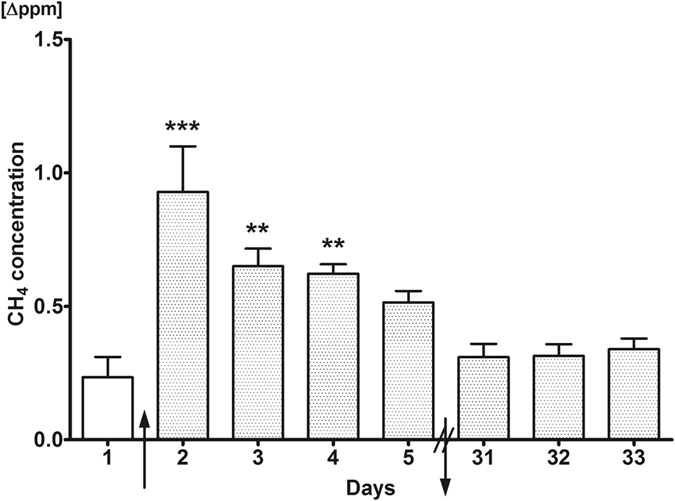
Various studies have established the possibility of non-bacterial methane (CH) generation in oxido-reductive stress conditions in plants and animals. Increased ethanol input is leading to oxido-reductive imbalance in eukaryotes, thus our aim was to provide evidence for the possibility of ethanol-induced methanogenesis in non-CH producer humans, and to corroborate the in vivo relevance of this pathway in rodents. Healthy volunteers consumed 1.15 g/kg/day alcohol for 4 days and the amount of exhaled CH was recorded by high sensitivity photoacoustic spectroscopy. Additionally, Sprague-Dawley rats were allocated into control, 1.15 g/kg/day and 2.7 g/kg/day ethanol-consuming groups to detect the whole-body CH emissions and mitochondrial functions in liver and hippocampus samples with high-resolution respirometry. Mitochondria-targeted L-alpha-glycerylphosphorylcholine (GPC) can increase tolerance to liver injury, thus the effects of GPC supplementations were tested in further ethanol-fed groups. Alcohol consumption was accompanied by significant CH emissions in both human and rat series of experiments. 2.7 g/kg/day ethanol feeding reduced the oxidative phosphorylation capacity of rat liver mitochondria, while GPC significantly decreased the alcohol-induced CH formation and hepatic mitochondrial dysfunction as well. These data demonstrate a potential for ethanol to influence human methanogenesis, and suggest a biomarker role for exhaled CH in association with mitochondrial dysfunction.
各种研究已经证实,在植物和动物的氧化还原应激条件下,有可能产生非细菌甲烷(CH)。乙醇输入的增加导致真核生物的氧化还原失衡,因此,我们的目的是为乙醇诱导非 CH 产生者人类产甲烷的可能性提供证据,并证实该途径在啮齿动物体内的相关性。健康志愿者连续 4 天每天摄入 1.15g/kg 酒精,通过高灵敏度光声光谱法记录呼出的 CH 量。此外,将 Sprague-Dawley 大鼠分为对照组、1.15g/kg/天和 2.7g/kg/天乙醇摄入组,用高分辨率呼吸测定法检测肝脏和海马样本中的全身 CH 排放和线粒体功能。靶向线粒体的 L-α-甘油磷酸胆碱(GPC)可以提高对肝损伤的耐受性,因此在进一步的乙醇喂养组中测试了 GPC 补充的效果。在人体和大鼠实验系列中,酒精摄入伴随着显著的 CH 排放。2.7g/kg/天的乙醇喂养降低了大鼠肝线粒体的氧化磷酸化能力,而 GPC 则显著降低了酒精诱导的 CH 形成和肝线粒体功能障碍。这些数据表明,乙醇有可能影响人类产甲烷作用,并提示呼气 CH 与线粒体功能障碍相关的生物标志物作用。