Unité des Interactions Bactéries-Cellules, Institut Pasteur, Paris, France.
U604 Inserm, Paris, France.
Cell Mol Life Sci. 2018 Feb;75(3):355-374. doi: 10.1007/s00018-017-2603-0. Epub 2017 Aug 5.
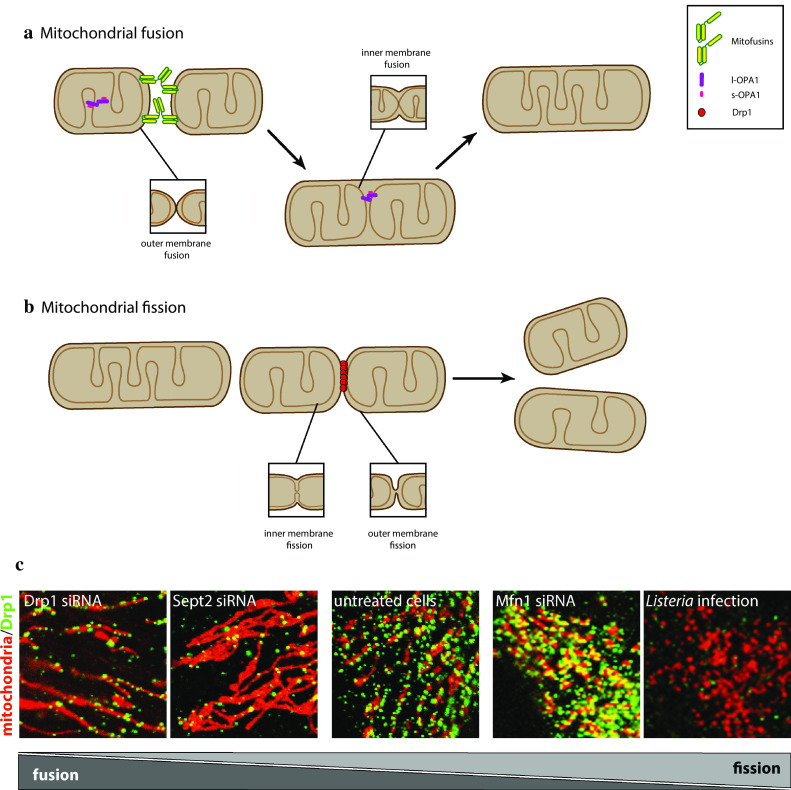
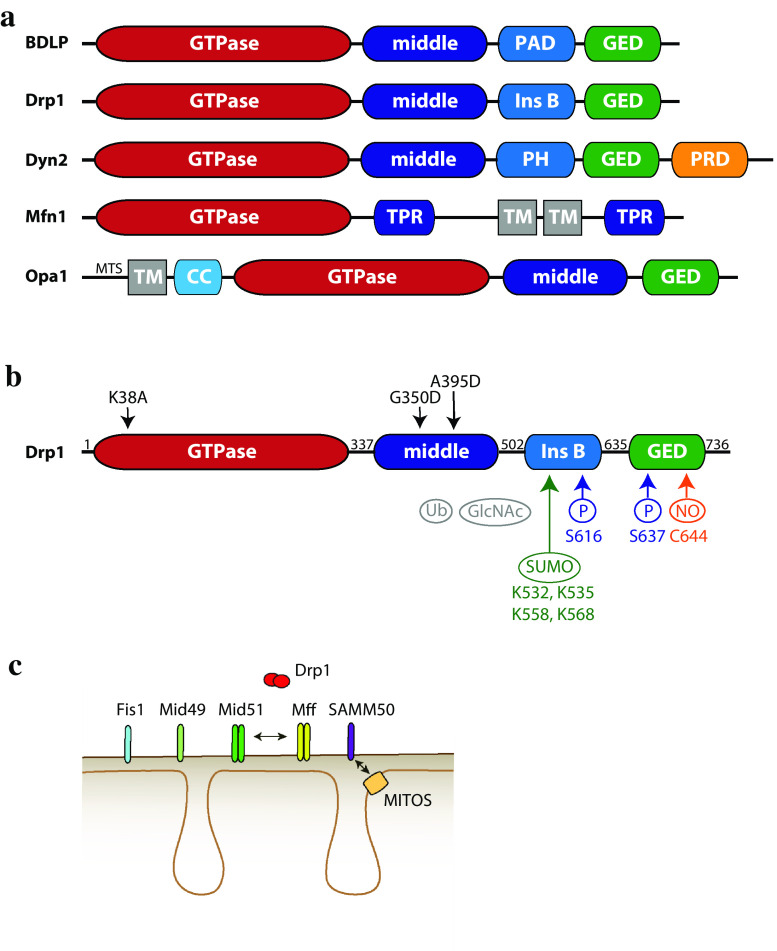
The mitochondrial network constantly changes and remodels its shape to face the cellular energy demand. In human cells, mitochondrial fusion is regulated by the large, evolutionarily conserved GTPases Mfn1 and Mfn2, which are embedded in the mitochondrial outer membrane, and by OPA1, embedded in the mitochondrial inner membrane. In contrast, the soluble dynamin-related GTPase Drp1 is recruited from the cytosol to mitochondria and is key to mitochondrial fission. A number of new players have been recently involved in Drp1-dependent mitochondrial fission, ranging from large cellular structures such as the ER and the cytoskeleton to the surprising involvement of the endocytic dynamin 2 in the terminal abscission step. Here we review the recent findings that have expanded the mechanistic model for the mitochondrial fission process in human cells and highlight open questions.
线粒体网络不断改变和重塑其形状以适应细胞的能量需求。在人类细胞中,线粒体融合受大型、进化上保守的 GTP 酶 Mfn1 和 Mfn2 调节,它们嵌入线粒体的外膜,而 OPA1 则嵌入线粒体的内膜。相比之下,可溶性与 dynamin 相关的 GTP 酶 Drp1 从细胞质招募到线粒体,是线粒体裂变的关键。最近有许多新的参与者参与了依赖 Drp1 的线粒体裂变,范围从 ER 和细胞骨架等大型细胞结构到令人惊讶的内吞 dynamin 2 在末端分离步骤中的参与。在这里,我们回顾了最近的发现,这些发现扩展了人类细胞中线粒体裂变过程的机制模型,并强调了一些悬而未决的问题。