Du Hai-Wen, Wang Yong, Zhuang Da-Fang, Jiang Xiao-San
State Key Laboratory of Resources and Environmental Information Systems, Institute of Geographical Sciences and Natural Resources Research, Chinese Academy of Sciences, 11A Datun Road, Chaoyang District, Beijing, 100101, China.
College of Resources and Environmental Science, Nanjing Agricultural University, No.6 Tongwei Road, Nangjing, 210095, China.
Infect Dis Poverty. 2017 Aug 7;6(1):124. doi: 10.1186/s40249-017-0338-7.
The nest flea index of Meriones unguiculatus is a critical indicator for the prevention and control of plague, which can be used not only to detect the spatial and temporal distributions of Meriones unguiculatus, but also to reveal its cluster rule. This research detected the temporal and spatial distribution characteristics of the plague natural foci of Mongolian gerbils by body flea index from 2005 to 2014, in order to predict plague outbreaks.
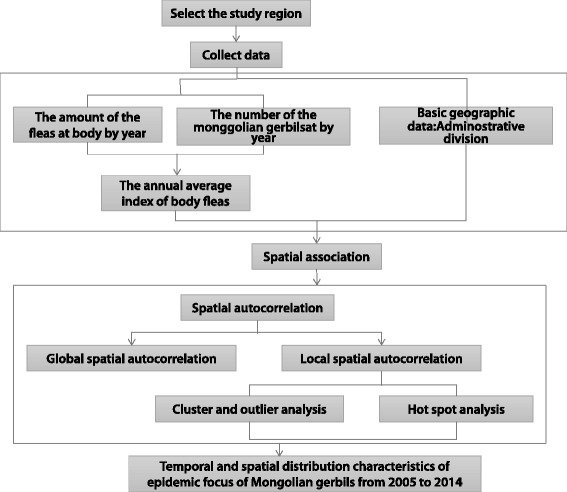
Global spatial autocorrelation was used to describe the entire spatial distribution pattern of the body flea index in the natural plague foci of typical Chinese Mongolian gerbils. Cluster and outlier analysis and hot spot analysis were also used to detect the intensity of clusters based on geographic information system methods. The quantity of M. unguiculatus nest fleas in the sentinel surveillance sites from 2005 to 2014 and host density data of the study area from 2005 to 2010 used in this study were provided by Chinese Center for Disease Control and Prevention.
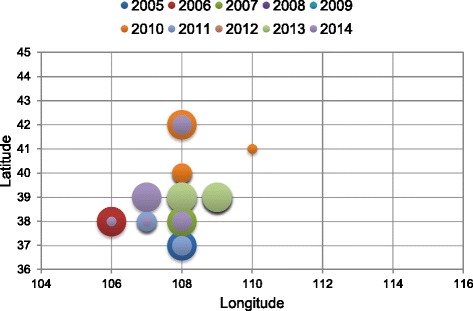
The epidemic focus regions of the Mongolian gerbils remain the same as the hot spot regions relating to the body flea index. High clustering areas possess a similar pattern as the distribution pattern of the body flea index indicating that the transmission risk of plague is relatively high. In terms of time series, the area of the epidemic focus gradually increased from 2005 to 2007, declined rapidly in 2008 and 2009, and then decreased slowly and began trending towards stability from 2009 to 2014. For the spatial change, the epidemic focus regions began moving northward from the southwest epidemic focus of the Mongolian gerbils from 2005 to 2007, and then moved from north to south in 2007 and 2008.
The body flea index of Chinese gerbil foci reveals significant spatial and temporal aggregation characteristics through the employing of spatial autocorrelation. The diversity of temporary and spatial distribution is mainly affected by seasonal variation, the human activity and natural factors.
长爪沙鼠巢蚤指数是鼠疫防控的关键指标,不仅可用于探测长爪沙鼠的时空分布,还能揭示其聚集规律。本研究通过2005 - 2014年长爪沙鼠体蚤指数检测鼠疫自然疫源地的时空分布特征,以预测鼠疫疫情。
运用全局空间自相关描述典型中国长爪沙鼠自然鼠疫疫源地体蚤指数的整体空间分布格局。基于地理信息系统方法,采用聚类与异常值分析以及热点分析检测聚集强度。本研究使用的2005 - 2014年哨点监测点长爪沙鼠巢蚤数量以及2005 - 2010年研究区域宿主密度数据由中国疾病预防控制中心提供。
长爪沙鼠的疫源地与体蚤指数热点区域一致。高聚集区与体蚤指数分布格局相似,表明鼠疫传播风险相对较高。从时间序列来看,疫源地面积在2005 - 2007年逐渐增加,在2008年和2009年迅速下降,然后缓慢下降,并在2009 - 2014年趋于稳定。从空间变化来看,疫源地在2005 - 2007年从长爪沙鼠西南疫源地开始向北移动,然后在2007年和2008年从北向南移动。
通过空间自相关分析,长爪沙鼠疫源地体蚤指数呈现出显著的时空聚集特征。时空分布的多样性主要受季节变化、人类活动和自然因素影响。