
侵袭性鼠伤寒沙门氏菌ST313在感染动物模型中的毒力。
Virulence of invasive Salmonella Typhimurium ST313 in animal models of infection.
作者信息
Ramachandran Girish, Panda Aruna, Higginson Ellen E, Ateh Eugene, Lipsky Michael M, Sen Sunil, Matson Courtney A, Permala-Booth Jasnehta, DeTolla Louis J, Tennant Sharon M
机构信息
Center for Vaccine Development and Institute for Global Health, University of Maryland School of Medicine, Baltimore, Maryland, United States of America.
Department of Medicine, University of Maryland School of Medicine, Baltimore, Maryland, United States of America.
出版信息
PLoS Negl Trop Dis. 2017 Aug 4;11(8):e0005697. doi: 10.1371/journal.pntd.0005697. eCollection 2017 Aug.
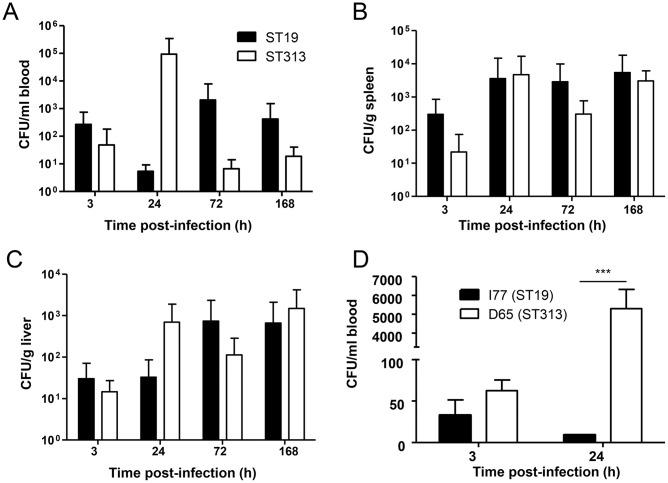
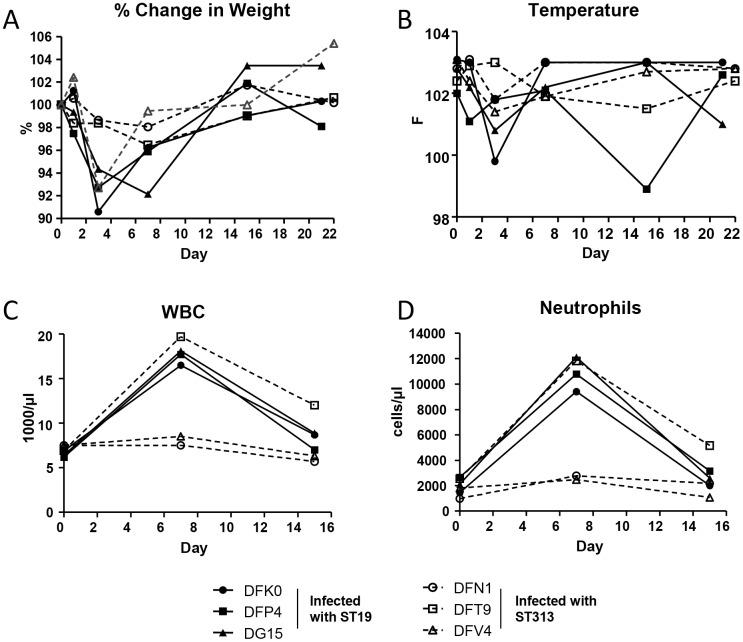
Salmonella Typhimurium sequence type (ST) 313 produces septicemia in infants in sub-Saharan Africa. Although there are known genetic and phenotypic differences between ST313 strains and gastroenteritis-associated ST19 strains, conflicting data about the in vivo virulence of ST313 strains have been reported. To resolve these differences, we tested clinical Salmonella Typhimurium ST313 and ST19 strains in murine and rhesus macaque infection models. The 50% lethal dose (LD50) was determined for three Salmonella Typhimurium ST19 and ST313 strains in mice. For dissemination studies, bacterial burden in organs was determined at various time-points post-challenge. Indian rhesus macaques were infected with one ST19 and one ST313 strain. Animals were monitored for clinical signs and bacterial burden and pathology were determined. The LD50 values for ST19 and ST313 infected mice were not significantly different. However, ST313-infected BALB/c mice had significantly higher bacterial numbers in blood at 24 h than ST19-infected mice. ST19-infected rhesus macaques exhibited moderate-to-severe diarrhea while ST313-infected monkeys showed no-to-mild diarrhea. ST19-infected monkeys had higher bacterial burden and increased inflammation in tissues. Our data suggest that Salmonella Typhimurium ST313 invasiveness may be investigated using mice. The non-human primate results are consistent with clinical data, suggesting that ST313 strains do not cause diarrhea.
鼠伤寒沙门氏菌序列型(ST)313在撒哈拉以南非洲的婴儿中引发败血症。尽管已知ST313菌株与肠胃炎相关的ST19菌株之间存在基因和表型差异,但关于ST313菌株体内毒力的报道数据相互矛盾。为了解决这些差异,我们在小鼠和恒河猴感染模型中测试了临床鼠伤寒沙门氏菌ST313和ST19菌株。测定了三株鼠伤寒沙门氏菌ST19和ST313菌株在小鼠中的50%致死剂量(LD50)。在传播研究中,在攻击后的不同时间点测定器官中的细菌载量。印度恒河猴感染了一株ST19和一株ST313菌株。监测动物的临床症状,并测定细菌载量和病理情况。ST19和ST313感染小鼠的LD50值没有显著差异。然而,ST313感染的BALB/c小鼠在24小时时血液中的细菌数量显著高于ST19感染的小鼠。ST19感染的恒河猴表现出中度至重度腹泻,而ST313感染的猴子则表现为无至轻度腹泻。ST19感染的猴子细菌载量更高,组织炎症增加。我们的数据表明,可以使用小鼠来研究鼠伤寒沙门氏菌ST313的侵袭性。非人灵长类动物的结果与临床数据一致,表明ST313菌株不会引起腹泻。


 Zotero 插件