Department of Pathology, The Johns Hopkins University, Baltimore, MD, 21231, USA.
Department of Oncology, The Johns Hopkins University, Baltimore, MD, 21231, USA.
J Ovarian Res. 2017 Aug 7;10(1):53. doi: 10.1186/s13048-017-0347-y.
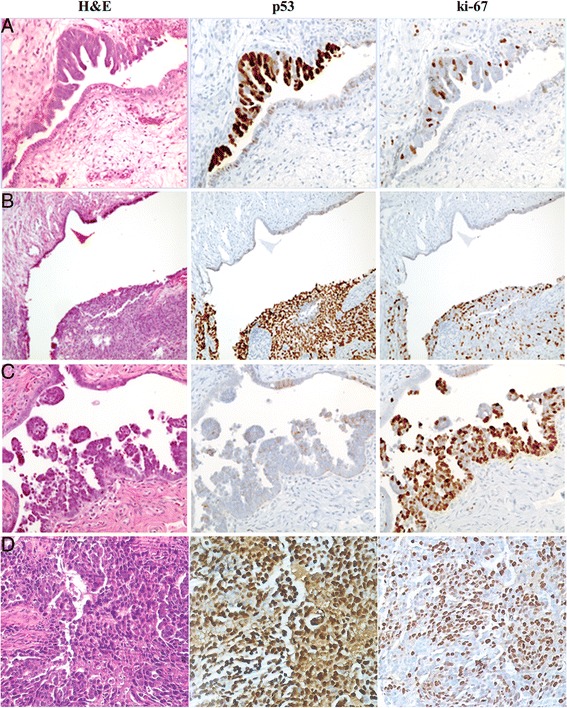
Ovarian carcinoma is highly dependent on the ubiquitin proteasome system (UPS), but its clinical response to treatment with the proteasome inhibitor bortezomib has been disappointing. This has driven exploration of alternate approaches to target the UPS in ovarian cancer. Recently, proteasome inhibitors targeting the 19S regulatory particle-associated RPN13 protein have been described, such as RA190. RPN13, which is encoded by ADRM1, facilitates the recognition by the proteasome of its polyubiquinated substrates. Inhibition of RPN13 produces a rapid, toxic accumulation of polyubiquitinated proteins in ovarian and other cancer cells, triggering apoptosis. Here, we sought to determine if RPN13 is available as a target in precursors of ovarian/fallopian tube cancer as well as all advanced cases, and the impact of increased ADRM1 gene copy number on sensitivity of ovarian cancer to RA190.
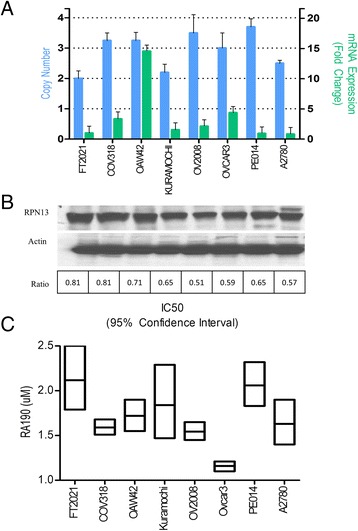
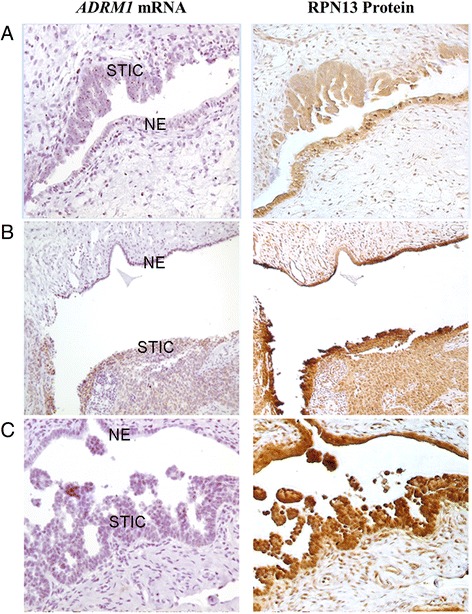
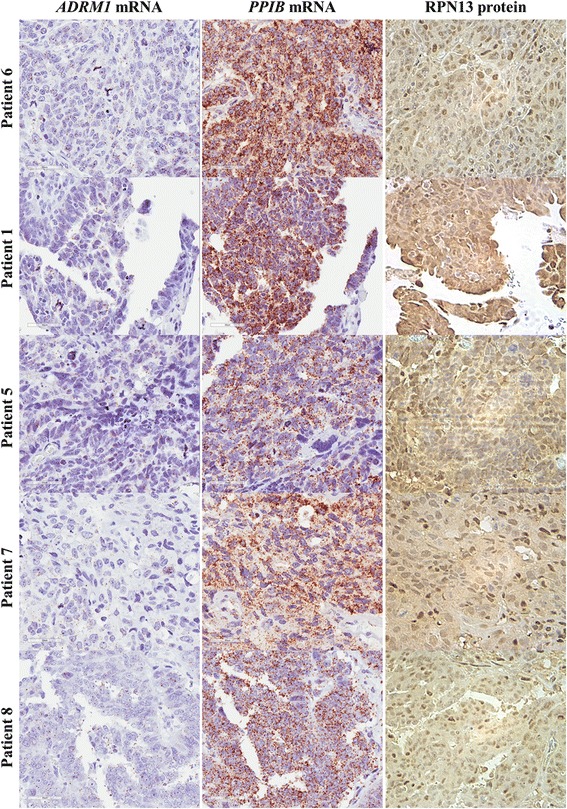
ADRM1 mRNA was quantified by RNAscope in situ hybridization and RPN13 protein detected by immunohistochemistry in high grade serous carcinoma (HGSC) of the ovary and serous tubal intraepithelial carcinoma (STIC). Amplification of ADRM1 and sensitivity to RA190 were determined in ovarian cancer cell lines.
Here, we demonstrate that expression of ADRM1mRNA is significantly elevated in STIC and HGSC as compared to normal fallopian tube epithelium. ADRM1 mRNA and RPN13 were ubiquitously and robustly expressed in ovarian carcinoma tissue and cell lines. No correlation was found between ADRM1 amplification and sensitivity of ovarian cancer cell lines to RA190, but all were susceptible.
RPN13 can potentially be targeted by RA190 in both in situ and metastatic ovarian carcinoma. Ovarian cancer cell lines are sensitive to RA190 regardless of whether the ADRM1 gene is amplified.
卵巢癌高度依赖泛素蛋白酶体系统 (UPS),但用蛋白酶体抑制剂硼替佐米治疗的临床反应令人失望。这促使人们探索针对卵巢癌 UPS 的替代方法。最近,已经描述了针对泛素蛋白酶体 19S 调节颗粒相关 RPN13 蛋白的蛋白酶体抑制剂,例如 RA190。RPN13 由 ADRM1 编码,有助于蛋白酶体识别其多泛素化底物。RPN13 的抑制会导致卵巢和其他癌细胞中多泛素化蛋白的快速、毒性积累,引发细胞凋亡。在这里,我们试图确定 RPN13 是否可作为卵巢/输卵管癌前体以及所有晚期病例的靶标,以及 ADRM1 基因拷贝数增加对 RA190 治疗卵巢癌敏感性的影响。
通过 RNAscope 原位杂交定量检测 ADRM1 mRNA,并用免疫组织化学检测高级别浆液性卵巢癌 (HGSC) 和浆液性输卵管上皮内癌 (STIC) 中的 RPN13 蛋白。在卵巢癌细胞系中测定 ADRM1 的扩增和对 RA190 的敏感性。
在这里,我们证明与正常输卵管上皮相比,STIC 和 HGSC 中 ADRM1 mRNA 的表达显着升高。ADRM1 mRNA 和 RPN13 在卵巢癌组织和细胞系中广泛且强烈表达。未发现 ADRM1 扩增与卵巢癌细胞系对 RA190 的敏感性之间存在相关性,但所有细胞系均易感。
RA190 可潜在靶向 STIC 和转移性卵巢癌中的 RPN13。无论 ADRM1 基因是否扩增,卵巢癌细胞系对 RA190 均敏感。