Tay A K, Jayasuriya R, Jayasuriya D, Silove D
School of Psychiatry, Psychiatry Research and Teaching Unit, Academic Mental Health Unit, University of New South Wales, Sydney, NSW, Australia.
School of Public Health and Community Medicine, Faculty of Medicine, University of New South Wales, Sydney, NSW, Australia.
Transl Psychiatry. 2017 Aug 8;7(8):e1200. doi: 10.1038/tp.2017.166.
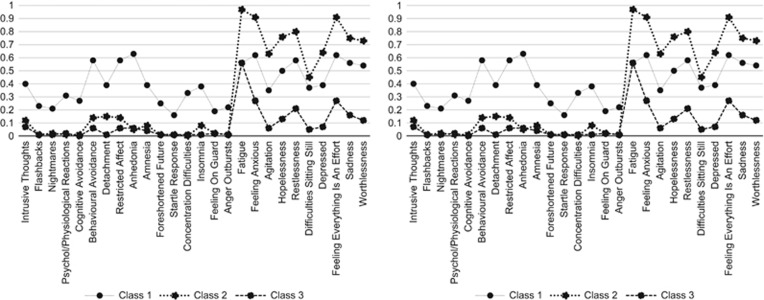
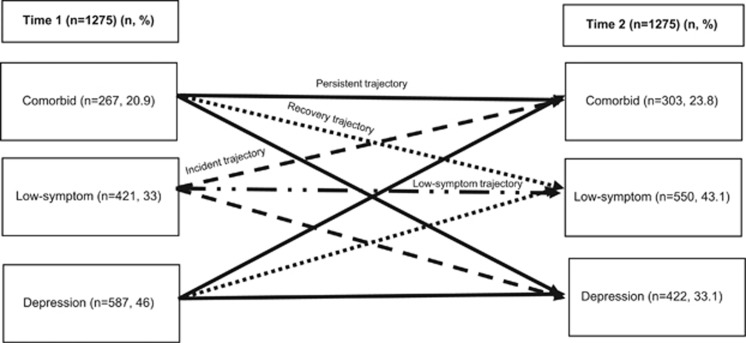
We conducted a 12-month follow-up of a population sample of adults from districts (Mannar, Killinochi, Mullaitivu and Jaffna) exposed to high levels of mass conflict in Sri Lanka, the aim of the present analysis being to identify trajectories of depression and anxiety symptoms and their associations with exposure to psychological trauma and ongoing living adversities. The cohort of 1275 adults (response 86%) followed-up in 2015 was a structured subsample drawn from the baseline nationally representative survey conducted in 2014 across 25 districts in Sri Lanka. Interviews were conducted using electronic tablets by field workers applying contextually adapted indices of trauma exposure, ongoing adversities and symptoms of depression and anxiety. Latent transition analysis revealed a three-class longitudinal model from which four composite trajectories were derived, comprising a persistent symptom trajectory (n=555, 43.5%), an incident or new onset trajectory (n=170, 13.3%), a recovery trajectory (n=299, 23.5%) and a persistently low-symptom trajectory (n=251, 19.7%). Factors associated with both the persistent symptom and incident trajectories were female gender, past trauma exposure and lack of access to health services. Loss of a job was uniquely associated with the persisting trajectory at follow-up. The recovery trajectory comprised a higher proportion of men, older persons and those without risk factors. Our findings assist in translating epidemiologic data into public policy and practice by indicating the importance of stable employment and the provision of healthcare as key factors that may act to reduce anxiety and depressive symptoms in the post-conflict phase. The findings also confirm that women are at high risk of mental distress. Brief screening for trauma exposure in populations with high levels of exposure to mass conflict may assist in defining those at risk of ongoing symptoms of anxiety and depression.
我们对来自斯里兰卡受大规模冲突影响严重地区(马纳尔、基利诺奇、穆莱蒂武和贾夫纳)的成年人群样本进行了为期12个月的随访,本分析的目的是确定抑郁和焦虑症状的轨迹及其与心理创伤暴露和持续生活困境的关联。2015年随访的1275名成年人队列(应答率86%)是从2014年在斯里兰卡25个地区进行的具有全国代表性的基线调查中抽取的结构化子样本。现场工作人员使用电子平板电脑进行访谈,应用根据具体情况调整的创伤暴露、持续困境以及抑郁和焦虑症状指标。潜在转变分析揭示了一个三类纵向模型,从中得出了四条复合轨迹,包括持续症状轨迹(n = 555,43.5%)、新发或初发轨迹(n = 170,13.3%)、康复轨迹(n = 299,23.5%)和持续低症状轨迹(n = 251,19.7%)。与持续症状轨迹和新发轨迹相关的因素包括女性性别、既往创伤暴露以及无法获得医疗服务。失业与随访时的持续轨迹有独特关联。康复轨迹中男性、年长者和无风险因素者的比例较高。我们的研究结果通过表明稳定就业和提供医疗保健作为可能有助于减少冲突后阶段焦虑和抑郁症状的关键因素的重要性,有助于将流行病学数据转化为公共政策和实践。研究结果还证实女性面临精神困扰的高风险。对受大规模冲突影响程度高的人群进行创伤暴露的简短筛查可能有助于确定那些有持续焦虑和抑郁症状风险的人。