Digital Futures Lab, Ieso Digital Health, The Jeffrey's Building, Cowley Road, Cambridge, CB4 0DS, UK.
Department of Psychology, Faculty of Science, Memorial University of Newfoundland, St John's, Canada.
Psychol Med. 2022 Jan;52(2):332-341. doi: 10.1017/S0033291720002032. Epub 2020 Jun 29.
It is increasingly recognized that existing diagnostic approaches do not capture the underlying heterogeneity and complexity of psychiatric disorders such as depression. This study uses a data-driven approach to define fluid depressive states and explore how patients transition between these states in response to cognitive behavioural therapy (CBT).
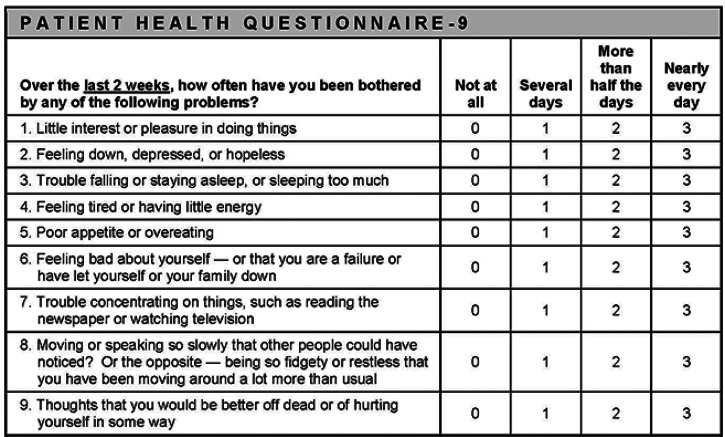
Item-level Patient Health Questionnaire (PHQ-9) data were collected from 9891 patients with a diagnosis of depression, at each CBT treatment session. Latent Markov modelling was used on these data to define depressive states and explore transition probabilities between states. Clinical outcomes and patient demographics were compared between patients starting at different depressive states.
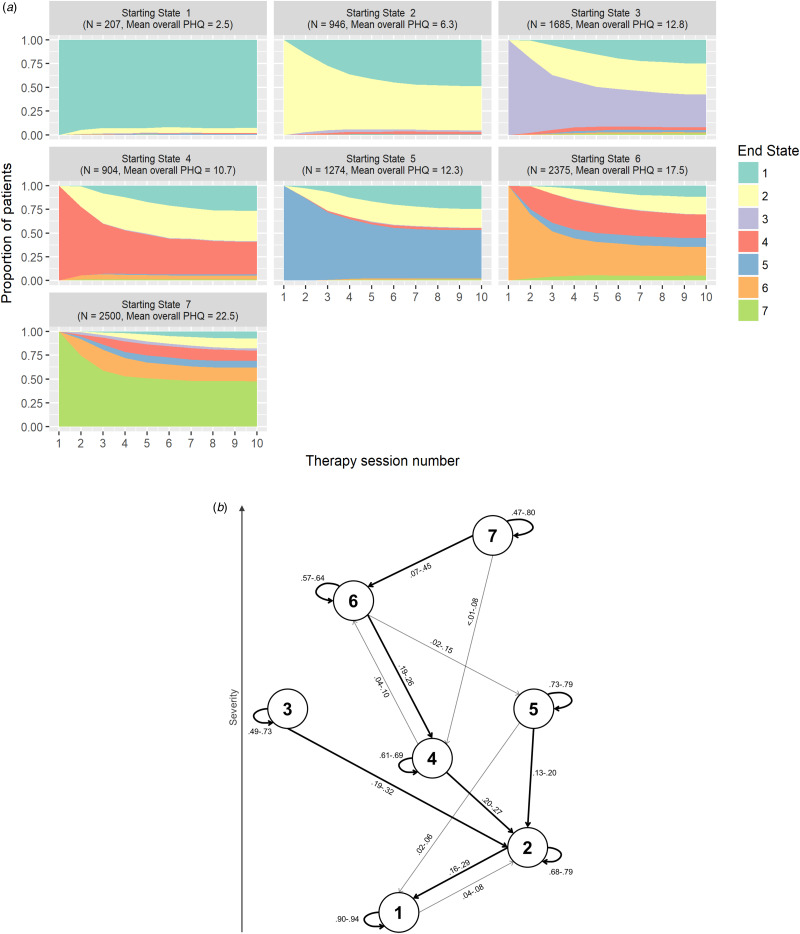
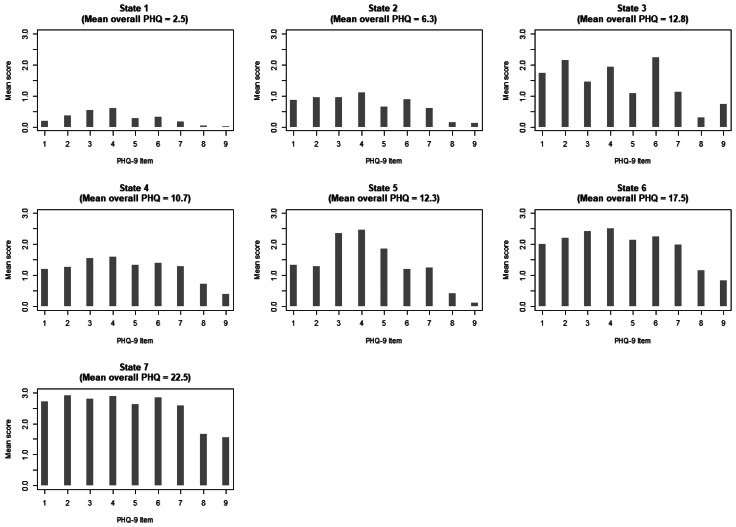
A model with seven depressive states emerged as the best compromise between optimal fit and interpretability. States loading preferentially on cognitive/affective v. somatic symptoms of depression were identified. Analysis of transition probabilities revealed that patients in cognitive/affective states do not typically transition towards somatic states and vice-versa. Post-hoc analyses also showed that patients who start in a somatic depressive state are less likely to engage with or improve with therapy. These patients are also more likely to be female, suffer from a comorbid long-term physical condition and be taking psychotropic medication.
This study presents a novel approach for depression sub-typing, defining fluid depressive states and exploring transitions between states in response to CBT. Understanding how different symptom profiles respond to therapy will inform the development and delivery of stratified treatment protocols, improving clinical outcomes and cost-effectiveness of psychological therapies for patients with depression.
越来越多的人认识到,现有的诊断方法无法捕捉到抑郁症等精神疾病的潜在异质性和复杂性。本研究采用数据驱动的方法来定义流动的抑郁状态,并探索患者在认知行为疗法(CBT)治疗下如何在这些状态之间转换。
从 9891 名被诊断为抑郁症的患者的每个 CBT 治疗疗程中收集了患者健康问卷(PHQ-9)的项目级数据。使用潜在马尔可夫模型对这些数据进行分析,以定义抑郁状态并探索状态之间的转换概率。比较了处于不同抑郁状态的患者的临床结局和患者人口统计学特征。
具有七个抑郁状态的模型是在最优拟合和可解释性之间的最佳折衷。确定了优先加载于抑郁的认知/情感症状而非躯体症状的状态。对转换概率的分析表明,处于认知/情感状态的患者通常不会向躯体状态转换,反之亦然。事后分析还表明,从躯体抑郁状态开始的患者不太可能接受或改善治疗。这些患者更可能是女性,患有合并的长期躯体疾病,并且正在服用精神药物。
本研究提出了一种新的抑郁症亚型方法,定义了流动的抑郁状态,并探索了对 CBT 的状态转换。了解不同症状谱对治疗的反应将为分层治疗方案的制定和实施提供信息,从而改善抑郁症患者的临床结局和心理治疗的成本效益。