Giacopuzzi Edoardo, Gennarelli Massimo, Minelli Alessandra, Gardella Rita, Valsecchi Paolo, Traversa Michele, Bonvicini Cristian, Vita Antonio, Sacchetti Emilio, Magri Chiara
Department of Molecular and Translational Medicine, University of Brescia, Brescia, Italy.
Genetic Unit, IRCCS Centro S. Giovanni di Dio Fatebenefratelli, Brescia, Italy.
PLoS One. 2017 Aug 7;12(8):e0182778. doi: 10.1371/journal.pone.0182778. eCollection 2017.
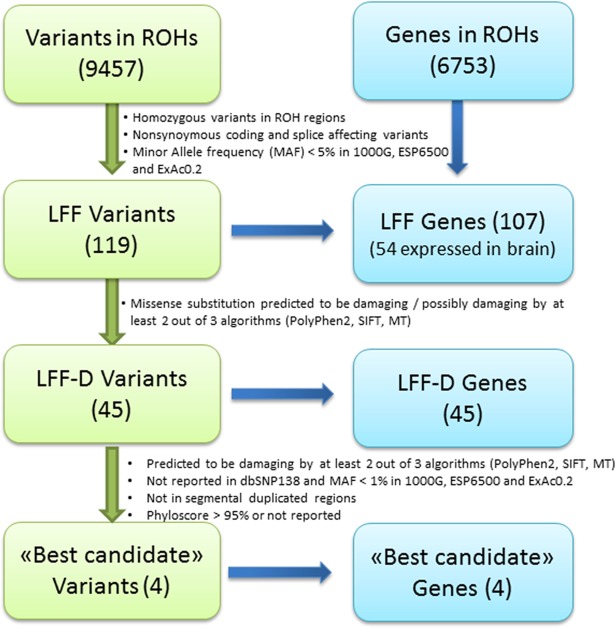
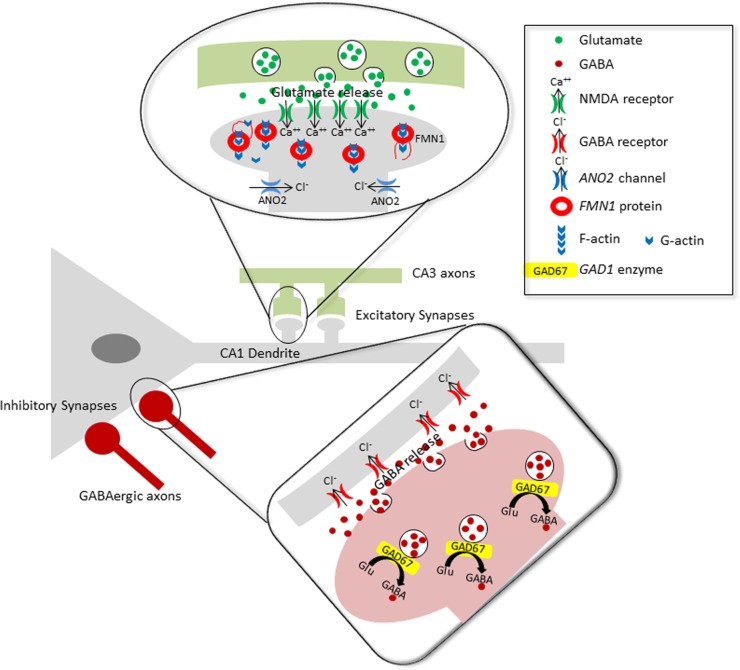
Inbreeding is a known risk factor for recessive Mendelian diseases and previous studies have suggested that it could also play a role in complex disorders, such as psychiatric diseases. Recent inbreeding results in the presence of long runs of homozygosity (ROHs) along the genome, which are also defined as autozygosity regions. Genetic variants in these regions have two alleles that are identical by descent, thus increasing the odds of bearing rare recessive deleterious mutations due to a homozygous state. A recent study showed a suggestive enrichment of long ROHs in schizophrenic patients, suggesting that recent inbreeding could play a role in the disease. To better understand the impact of autozygosity on schizophrenia risk, we selected, from a cohort of 180 Italian patients, seven subjects with extremely high numbers of large ROHs that were likely due to recent inbreeding and characterized the mutational landscape within their ROHs using Whole Exome Sequencing and, gene set enrichment analysis. We identified a significant overlap (17%; empirical p-value = 0.0171) between genes inside ROHs affected by low frequency functional homozygous variants (107 genes) and the group of most promising candidate genes mutated in schizophrenia. Moreover, in four patients, we identified novel and extremely rare damaging mutations in the genes involved in neurodevelopment (MEGF8) and in GABA/glutamatergic synaptic transmission (GAD1, FMN1, ANO2). These results provide insights into the contribution of rare recessive mutations and inbreeding as risk factors for schizophrenia. ROHs that are likely due to recent inbreeding harbor a combination of predisposing low-frequency variants and extremely rare variants that have a high impact on pivotal biological pathways implicated in the disease. In addition, this study confirms that focusing on patients with high levels of homozygosity could be a useful prioritization strategy for discovering new high-impact mutations in genetically complex disorders.
近亲繁殖是隐性孟德尔疾病的已知风险因素,先前的研究表明,它也可能在复杂疾病(如精神疾病)中起作用。近期的近亲繁殖会导致基因组中出现长片段纯合子(ROH),这些区域也被定义为纯合子区域。这些区域中的基因变异有两个通过遗传而相同的等位基因,因此由于纯合状态而增加了携带罕见隐性有害突变的几率。最近的一项研究表明,精神分裂症患者中长ROH有提示性富集,这表明近期的近亲繁殖可能在该疾病中起作用。为了更好地理解纯合性对精神分裂症风险的影响,我们从180名意大利患者的队列中挑选出7名具有极大量大ROH的受试者,这些ROH可能是由于近期近亲繁殖导致的,并使用全外显子测序和基因集富集分析来表征其ROH内的突变情况。我们发现,受低频功能性纯合变异影响的ROH内的基因(107个基因)与精神分裂症中最有前景的候选突变基因组之间存在显著重叠(17%;经验p值 = 0.0171)。此外,在4名患者中,我们在参与神经发育的基因(MEGF8)以及GABA/谷氨酸能突触传递的基因(GAD1、FMN1、ANO2)中发现了新的且极其罕见的有害突变。这些结果为罕见隐性突变和近亲繁殖作为精神分裂症风险因素的作用提供了见解。可能由于近期近亲繁殖导致的ROH包含了易感性低频变异和对该疾病中关键生物学途径有高度影响的极其罕见变异的组合。此外,这项研究证实,关注高纯合水平的患者可能是在遗传复杂疾病中发现新的高影响突变的有用的优先排序策略。