Kohal Ralf-Joachim, Kilian Jolanta Bernadette, Stampf Susanne, Spies Benedikt Christopher
Department of Prosthetic Dentistry, Center for Dental Medicine, University Hospital Freiburg, Albert-Ludwigs-University, Freiburg 79106, Germany.
Private Practice, Singen 78224, Germany.
Materials (Basel). 2015 Apr 1;8(4):1577-1589. doi: 10.3390/ma8041577.
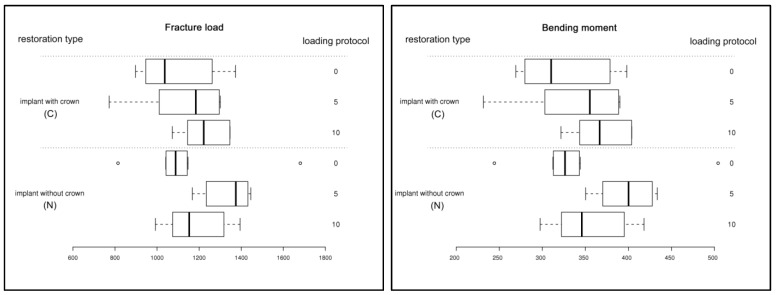
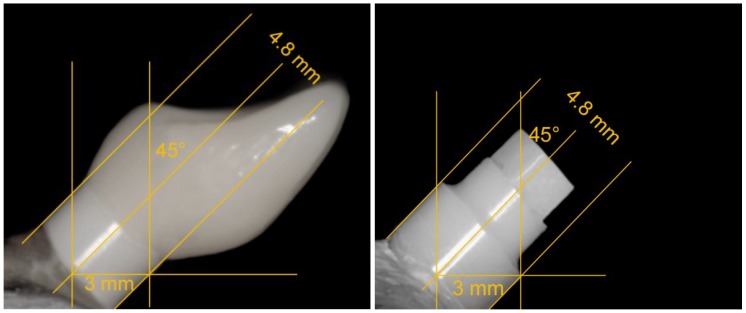
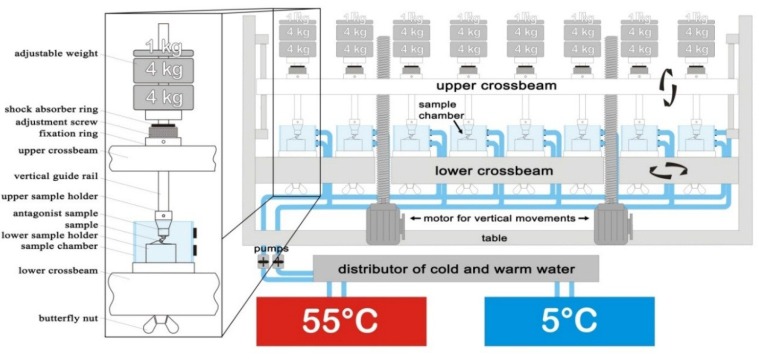
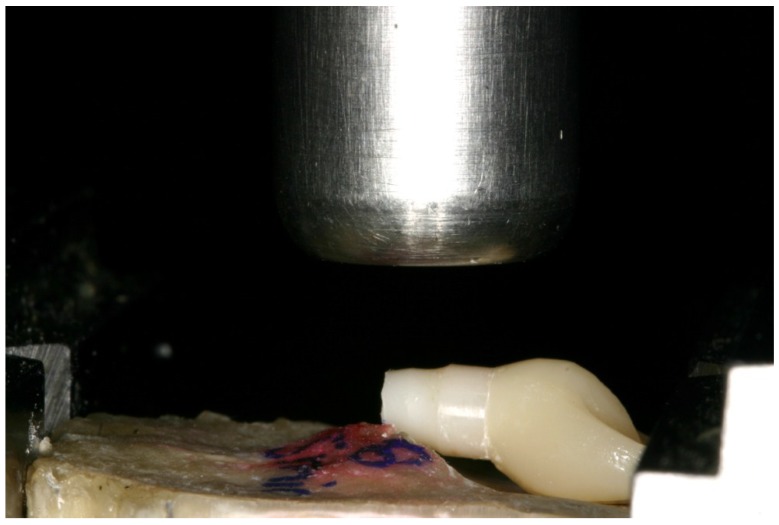
The aim of the current investigation was to evaluate the fracture resistance of one-piece zirconia oral implants with and without all-ceramic incisor crowns after long-term thermomechanical cycling. A total of 48 implants were evaluated. The groups with crowns (C, 24 samples) and without crowns (N, 24 samples) were subdivided according to the loading protocol, resulting in three groups of 8 samples each: Group "0" was not exposed to cyclic loading, whereas groups "5" and "10" were loaded with 5 and 10 million chewing cycles, respectively. This resulted in 6 different groups: C0/N0, C5/N5 and C10/N10. Subsequently, all 48 implants were statically loaded to fracture and bending moments were calculated. All implants survived the artificial aging. For the static loading the following average bending moments were calculated: C0: 326 Ncm; C5: 339 Ncm; C10: 369 Ncm; N0: 339 Ncm; N5: 398 Ncm and N10: 355 Ncm. To a certain extent, thermomechanical cycling resulted in an increase of fracture resistance which did not prove to be statistically significant. Regarding its fracture resistance, the evaluated ceramic implant system made of Y-TZP seems to be able to resist physiological chewing forces long-term. Restauration with all-ceramic single crowns showed no negative influence on fracture resistance.
本研究的目的是评估经过长期热机械循环后,带有和不带有全瓷门牙冠的一体式氧化锆口腔种植体的抗断裂性。共评估了48颗种植体。有冠组(C,24个样本)和无冠组(N,24个样本)根据加载方案进一步细分,每组8个样本,分为三组:“0”组未进行循环加载,“5”组和“10”组分别加载500万次和1000万次咀嚼循环。由此产生了6个不同的组:C0/N0、C5/N5和C10/N10。随后,对所有48颗种植体进行静态加载直至断裂,并计算弯曲力矩。所有种植体均在人工老化后存活。对于静态加载,计算出以下平均弯曲力矩:C0:326 Ncm;C5:339 Ncm;C10:369 Ncm;N0:339 Ncm;N5:398 Ncm;N10:355 Ncm。在一定程度上,热机械循环导致抗断裂性增加,但未证明具有统计学意义。就其抗断裂性而言, 所评估的由钇稳定四方相氧化锆多晶体(Y-TZP)制成的陶瓷种植体系统似乎能够长期抵抗生理咀嚼力。全瓷单冠修复对种植体抗断裂性没有负面影响。