Fehlberg Elizabeth A, Lucero Robert J, Weaver Michael T, McDaniel Anna M, Chandler A Michelle, Richey Phyllis A, Mion Lorraine C, Shorr Ronald I
Departments of Biobehavioral Nursing and Family, Community, and Health System Science, University of Florida College of Nursing, Gainesville, Florida, USA.
Clinical and Translational Science Institute, University of Florida, Gainesville, Florida, USA.
BMJ Open. 2017 Aug 7;7(8):e017045. doi: 10.1136/bmjopen-2017-017045.
We aimed to determine if abnormal laboratory values which may indicate volume depletion are associated with increased odds of experiencing a hospital-acquired fall.
Matched case-control study.
Four hospitals located in the Southeast USA.
Data from 699 adult fallers and 1189 matched controls (non-fallers) were collected via chart review from 2005 to 2010. Controls were matched to cases by nursing unit, time of fall and length of stay.
The primary exposures included serum sodium, blood urea nitrogen (BUN), creatinine, BUN/creatinine ratio and haematocrit. Conditional logistic regression with m:n matching was used to determine adjusted and unadjusted ORs.
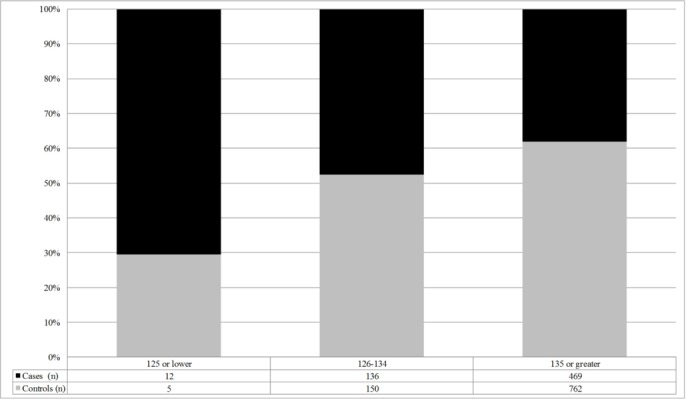
Serum sodium levels were strongly associated with falls. In models controlling for demographic and other fall risk factors, patients with serum sodium levels of 125 mEq/L or less were associated with increased odds of experiencing a fall as compared with those with serum sodium levels of greater than 134 mEq/L (adjusted OR (aOR)=5.08, 95% CI 1.43 to 18.08). Conversely, elevated BUN, creatinine and elevated BUN/creatinine ratios were not associated with increased odds of experiencing a fall (aOR=0.64, 95% CI 0.49 to 0.84; aOR=0.70, 95% CI 0.54 to 0.92 and aOR=0.77, 95% CI 0.58 to 1.04, respectively.) CONCLUSIONS: Laboratory indices that may indicate volume depletion appear to be unrelated to falls. However, hyponatraemia does appear to be a risk factor for falls, and those with serum sodium levels below 126 mEq/L are at especially high risk. It may be that other deficits associated with hyponatraemia, like altered mental status, are associated with risk of experiencing a hospital-acquired fall. These results indicate that abnormal laboratory values, like low sodium, can be useful for identifying hospitalised patients at risk of falling. Therefore, further investigation into abnormal laboratory values as predictors of hospital-acquired falls is warranted.
我们旨在确定可能提示容量耗竭的异常实验室检查值是否与医院获得性跌倒几率增加相关。
匹配病例对照研究。
位于美国东南部的四家医院。
通过病历回顾收集了2005年至2010年期间699例成年跌倒患者和1189例匹配对照(非跌倒患者)的数据。对照根据护理单元、跌倒时间和住院时间与病例进行匹配。
主要暴露因素包括血清钠、血尿素氮(BUN)、肌酐、BUN/肌酐比值和血细胞比容。采用m:n匹配的条件逻辑回归来确定调整和未调整的比值比(OR)。
血清钠水平与跌倒密切相关。在控制人口统计学和其他跌倒风险因素的模型中,血清钠水平低于或等于125 mEq/L的患者与血清钠水平高于134 mEq/L的患者相比,跌倒几率增加(调整后OR(aOR)=5.08,95%可信区间1.43至18.08)。相反,BUN升高、肌酐升高以及BUN/肌酐比值升高与跌倒几率增加无关(aOR分别为0.