Aranda-Gallardo Marta, Morales-Asencio Jose M, Canca-Sanchez Jose C, Barrero-Sojo Silvia, Perez-Jimenez Claudia, Morales-Fernandez Angeles, de Luna-Rodriguez Margarita Enriquez, Moya-Suarez Ana B, Mora-Banderas Ana M
BMC Health Serv Res. 2013 Apr 2;13:122. doi: 10.1186/1472-6963-13-122.
Falls are a serious problem for hospitalized patients, reducing the duration and quality of life. It is estimated that over 84% of all adverse events in hospitalized patients are related to falls. Some fall risk assessment tools have been developed and tested in environments other than those for which they were developed with serious validity discrepancies. The aim of this review is to determine the accuracy of instruments for detecting fall risk and predicting falls in acute hospitalized patients.
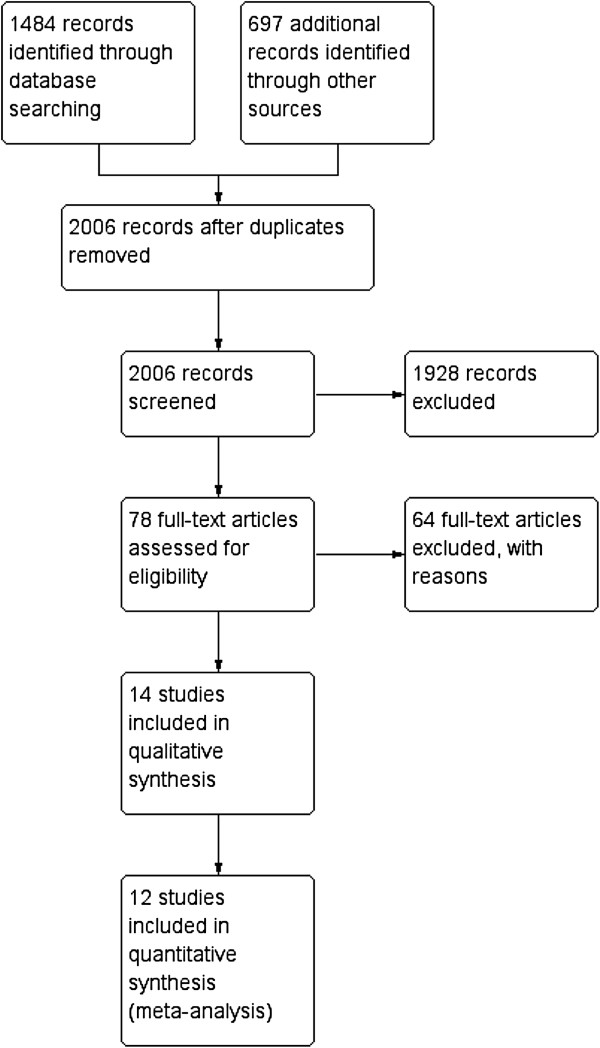
Systematic review and meta-analysis. Main databases, related websites and grey literature were searched. Two blinded reviewers evaluated title and abstracts of the selected articles and, if they met inclusion criteria, methodological quality was assessed in a new blinded process. Meta-analyses of diagnostic ORs (DOR) and likelihood (LH) coefficients were performed with the random effects method. Forest plots were calculated for sensitivity and specificity, DOR and LH. Additionally, summary ROC (SROC) curves were calculated for every analysis.
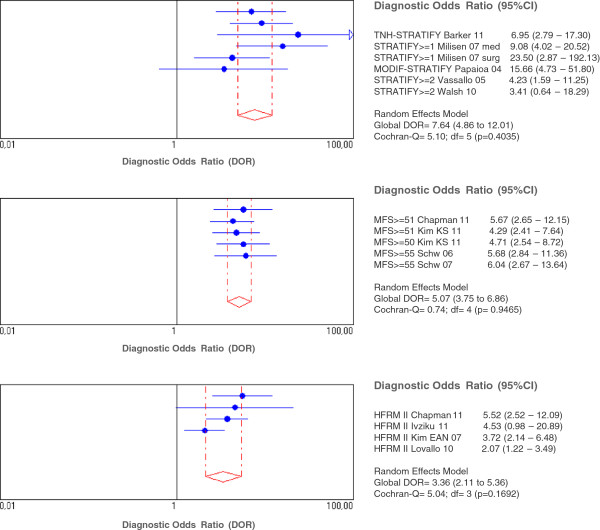
Fourteen studies were selected for the review. The meta-analysis was performed with the Morse (MFS), STRATIFY and Hendrich II Fall Risk Model scales. The STRATIFY tool provided greater diagnostic validity, with a DOR value of 7.64 (4.86 - 12.00). A meta-regression was performed to assess the effect of average patient age over 65 years and the performance or otherwise of risk reassessments during the patient's stay. The reassessment showed a significant reduction in the DOR on the MFS (rDOR 0.75, 95% CI: 0.64 - 0.89, p = 0.017).
The STRATIFY scale was found to be the best tool for assessing the risk of falls by hospitalized acutely-ill adults. However, the behaviour of these instruments varies considerably depending on the population and the environment, and so their operation should be tested prior to implementation. Further studies are needed to investigate the effect of the reassessment of these instruments with respect to hospitalized adult patients, and to consider the real compliance by healthcare personnel with procedures related to patient safety, and in particular concerning the prevention of falls.
跌倒对于住院患者而言是一个严重问题,会缩短患者住院时间并降低生活质量。据估计,住院患者中超过84%的不良事件与跌倒有关。一些跌倒风险评估工具已被开发出来,并在其最初开发环境以外的其他环境中进行测试,结果显示出严重的效度差异。本综述的目的是确定用于检测急性住院患者跌倒风险和预测跌倒的工具的准确性。
系统综述和荟萃分析。检索了主要数据库、相关网站和灰色文献。两名盲法评审员评估所选文章的标题和摘要,若文章符合纳入标准,则在新一轮盲法过程中评估其方法学质量。采用随机效应方法对诊断比值比(DOR)和似然比(LH)系数进行荟萃分析。计算敏感度、特异度、DOR和LH的森林图。此外,对每项分析计算汇总ROC(SROC)曲线。
本综述共纳入14项研究。采用莫尔斯跌倒风险评估量表(MFS)、STRATIFY量表和亨德里克二世跌倒风险模型量表进行荟萃分析。STRATIFY工具具有更高的诊断效度,DOR值为7.64(4.86 - 12.00)。进行了一项荟萃回归分析,以评估平均年龄超过65岁的患者以及住院期间风险重新评估的执行情况所产生的影响。重新评估显示MFS量表的DOR显著降低(rDOR 0.75,95%可信区间:0.64 - 0.89,p = 0.017)。
STRATIFY量表被认为是评估急性病成年住院患者跌倒风险的最佳工具。然而,这些工具的表现会因人群和环境的不同而有很大差异,因此在实施前应测试其操作性。需要进一步研究来调查这些工具重新评估对成年住院患者的影响,并考虑医护人员对患者安全相关程序,特别是预防跌倒程序的实际依从情况。