Lowery Nick Vallespir, McNally Luke, Ratcliff William C, Brown Sam P
Institute of Evolutionary Biology, School of the Biological Sciences, University of Edinburgh, Edinburgh, United Kingdom
Institute of Evolutionary Biology, School of the Biological Sciences, University of Edinburgh, Edinburgh, United Kingdom.
mBio. 2017 Aug 8;8(4):e00672-17. doi: 10.1128/mBio.00672-17.
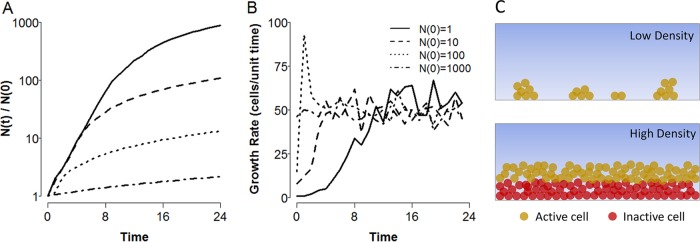
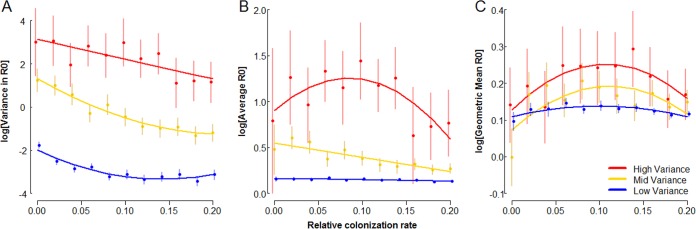
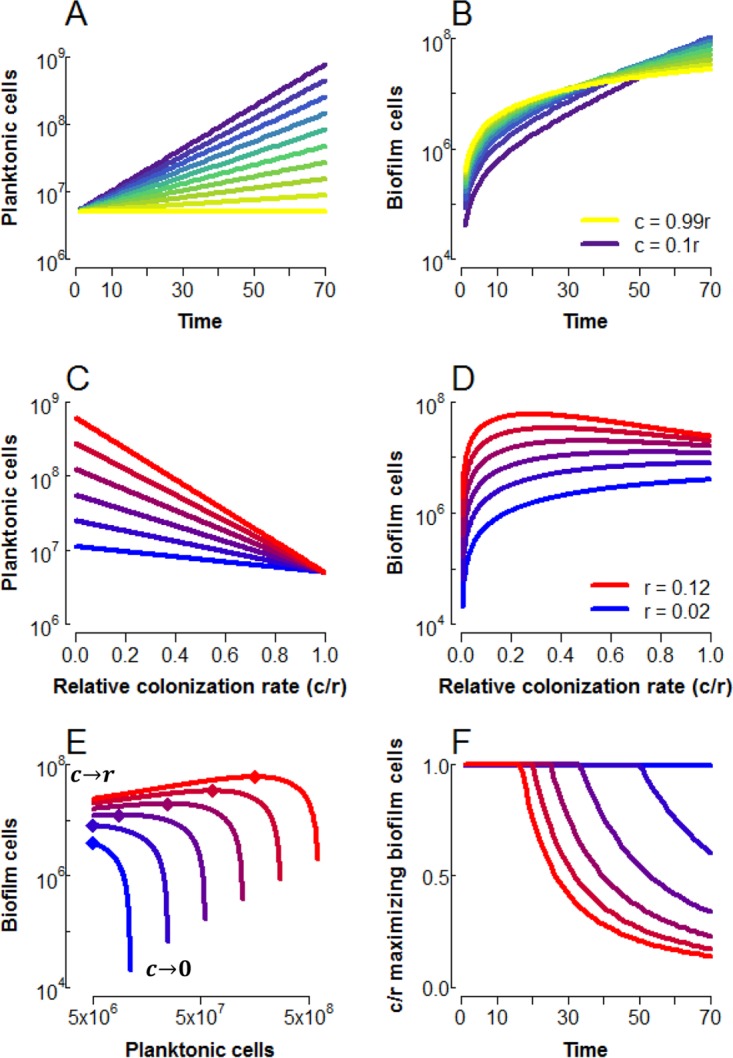
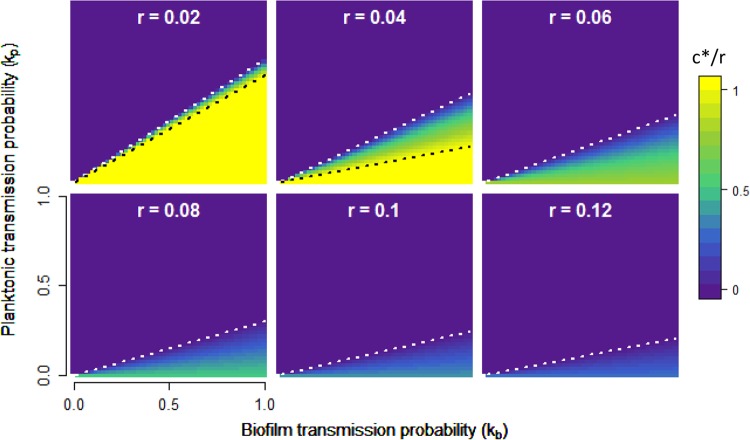
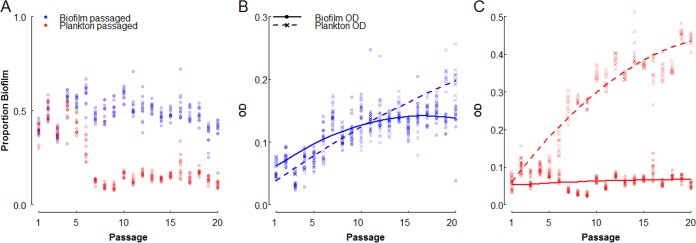
Bacterial cells, like many other organisms, face a tradeoff between longevity and fecundity. Planktonic cells are fast growing and fragile, while biofilm cells are often slower growing but stress resistant. Here we ask why bacterial lineages invest simultaneously in both fast- and slow-growing types. We develop a population dynamic model of lineage expansion across a patchy environment and find that mixed investment is favored across a broad range of environmental conditions, even when transmission is entirely via biofilm cells. This mixed strategy is favored because of a division of labor where exponentially dividing planktonic cells can act as an engine for the production of future biofilm cells, which grow more slowly. We use experimental evolution to test our predictions and show that phenotypic heterogeneity is persistent even under selection for purely planktonic or purely biofilm transmission. Furthermore, simulations suggest that maintenance of a biofilm subpopulation serves as a cost-effective hedge against environmental uncertainty, which is also consistent with our experimental findings. Cell types specialized for survival have been observed and described within clonal bacterial populations for decades, but why are these specialists continually produced under benign conditions when such investment comes at a high reproductive cost? Conversely, when survival becomes an imperative, does it ever benefit the population to maintain a pool of rapidly growing but vulnerable planktonic cells? Using a combination of mathematical modeling, simulations, and experiments, we find that mixed investment strategies are favored over a broad range of environmental conditions and rely on a division of labor between cell types, where reproductive specialists amplify survival specialists, which can be transmitted through the environment with a limited mortality rate. We also show that survival specialists benefit rapidly growing populations by serving as a hedge against unpredictable changes in the environment. These results help to clarify the general evolutionary and ecological forces that can generate and maintain diverse subtypes within clonal bacterial populations.
与许多其他生物体一样,细菌细胞在寿命和繁殖力之间面临权衡。浮游细胞生长迅速但脆弱,而生物膜细胞生长通常较慢但具有抗逆性。在这里,我们探讨为什么细菌谱系会同时投资于快速生长型和缓慢生长型。我们建立了一个在斑驳环境中谱系扩张的种群动态模型,发现即使在完全通过生物膜细胞进行传播的情况下,混合投资在广泛的环境条件下也是有利的。这种混合策略之所以有利,是因为存在分工,指数增长的浮游细胞可以充当未来生物膜细胞产生的引擎,而生物膜细胞生长较慢。我们使用实验进化来检验我们的预测,结果表明即使在选择纯浮游或纯生物膜传播的情况下,表型异质性仍然存在。此外,模拟表明维持生物膜亚群是应对环境不确定性的一种经济有效的保障措施,这也与我们的实验结果一致。数十年来,在克隆细菌群体中已经观察到并描述了专门用于生存的细胞类型,但为什么在良性条件下这些专门细胞会持续产生,而这种投资会带来高昂的繁殖成本呢?相反,当生存成为当务之急时,维持一群快速生长但脆弱的浮游细胞对种群是否有好处呢?通过结合数学建模、模拟和实验,我们发现混合投资策略在广泛的环境条件下是有利的,并且依赖于细胞类型之间的分工,其中繁殖专门细胞会扩增生存专门细胞,生存专门细胞可以以有限的死亡率在环境中传播。我们还表明,生存专门细胞通过作为应对不可预测的环境变化的保障措施,使快速生长的种群受益。这些结果有助于阐明能够在克隆细菌群体中产生和维持不同亚型的一般进化和生态力量。