Sheng Lina, Edwards Katheryn, Tsai Hsieh-Chin, Hanrahan Ines, Zhu Mei-Jun
School of Food Science, Washington State University, PullmanWA, United States.
Washington Tree Fruit Research Commission, WenatcheeWA, United States.
Front Microbiol. 2017 Jul 24;8:1396. doi: 10.3389/fmicb.2017.01396. eCollection 2017.
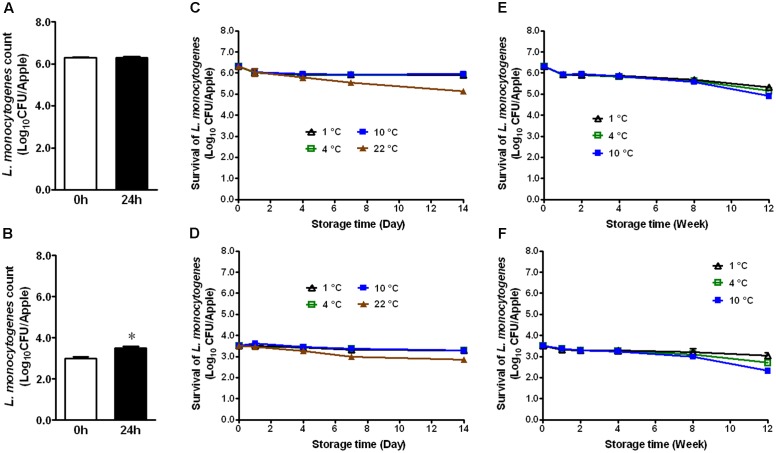
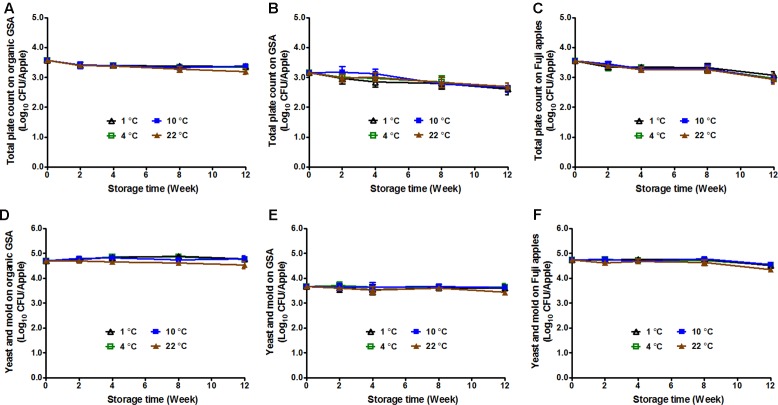
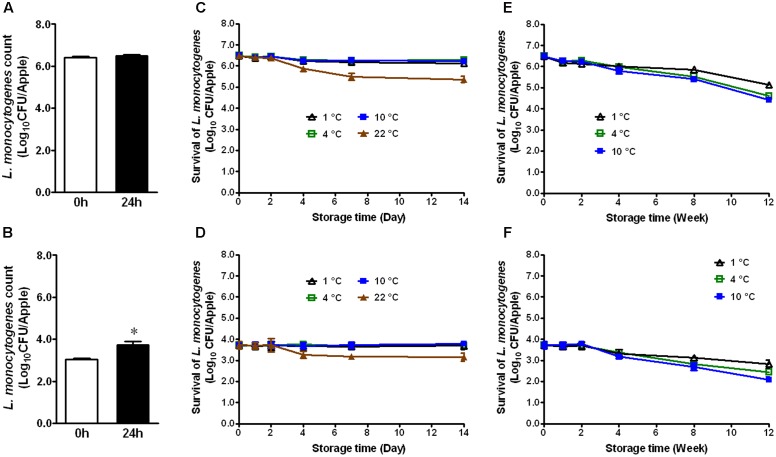
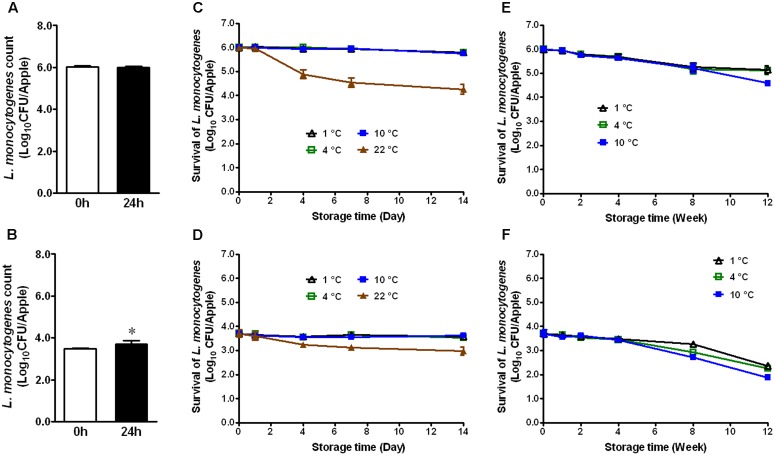
Fresh apples are typically stored for up to 1 year commercially; different apple varieties require different storage temperatures to maintain their quality characteristics. There is sparse information available about survival on fresh apples under various storage temperatures. The objective of this study was to comprehensively evaluate the effect of storage temperature on apple fruit decay and survival. Unwaxed apple fruits of selected varieties (Fuji and Granny Smith) were dip inoculated in a three-strain cocktail to establish ∼3.5 and 6.0 Log CFU/apple. Twenty-four hours post-inoculation, apples were subjected to 1, 4, 10, or 22°C storage for up to 3 months. Apples under the different storage treatments were sampled at 1-, 4-, 7- and 14-day for short-term storage under all four tested temperatures, and 2-, 4-, 8-, and 12-week for long-term storage at 1, 4, and 10°C. A set of uninoculated and unwaxed apples were simultaneously subjected to the previously mentioned storage temperatures and sampled biweekly for their total bacterial count (TPC) and yeasts/molds (Y/M) count. During the 2-week short-term storage, population on organic Granny Smith apples stored at 1, 4, or 10°C was reduced by 0.2-0.3 Log. When apples were stored at 22°C, there was a 0.5-1.2 Log CFU/apple reduction 14-day post storage dependent on the initial inoculation level. During the 12-week cold storage under 1, 4, and 10°C, count on organic Granny Smith apples decreased by 0.5-1.5 Log CFU/apple for both inoculation levels. had similar survival pattern on conventional Granny Smith and Fuji apples with 0.8-2.0 Log CFU/apple reduction over a 3-month cold storage period. Interestingly, both TPC and Y/M count were stable regardless of apple variety or cultivation practice during the 12-week storage at all tested temperatures. In summary, while did not proliferate on apple surfaces during 12 weeks of refrigerated storage, only a limited reduction of was observed in this study. Therefore, the apple industry cannot rely on cold storage alone to control this pathogen. Additional interventions are needed to eradicate on fresh apples during long-term cold storage.
新鲜苹果在商业上通常可储存长达1年;不同苹果品种需要不同的储存温度来保持其品质特性。关于各种储存温度下新鲜苹果上的(某种微生物,原文未明确)存活情况,可获取的信息很少。本研究的目的是全面评估储存温度对苹果果实腐烂和(该微生物)存活的影响。将选定品种(富士和澳洲青苹)的未打蜡苹果果实浸入含有三种菌株的混合菌液中,以使每个苹果的菌量达到约3.5和6.0 Log CFU。接种后24小时,将苹果置于1、4、10或22°C下储存长达3个月。在所有四个测试温度下,对不同储存处理的苹果在1天、4天、7天和14天进行短期储存采样,在1°C、4°C和10°C下储存2周、4周、8周和12周进行长期储存采样。同时将一组未接种且未打蜡的苹果置于上述储存温度下,并每两周采样一次,检测其总细菌数(TPC)和酵母/霉菌(Y/M)数量。在为期2周的短期储存期间,储存在1°C、4°C或10°C下的有机澳洲青苹上的(该微生物)数量减少了0.2 - 0.3 Log。当苹果储存在22°C时,储存14天后每个苹果的菌量减少了0.5 - 1.2 Log CFU,这取决于初始接种水平。在1°C、4°C和10°C下进行的为期12周的冷藏期间,两种接种水平下有机澳洲青苹上的(该微生物)数量均减少了0.5 - 1.5 Log CFU/苹果。在传统澳洲青苹和富士苹果上的(该微生物)具有相似的存活模式,在3个月的冷藏期内每个苹果的菌量减少了0.8 - 2.0 Log CFU。有趣的是,在所有测试温度下为期12周的储存期间,无论苹果品种或种植方式如何,TPC和Y/M数量均保持稳定。总之,虽然在12周的冷藏储存期间(该微生物)没有在苹果表面增殖,但在本研究中仅观察到(该微生物)数量有有限的减少。因此,苹果产业不能仅依靠冷藏来控制这种病原体。需要采取额外的干预措施来根除长期冷藏期间新鲜苹果上的(该微生物)。