De Vuyst Evelyne, Salmon Michel, Evrard Céline, Lambert de Rouvroit Catherine, Poumay Yves
Cell and Tissue Laboratory, URPhyM-NARILIS, University of Namur, Namur, Belgium.
StratiCell, Les Isnes, Belgium.
Front Med (Lausanne). 2017 Jul 24;4:119. doi: 10.3389/fmed.2017.00119. eCollection 2017.
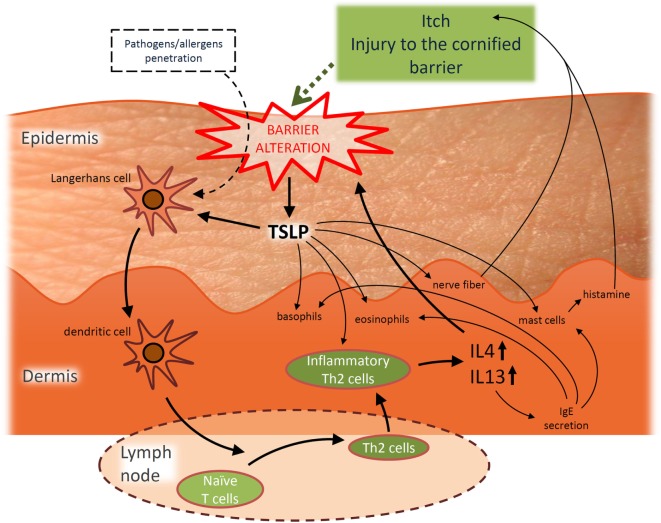
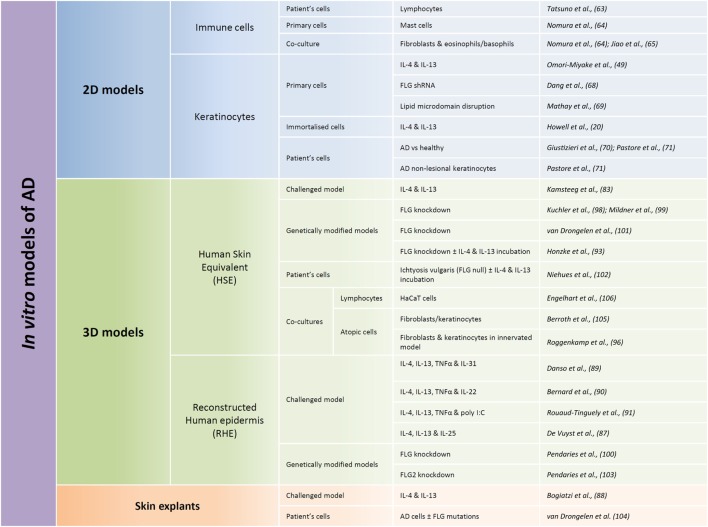
Atopic dermatitis (AD) is a complex inflammatory skin condition that is not fully understood. Epidermal barrier defects and Th2 immune response dysregulations are thought to play crucial roles in the pathogenesis of the disease. A vicious circle takes place between these alterations, and it can further be complicated by additional genetic and environmental factors. Studies investigating in more depth the etiology of the disease are thus needed in order to develop functional treatments. In recent years, there have been significant advances regarding models reproducing important features of AD. However, since a lot of models have been developed, finding the appropriate experimental setting can be difficult. Therefore, herein, we review the different types of models mimicking features of AD. The simplest models are two-dimensional culture systems composed of immune cells or keratinocytes, whereas three-dimensional skin or epidermal equivalents reconstitute more complex stratified tissues exhibiting barrier properties. In those models, hallmarks of AD are obtained, either by challenging tissues with interleukin cocktails overexpressed in AD epidermis or by silencing expression of pivotal genes encoding epidermal barrier proteins. Tissue equivalents cocultured with lymphocytes or containing AD patient cells are also described. Furthermore, each model is placed in its study context with a brief summary of the main results obtained. In conclusion, the described models are useful tools to better understand AD pathogenesis, but also to screen new compounds in the field of AD, which probably will open the way to new preventive or therapeutic strategies.
特应性皮炎(AD)是一种尚未完全被理解的复杂炎症性皮肤病。表皮屏障缺陷和Th2免疫反应失调被认为在该疾病的发病机制中起关键作用。这些改变之间会形成恶性循环,并且可能因其他遗传和环境因素而进一步复杂化。因此,需要进行更深入研究该疾病病因的研究,以便开发有效的治疗方法。近年来,在重现AD重要特征的模型方面取得了重大进展。然而,由于已经开发了许多模型,找到合适的实验环境可能很困难。因此,在此我们综述了模拟AD特征的不同类型模型。最简单的模型是由免疫细胞或角质形成细胞组成的二维培养系统,而三维皮肤或表皮替代物则重建了表现出屏障特性的更复杂的分层组织。在这些模型中,通过用AD表皮中过表达的白细胞介素混合物刺激组织或通过沉默编码表皮屏障蛋白的关键基因的表达来获得AD的特征。还描述了与淋巴细胞共培养或含有AD患者细胞的组织替代物。此外,每个模型都置于其研究背景中,并简要总结了所获得的主要结果。总之,所描述的模型是更好地理解AD发病机制的有用工具,也是在AD领域筛选新化合物的有用工具,这可能会为新的预防或治疗策略开辟道路。