
在索拉非尼诱导的肿瘤代谢变化的早期检测中,蛙皮素和转铁蛋白受体表达的荧光成像与18F-FDG PET相当。
Fluorescence imaging of bombesin and transferrin receptor expression is comparable to 18F-FDG PET in early detection of sorafenib-induced changes in tumor metabolism.
作者信息
Tseng Jen-Chieh, Narayanan Nara, Ho Guojie, Groves Kevin, Delaney Jeannine, Bao Bagna, Zhang Jun, Morin Jeffrey, Kossodo Sylvie, Rajopadhye Milind, Peterson Jeffrey D
机构信息
Discovery & Analytical Solutions R&D, PerkinElmer Inc., Hopkinton, Massachusetts, United States of America.
出版信息
PLoS One. 2017 Aug 8;12(8):e0182689. doi: 10.1371/journal.pone.0182689. eCollection 2017.
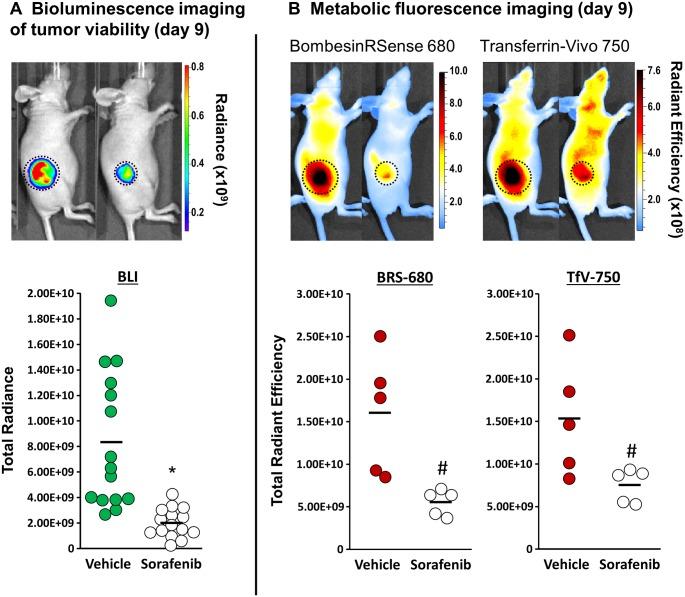
Physical measurement of tumor volume reduction is the most commonly used approach to assess tumor progression and treatment efficacy in mouse tumor models. However, it is relatively insensitive, and often requires long treatment courses to achieve gross physical tumor destruction. As alternatives, several non-invasive imaging methods such as bioluminescence imaging (BLI), fluorescence imaging (FLI) and positron emission tomography (PET) have been developed for more accurate measurement. As tumors have elevated glucose metabolism, 18F-fludeoxyglucose (18F-FDG) has become a sensitive PET imaging tracer for cancer detection, diagnosis, and efficacy assessment by measuring alterations in glucose metabolism. In particular, the ability of 18F-FDG imaging to detect drug-induced effects on tumor metabolism at a very early phase has dramatically improved the speed of decision-making regarding treatment efficacy. Here we demonstrated an approach with FLI that offers not only comparable performance to PET imaging, but also provides additional benefits, including ease of use, imaging throughput, probe stability, and the potential for multiplex imaging. In this report, we used sorafenib, a tyrosine kinase inhibitor clinically approved for cancer therapy, for treatment of a mouse tumor xenograft model. The drug is known to block several key signaling pathways involved in tumor metabolism. We first identified an appropriate sorafenib dose, 40 mg/kg (daily on days 0-4 and 7-10), that retained ultimate therapeutic efficacy yet provided a 2-3 day window post-treatment for imaging early, subtle metabolic changes prior to gross tumor regression. We then used 18F-FDG PET as the gold standard for assessing the effects of sorafenib treatment on tumor metabolism and compared this to results obtained by measurement of tumor size, tumor BLI, and tumor FLI changes. PET imaging showed ~55-60% inhibition of tumor uptake of 18F-FDG as early as days 2 and 3 post-treatment, without noticeable changes in tumor size. For comparison, two FLI probes, BombesinRSense™ 680 (BRS-680) and Transferrin-Vivo™ 750 (TfV-750), were assessed for their potential in metabolic imaging. Metabolically active cancer cells are known to have elevated bombesin and transferrin receptor levels on the surface. In excellent agreement with PET imaging, the BRS-680 imaging showed 40% and 79% inhibition on days 2 and 3, respectively, and the TfV-750 imaging showed 65% inhibition on day 3. In both cases, no significant reduction in tumor volume or BLI signal was observed during the first 3 days of treatment. These results suggest that metabolic FLI has potential preclinical application as an additional method for detecting drug-induced metabolic changes in tumors.
在小鼠肿瘤模型中,通过物理测量肿瘤体积缩小是评估肿瘤进展和治疗效果最常用的方法。然而,这种方法相对不敏感,通常需要较长的治疗疗程才能实现肿瘤的大体物理性破坏。作为替代方法,已经开发了几种非侵入性成像方法,如生物发光成像(BLI)、荧光成像(FLI)和正电子发射断层扫描(PET),以进行更准确的测量。由于肿瘤具有较高的葡萄糖代谢,18F-氟脱氧葡萄糖(18F-FDG)已成为一种敏感的PET成像示踪剂,通过测量葡萄糖代谢的变化来进行癌症检测、诊断和疗效评估。特别是,18F-FDG成像在极早期检测药物对肿瘤代谢影响的能力极大地提高了关于治疗效果决策的速度。在这里,我们展示了一种FLI方法,它不仅具有与PET成像相当的性能,还提供了额外的优势,包括易用性、成像通量、探针稳定性以及多重成像的潜力。在本报告中,我们使用索拉非尼(一种临床上批准用于癌症治疗的酪氨酸激酶抑制剂)治疗小鼠肿瘤异种移植模型。已知该药物可阻断参与肿瘤代谢的几个关键信号通路。我们首先确定了合适的索拉非尼剂量,即40mg/kg(在第0 - 4天和第7 - 10天每天给药),该剂量保留了最终的治疗效果,同时在治疗后提供了2 - 3天的窗口期,以便在肿瘤明显消退之前对早期细微的代谢变化进行成像。然后,我们将18F-FDG PET作为评估索拉非尼治疗对肿瘤代谢影响的金标准,并将其与通过测量肿瘤大小、肿瘤BLI和肿瘤FLI变化获得的结果进行比较。PET成像显示,早在治疗后第2天和第3天,肿瘤对18F-FDG的摄取就受到了约55 - 60%的抑制,而肿瘤大小没有明显变化。作为比较,评估了两种FLI探针,即蛙皮素RSense™ 680(BRS - 680)和转铁蛋白 - Vivo™ 750(TfV - 750)在代谢成像方面的潜力。已知代谢活跃的癌细胞表面蛙皮素和转铁蛋白受体水平升高。与PET成像结果高度一致,BRS - 680成像在第2天和第3天分别显示出40%和79%的抑制,TfV - 750成像在第3天显示出65%的抑制。在这两种情况下,治疗的前3天内均未观察到肿瘤体积或BLI信号有显著降低。这些结果表明,代谢性FLI作为一种检测药物诱导的肿瘤代谢变化的额外方法具有潜在的临床前应用价值。




 Zotero 插件