Vega Jorge D, Hara Daiki, Schmidt Ryder M, Abuhaija Marwan B, Tao Wensi, Dogan Nesrin, Pollack Alan, Ford John C, Shi Junwei
Department of Radiation Oncology, Miller School of Medicine, University of Miami, Miami, FL, United States.
Department of Biomedical Engineering, University of Miami, Coral Gables, FL, United States.
Front Oncol. 2023 Mar 14;13:1130155. doi: 10.3389/fonc.2023.1130155. eCollection 2023.
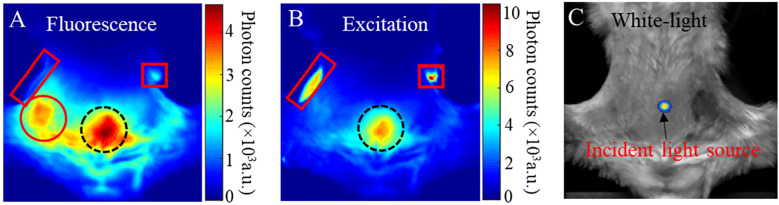
Using active tumor-targeting nanoparticles, fluorescence imaging can provide highly sensitive and specific tumor detection, and precisely guide radiation in translational radiotherapy study. However, the inevitable presence of non-specific nanoparticle uptake throughout the body can result in high levels of heterogeneous background fluorescence, which limits the detection sensitivity of fluorescence imaging and further complicates the early detection of small cancers. In this study, background fluorescence emanating from the baseline fluorophores was estimated from the distribution of excitation light transmitting through tissues, by using linear mean square error estimation. An adaptive masked-based background subtraction strategy was then implemented to selectively refine the background fluorescence subtraction. First, an experiment was performed on a mouse intratumorally injected with passively targeted fluorescent nanoparticles, to validate the reliability and robustness of the proposed method in a stringent situation wherein the target fluorescence was overlapped with the strong background. Then, we conducted studies on 10 mice which were inoculated with orthotopic breast tumors and intravenously injected with actively targeted fluorescent nanoparticles. Results demonstrated that active targeting combined with the proposed background subtraction method synergistically increased the accuracy of fluorescence molecular imaging, affording sensitive tumor detection.
使用主动肿瘤靶向纳米颗粒,荧光成像可以提供高度灵敏和特异的肿瘤检测,并在转化放射治疗研究中精确引导放疗。然而,纳米颗粒在全身不可避免地存在非特异性摄取,这会导致高水平的异质性背景荧光,限制了荧光成像的检测灵敏度,并进一步使小癌症的早期检测复杂化。在本研究中,通过使用线性均方误差估计,根据透过组织的激发光分布来估计基线荧光团发出的背景荧光。然后实施了一种基于自适应掩膜的背景减法策略,以选择性地优化背景荧光减法。首先,对一只瘤内注射了被动靶向荧光纳米颗粒的小鼠进行实验,以在目标荧光与强背景重叠的严格情况下验证所提出方法的可靠性和稳健性。然后,我们对10只接种了原位乳腺肿瘤并静脉注射了主动靶向荧光纳米颗粒的小鼠进行了研究。结果表明,主动靶向与所提出的背景减法方法相结合,协同提高了荧光分子成像的准确性,实现了灵敏的肿瘤检测。