Chini L S N, Assis L I S, Lugon J R
Divisão de Medicina Interna, Departamento de Medicina, Universidade Federal Fluminense, Niterói, RJ, Brasil.
Universidade Federal do Estado do Rio de Janeiro, Rio de Janeiro, RJ, Brasil.
Braz J Med Biol Res. 2017 Aug 7;50(9):e6048. doi: 10.1590/1414-431X20176048.
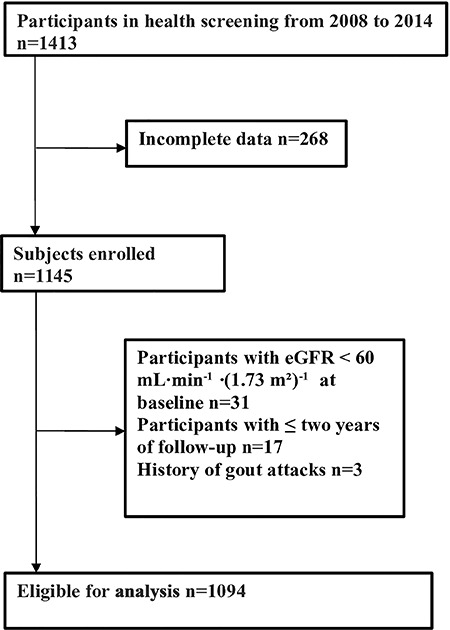
Uric acid (UA) levels are increased in patients with kidney dysfunction. We analyzed the association between asymptomatic hyperuricemia and new-onset chronic kidney disease (CKD). A retrospective cohort study was designed to collect data from employees of an energy generation and distribution company in the city of Rio de Janeiro, Brazil, who had undergone the company's annual medical checkup from 2008 to 2014. People with ≤2 years of follow-up, with baseline estimated glomerular filtration rate (eGFR) <60 mL·min-1·(1.73 m2)-1 or with incomplete data were excluded. The endpoint was defined as eGFR <60 mL·min-1·(1.73 m2)-1 estimated through the chronic kidney disease epidemiology collaboration equation (CKD-EPI). The study included 1094 participants. The mean follow-up period was 5.05±1.05 years and 44 participants exhibited new-onset CKD. The prevalence of hyperuricemia was 4.2%. There was a significant inverse correlation between baseline serum levels of UA and baseline eGFR (R=-0.21, P<0.001). Female gender (OR=4.00; 95%CI=1.92-8.29, P<0.001) and age (OR=1.06; 95%CI=1.02-1.11, P=0.004) but not UA levels (OR=1.12; 95%CI=0.83-1.50; P=0.465) were associated with new-onset CKD. Diabetes mellitus and body mass index were independent factors for fast progression (OR=2.17; 95%CI=1.24-3.80, P=0.007 and OR=1.04; 95%CI=1.01-1.07; P=0.020). These results did not support UA as an independent predictor for CKD progression in the studied population.
肾功能不全患者的尿酸(UA)水平会升高。我们分析了无症状高尿酸血症与新发慢性肾脏病(CKD)之间的关联。一项回顾性队列研究旨在收集巴西里约热内卢一家发电和配电公司员工的数据,这些员工在2008年至2014年期间接受了公司的年度体检。随访时间≤2年、基线估计肾小球滤过率(eGFR)<60 mL·min-1·(1.73 m2)-1或数据不完整的人员被排除。终点定义为通过慢性肾脏病流行病学合作方程(CKD-EPI)估计的eGFR<60 mL·min-1·(1.73 m2)-1。该研究纳入了1094名参与者。平均随访期为5.05±1.05年,44名参与者出现了新发CKD。高尿酸血症的患病率为4.2%。基线血清UA水平与基线eGFR之间存在显著负相关(R=-0.21,P<0.001)。女性(OR=4.00;95%CI=1.92-8.29,P<0.001)和年龄(OR=1.06;95%CI=1.02-1.11,P=0.004)而非UA水平(OR=1.12;95%CI=0.83-1.50;P=0.465)与新发CKD相关。糖尿病和体重指数是快速进展的独立因素(OR=2.17;95%CI=1.24-3.80,P=0.007和OR=1.04;95%CI=1.01-1.07;P=0.020)。这些结果不支持UA作为所研究人群中CKD进展的独立预测指标。