Newsome David B, Schultz Benjamin F, Ferguson J B, Rohatgi Pradeep K
Materials Science and Engineering Department, University of Wisconsin-Milwaukee, 3200 N. Cramer St., Milwaukee, WI 53211, USA.
Materials (Basel). 2015 Sep 11;8(9):6085-6095. doi: 10.3390/ma8095292.
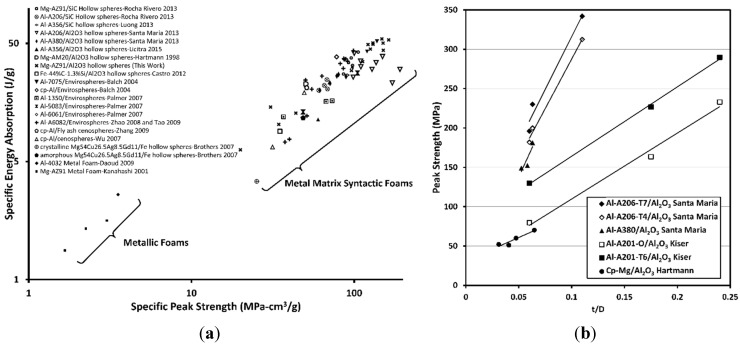
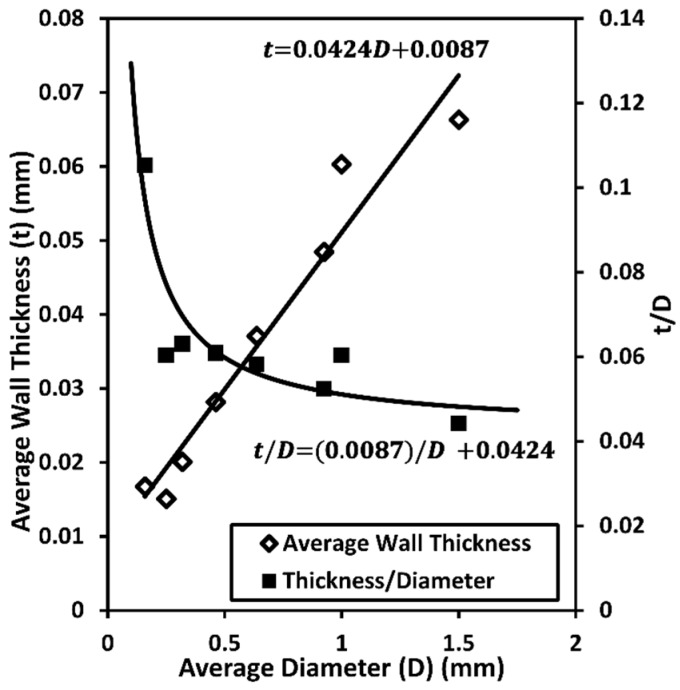
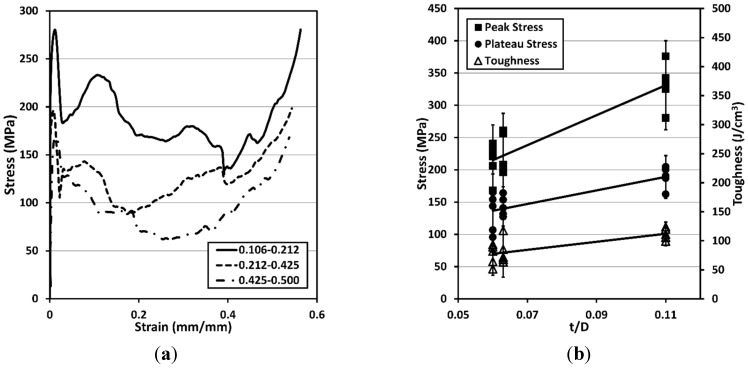
Magnesium alloys have considerably lower density than the aluminum alloy matrices that are typically used in syntactic foams, allowing for greater specific energy absorption. Despite the potential advantages, few studies have reported the properties of magnesium alloy matrix syntactic foams. In this work, Al₂O₃ hollow particles of three different size ranges, 0.106-0.212 mm, 0.212-0.425 mm, and 0.425-0.500 mm were encapsulated in Mg-AZ91D by a sub-atmospheric pressure infiltration technique. It is shown that the peak strength, plateau strength and toughness of the foam increases with increasing hollow sphere wall thickness to diameter (/) ratio. Since / was found to increase with decreasing hollow sphere diameter, the foams produced with smaller spheres showed improved performance-specifically, higher energy absorption per unit weight. These foams show better performance than other metallic foams on a specific property basis.
镁合金的密度比通常用于复合泡沫材料的铝合金基体低得多,从而具有更高的比能量吸收。尽管有这些潜在优势,但很少有研究报道镁合金基体复合泡沫材料的性能。在这项工作中,通过负压渗透技术将三种不同尺寸范围(0.106 - 0.212毫米、0.212 - 0.425毫米和0.425 - 0.500毫米)的Al₂O₃空心颗粒封装在Mg - AZ91D中。结果表明,泡沫材料的峰值强度、平台强度和韧性随着空心球壁厚与直径(/)比的增加而增加。由于发现/随着空心球直径的减小而增加,用较小球体生产的泡沫材料表现出更好的性能——具体而言,单位重量的能量吸收更高。基于特定性能,这些泡沫材料比其他金属泡沫材料表现出更好的性能。