Canty Russell, Gonzalez Edwin, MacDonald Caleb, Osswald Sebastian, Zea Hugo, Luhrs Claudia C
Mechanical and Aerospace Engineering Department, Naval Postgraduate School, Monterey, CA 93943, USA.
School of Materials Engineering, Purdue University, West Lafayette, IN 47907-2045, USA.
Materials (Basel). 2015 Oct 16;8(10):7048-7058. doi: 10.3390/ma8105359.
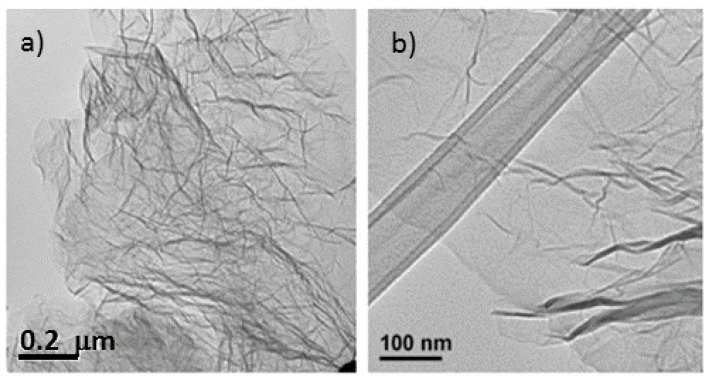
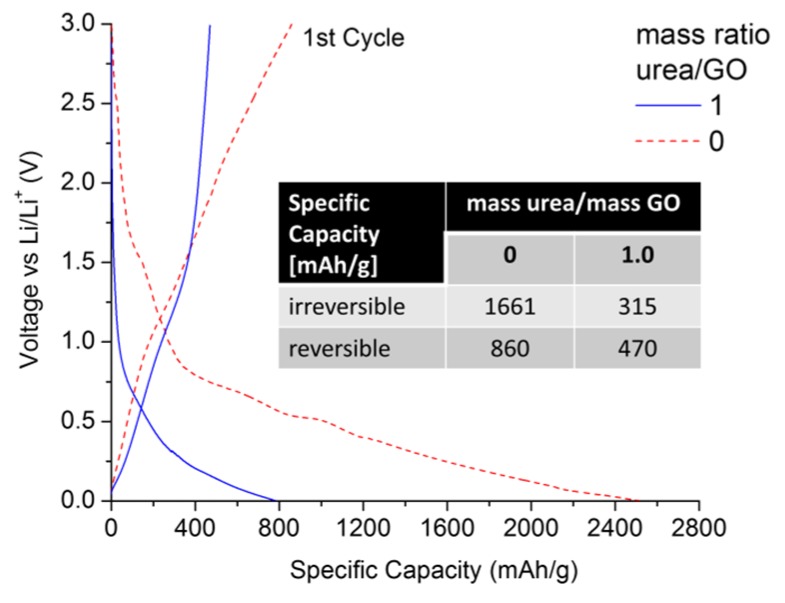
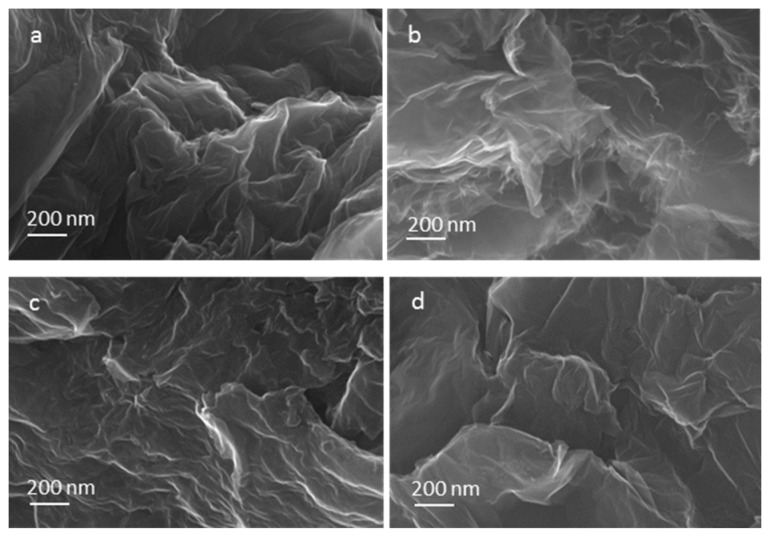
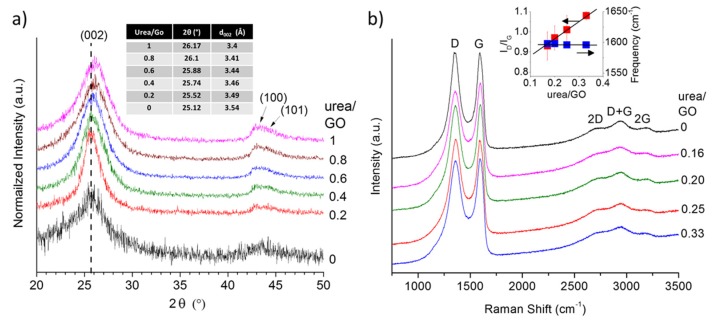
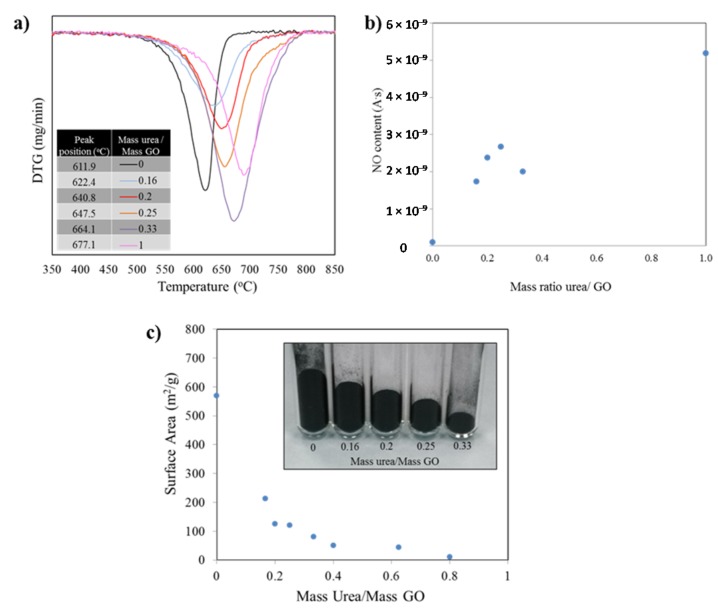
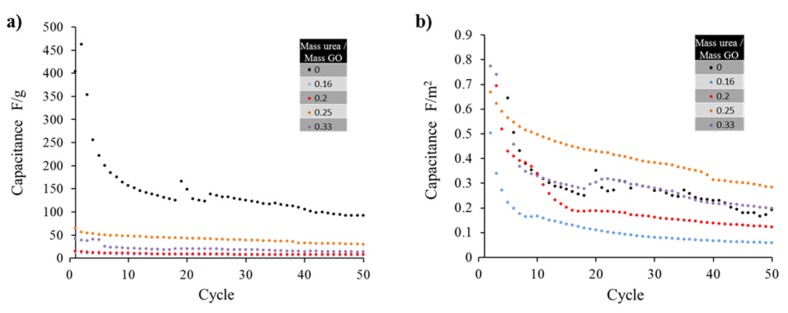
Graphene sheets doped with nitrogen were produced by the reduction-expansion (RES) method utilizing graphite oxide (GO) and urea as precursor materials. The simultaneous graphene generation and nitrogen insertion reactions are based on the fact that urea decomposes upon heating to release reducing gases. The volatile byproducts perform two primary functions: (i) promoting the reduction of the GO and (ii) providing the nitrogen to be inserted as the graphene structure is created. Samples with diverse urea/GO mass ratios were treated at 800 °C in inert atmosphere to generate graphene with diverse microstructural characteristics and levels of nitrogen doping. Scanning electron microscopy (SEM) and transmission electron microscopy (TEM) were used to study the microstructural features of the products. The effects of doping on the samples structure and surface area were studied by X-ray diffraction (XRD), Raman Spectroscopy, and Brunauer Emmet Teller (BET). The GO and urea decomposition-reduction process as well as nitrogen-doped graphene stability were studied by thermogravimetric analysis (TGA) coupled with mass spectroscopy (MS) analysis of the evolved gases. Results show that the proposed method offers a high level of control over the amount of nitrogen inserted in the graphene and may be used alternatively to control its surface area. To demonstrate the practical relevance of these findings, as-produced samples were used as electrodes in supercapacitor and battery devices and compared with conventional, thermally exfoliated graphene.
利用氧化石墨(GO)和尿素作为前驱体材料,通过还原膨胀(RES)法制备了氮掺杂的石墨烯片。石墨烯的生成和氮插入反应同时进行,这是基于尿素在加热时分解会释放还原气体这一事实。挥发性副产物发挥两个主要作用:(i)促进GO的还原,(ii)在石墨烯结构形成时提供要插入的氮。将具有不同尿素/GO质量比的样品在惰性气氛中于800℃下处理,以生成具有不同微观结构特征和氮掺杂水平的石墨烯。使用扫描电子显微镜(SEM)和透射电子显微镜(TEM)研究产物的微观结构特征。通过X射线衍射(XRD)、拉曼光谱和布鲁诺尔-埃米特-泰勒(BET)法研究掺杂对样品结构和表面积的影响。通过热重分析(TGA)结合逸出气体的质谱(MS)分析,研究了GO和尿素的分解还原过程以及氮掺杂石墨烯的稳定性。结果表明,所提出的方法能够高度控制石墨烯中插入的氮量,也可用于控制其表面积。为了证明这些发现的实际相关性,将制备的样品用作超级电容器和电池装置中的电极,并与传统的热剥离石墨烯进行比较。