Wu Chia-Jung, Huang Chien-Cheng, Weng Shih-Feng, Chen Ping-Jen, Hsu Chien-Chin, Wang Jhi-Joung, Guo How-Ran, Lin Hung-Jung
Department of Emergency Medicine, Chi-Mei Medical Center, 901 Zhonghua Road, Yongkang District, Tainan City, 710, Taiwan.
Department of Geriatrics and Gerontology, Chi-Mei Medical Center, Tainan, Taiwan.
BMC Geriatr. 2017 Aug 9;17(1):178. doi: 10.1186/s12877-017-0561-x.
The elderly are predisposed to septic arthritis (SA) because of the aging nature and increasing comorbidities. SA may in turn increase the long-term mortality in the geriatric patients; however, it remains unclear. We conducted this prospective nationwide population-based cohort study to clarify this issue.
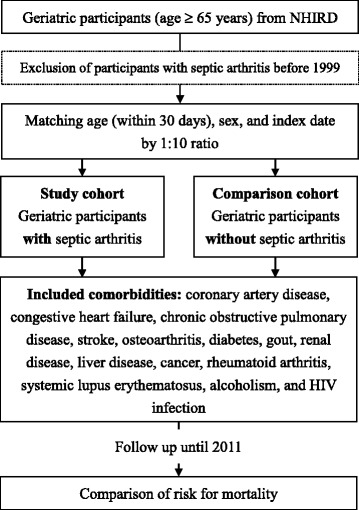
Using Taiwan National Health Insurance Research Database (NHIRD), we identified 1667 geriatric participants (≥ 65 years) with SA and 16,670 geriatric participants without SA matched at a ratio of 1:10 by age, sex, and index date between 1999 and 2010. A comparison of the long-term mortality between the two cohorts through follow-up until 2011 was performed.
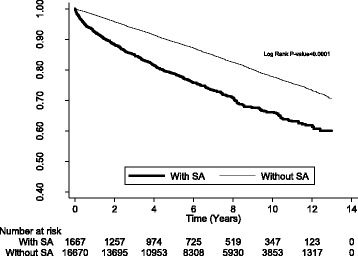
Geriatric participants with SA had a significantly increased mortality than those without SA [Adjusted hazard ratio (AHR): 1.49, 95% confidence interval (CI): 1.34-1.66], particularly the old elderly (≥ 85 years, AHR: 2.12, 95% CI: 1.58-2.84) and males (AHR: 1.54, 95% CI: 1.33-1.79). These results were stated after adjustment for osteoarthritis, diabetes, gout, renal disease, liver disease, cancer, rheumatoid arthritis, systemic lupus erythematosus, alcoholism, and human immunodeficiency virus infection. The increased mortality risk was highest in the first month (AHR: 3.93, 95% CI: 2.94-5.25) and remained increased even after following up for 2-4 years (AHR: 1.30, 95% CI: 1.03-1.65). After Cox proportional hazard regression analysis, SA (AHR: 1.37, 95% CI: 1.20-1.56), older age (≥ 85 years, AHR: 1.79, 95% CI: 1.59-2.02, 75-84 years, AHR: 1.65, 95% CI: 1.53-1.78), male sex, diabetes, renal disease, liver disease, cancer, and gout were independent mortality predictors. There was no significant difference in the mortality for SA between upper limb affected and lower limb affected.
This study delineated that SA significantly increased the long-term mortality in geriatric participants. For the increasing aging population worldwide, strategies for the prevention and treatment of SA and concomitant control of comorbidities are very important.
由于老龄化以及合并症增多,老年人易患化脓性关节炎(SA)。SA可能反过来增加老年患者的长期死亡率;然而,情况仍不清楚。我们开展了这项基于全国人口的前瞻性队列研究以阐明这一问题。
利用台湾国民健康保险研究数据库(NHIRD),我们确定了1667名患有SA的老年参与者(≥65岁)以及16670名未患SA的老年参与者,在1999年至2010年期间,按照年龄、性别和索引日期以1:10的比例进行匹配。对两组队列进行随访直至2011年,比较两者的长期死亡率。
患有SA的老年参与者的死亡率显著高于未患SA的参与者[调整后风险比(AHR):1.49,95%置信区间(CI):1.34 - 1.66],尤其是高龄老年人(≥85岁,AHR:2.12,95%CI:1.58 - 2.84)和男性(AHR:1.54,95%CI:1.33 - 1.79)。在对骨关节炎、糖尿病、痛风、肾病、肝病、癌症、类风湿关节炎、系统性红斑狼疮、酗酒和人类免疫缺陷病毒感染进行调整后得出这些结果。死亡风险增加在第一个月最高(AHR:3.93,95%CI:2.94 - 5.25),甚至在随访2 - 4年后仍保持增加(AHR:1.30,95%CI:1.03 - 1.65)。经过Cox比例风险回归分析,SA(AHR:1.37,95%CI:1.20 - 1.56)、高龄(≥85岁,AHR:1.79,95%CI:1.59 - 2.02,75 - 84岁,AHR:1.65,95%CI:1.53 - 1.78)、男性、糖尿病、肾病、肝病、癌症和痛风是独立的死亡预测因素。上肢受累和下肢受累的SA患者在死亡率上无显著差异。
本研究表明SA显著增加老年参与者的长期死亡率。对于全球日益老龄化的人口而言,SA的预防和治疗策略以及合并症的同步控制非常重要。