Calvez Elodie, Guillaumot Laurent, Girault Dominique, Richard Vaea, O'Connor Olivia, Paoaafaite Tuterarii, Teurlai Magali, Pocquet Nicolas, Cao-Lormeau Van-Mai, Dupont-Rouzeyrol Myrielle
Institut Pasteur de Nouvelle-Calédonie, URE-Dengue et autres Arboviroses, Réseau International Institut Pasteur, Nouméa, New Caledonia.
Institut Pasteur de Nouvelle-Calédonie, URE-Entomologie Médicale, Réseau International Institut Pasteur, Nouméa, New Caledonia.
Parasit Vectors. 2017 Aug 9;10(1):381. doi: 10.1186/s13071-017-2319-x.
Dengue virus (DENV) is the arbovirus with the highest incidence in New Caledonia and in the South Pacific region. In 2012-2014, a major DENV-1 outbreak occurred in New Caledonia. The only known vector of DENV in New Caledonia is Aedes aegypti but no study has yet evaluated the competence of New Caledonia Ae. aegypti populations to transmit DENV. This study compared the ability of field-collected Ae. aegypti from different locations in New Caledonia to transmit the DENV-1 responsible for the 2012-2014 outbreak. This study also aimed to compare the New Caledonia results with the vector competence of Ae. aegypti from French Polynesia as these two French countries have close links, including arbovirus circulation.
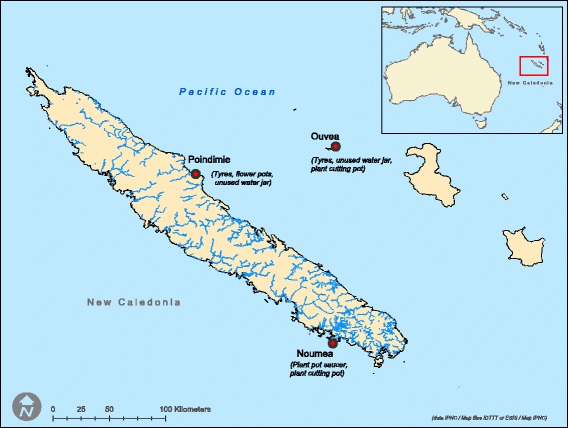
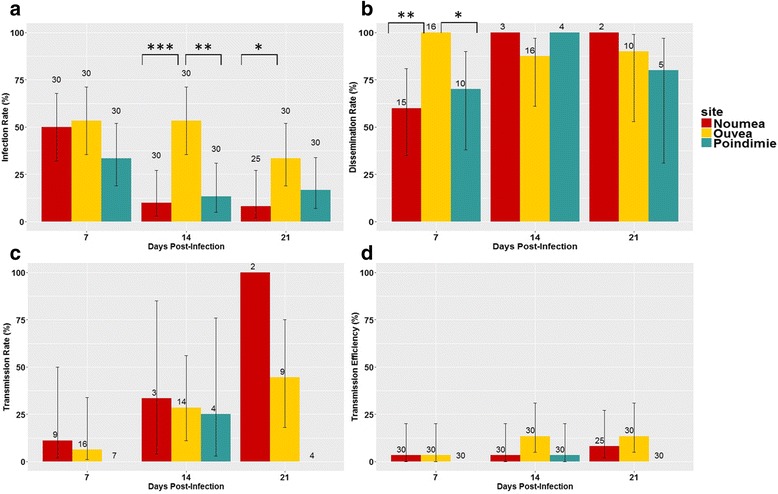
Three wild Ae. aegypti populations were collected in New Caledonia and one in French Polynesia. Female mosquitoes were orally exposed to DENV-1 (10 FFU/ml). Mosquito bodies (thorax and abdomen), heads and saliva were analyzed to measure infection, dissemination, transmission rates and transmission efficiency, at 7, 14 and 21 days post-infection (dpi), respectively.
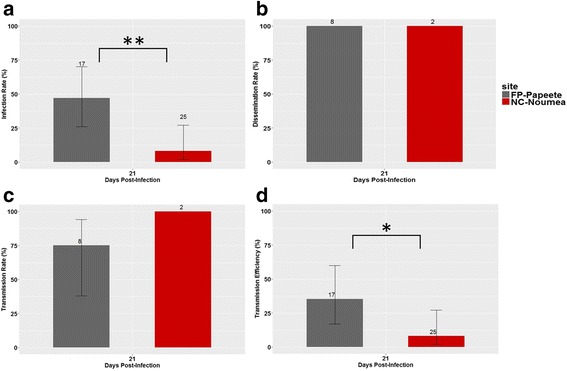
DENV-1 infection rates were heterogeneous, but dissemination rates were high and homogenous among the three Ae. aegypti populations from New Caledonia. Despite this high DENV-1 dissemination rate, the transmission rate, and therefore the transmission efficiency, observed were low. Aedes aegypti population from New Caledonia was less susceptible to infection and had lower ability to transmit DENV-1 than Ae. aegypti populations from French Polynesia.
This study suggests that even if susceptible to infection, the New Caledonian Ae. aegypti populations were moderately competent vectors for DENV-1 strain from the 2012-2014 outbreak. These results strongly suggest that other factors might have contributed to the spread of this DENV-1 strain in New Caledonia and in the Pacific region.
登革病毒(DENV)是新喀里多尼亚和南太平洋地区发病率最高的虫媒病毒。2012年至2014年,新喀里多尼亚发生了一次严重的DENV-1疫情。新喀里多尼亚已知的唯一登革病毒传播媒介是埃及伊蚊,但尚无研究评估新喀里多尼亚埃及伊蚊种群传播登革病毒的能力。本研究比较了从新喀里多尼亚不同地点采集的野外埃及伊蚊传播导致2012 - 2014年疫情的DENV-1的能力。本研究还旨在将新喀里多尼亚的结果与法属波利尼西亚埃及伊蚊的媒介能力进行比较,因为这两个法国海外领地联系密切,包括虫媒病毒的传播。
在新喀里多尼亚采集了三个野生埃及伊蚊种群,在法属波利尼西亚采集了一个种群。将雌蚊经口暴露于DENV-1(10 FFU/ml)。分别在感染后7天、14天和21天对蚊体(胸部和腹部)、头部和唾液进行分析,以测量感染率、传播率、传播效率和传播效能。
DENV-1感染率存在差异,但新喀里多尼亚的三个埃及伊蚊种群的传播率较高且一致。尽管DENV-1传播率很高,但观察到的传播率以及因此的传播效率较低。与法属波利尼西亚的埃及伊蚊种群相比,新喀里多尼亚的埃及伊蚊种群对感染的易感性较低,传播DENV-1的能力也较低。
本研究表明,即使新喀里多尼亚的埃及伊蚊种群易受感染,但它们作为2012 - 2014年疫情中DENV-1毒株的传播媒介能力中等。这些结果强烈表明,其他因素可能促成了该DENV-1毒株在新喀里多尼亚和太平洋地区的传播。