Das Nilay Kanti, Sil Amrita
Department of Dermatology, Bankura Sammilani Medical College, Bankura, West Bengal, India.
Member of Institutional Ethics Committee of Human Research, Medical College, Kolkata, West Bengal, India.
Indian J Dermatol. 2017 Jul-Aug;62(4):373-379. doi: 10.4103/ijd.IJD_271_17.
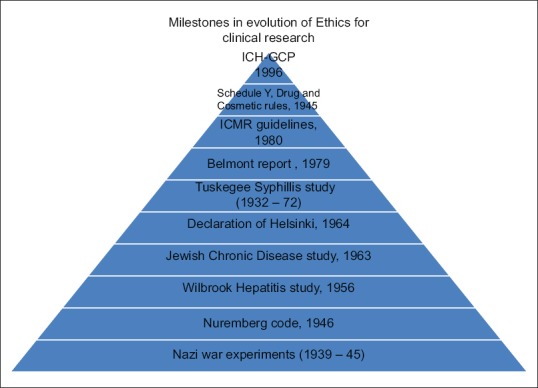
Ethics are the moral values of human behavior and the principles which govern these values. The situation becomes challenging for a doctor when he assumes the role of researcher. The doctor-researcher has to serve both the roles and at times the zeal of an investigator has the potential to cloud the morality of the physician inside. It is very important to realize that exploiting the faith of patients is an offence that tantamount to a crime. Medical science is one discipline where the advancement of knowledge is hugely guided by research and mankind has benefitted from many experiments. However benefit and risk are the two faces of the same coin. Various unethical human experiments made us realize that the whims of researchers need to be reined and led to the evolution of the first guidelines for researcher, the Nuremberg code. Thereafter the Good Clinical Practice guidelines serve as the guiding doctrine of clinical research. The principles of ethics rest on the four pillars of autonomy, beneficence, justice, non-maleficence and recently two more pillars are added which includes, confidentiality and honesty. Ethics committees serve as a guardian of these principles. The multidisciplinary Ethics Committee ensures a competent review of the ethical aspects of the project proposal submitted and does it free from any bias or external influence. Ethical review of clinical trial applications follows a decentralized process in India, and requires Ethics Committee approval for each trial site. All Ethics committees have to be registered with Drug Controller General of India (DCGI) without which they cannot approve any clinical trial protocol and has come into effect from 25th February 2013.
伦理道德是人类行为的道德价值观以及支配这些价值观的原则。当医生承担起研究者的角色时,情况就变得具有挑战性了。医生-研究者必须兼顾这两个角色,有时研究者的热情有可能会蒙蔽其内心作为医生的道德准则。必须认识到,利用患者的信任是一种等同于犯罪的违法行为。医学是一门知识进步在很大程度上由研究引导的学科,人类从许多实验中受益。然而,益处和风险是同一枚硬币的两面。各种不道德的人体实验让我们意识到研究者的突发奇想需要受到约束,这也促成了第一部针对研究者的准则——《纽伦堡法典》的诞生。此后,《药物临床试验质量管理规范》准则成为了临床研究的指导原则。伦理道德原则基于自主、有益、公正、不伤害这四大支柱,最近又增加了另外两大支柱,即保密和诚实。伦理委员会是这些原则的守护者。多学科伦理委员会确保对提交的项目提案的伦理方面进行全面审查,并且审查过程不受任何偏见或外部影响。在印度,对临床试验申请的伦理审查遵循分散式流程,每个试验地点都需要伦理委员会的批准。所有伦理委员会都必须在印度药品总监(DCGI)处注册,否则它们无法批准任何临床试验方案,该规定自2013年2月25日起生效。