Sato Katsutoshi, Koyasu Mio, Nomura Sachio, Sato Yuri, Kita Mizuho, Ashihara Yuumi, Adachi Yasue, Ohno Shinji, Iwase Takuji, Kitagawa Dai, Nakashima Eri, Yoshida Reiko, Miki Yoshio, Arai Masami
Clinical Genetic Oncology, Cancer Institute Hospital, Japanese Foundation of Cancer Research, Tokyo, Japan.
Translational Research Support, Cancer Institute Hospital, Japanese Foundation for Cancer Research, Tokyo, Japan.
Cancer Sci. 2017 Nov;108(11):2287-2294. doi: 10.1111/cas.13350. Epub 2017 Sep 18.
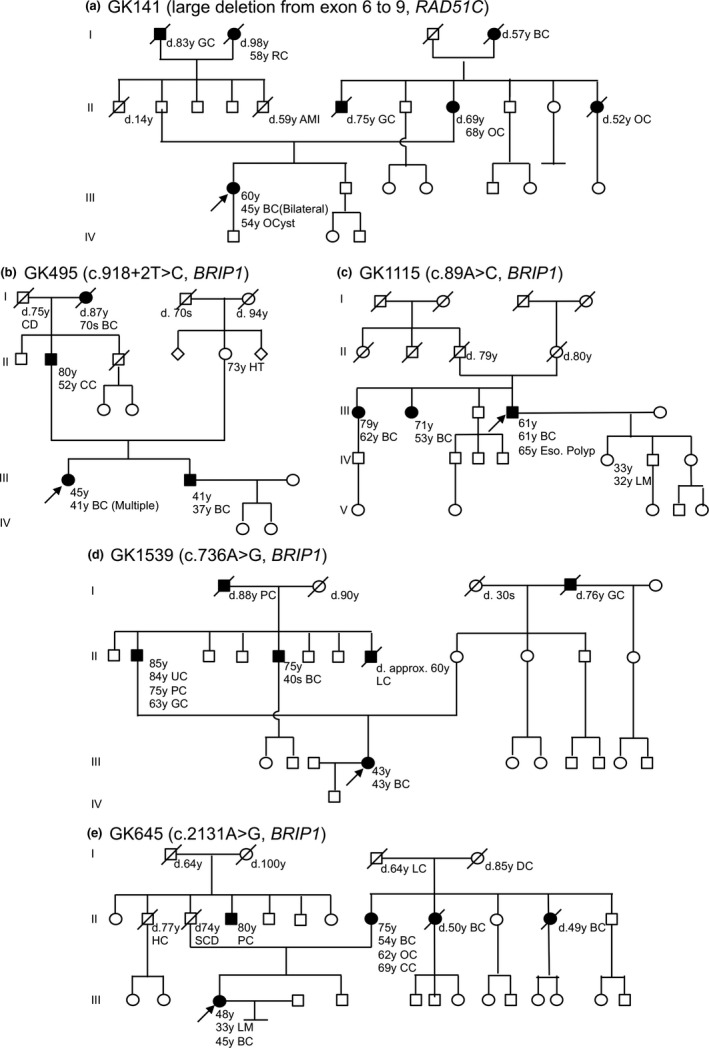
In addition to BRCA1 and BRCA2, RAD51C, PALB2 and BRIP1 are known as breast cancer susceptibility genes. However, the mutation status of these genes in Japanese familial breast cancer cases has not yet been evaluated. To this end, we analyzed the exon sequence and genomic rearrangement of RAD51C, PALB2 and BRIP1 in 100 Japanese patients diagnosed with familial breast and ovarian cancer and without BRCA1 and BRCA2 mutations. We detected a large deletion from exons 6 to 9 in RAD51C, 4 novel BRIP1 missense variants containing 3 novel non-synonymous variants, c.89A>C, c.736A>G and c.2131A>G, and a splice donor site variant c.918+2T>C. No deleterious variant of PALB2 was detected. The results of pedigree analysis showed that the proband with a large deletion on RAD51C had a family history of both breast and ovarian cancer, and the families of probands with novel BRIP1 missense variants included a male patient with breast cancer or many patients with breast cancer within the second-degree relatives. We showed that the mutation frequency of RAD51C in Japanese familial breast cancer cases was similar to that in Western countries and that the prevalence of deleterious mutation of PALB2 was possibly lower. Furthermore, our results suggested that BRIP1 mutation frequency in Japan might differ from that in Western countries.
除了BRCA1和BRCA2之外,RAD51C、PALB2和BRIP1也被认为是乳腺癌易感基因。然而,这些基因在日本家族性乳腺癌病例中的突变状态尚未得到评估。为此,我们分析了100例被诊断为家族性乳腺癌和卵巢癌且无BRCA1和BRCA2突变的日本患者中RAD51C、PALB2和BRIP1的外显子序列及基因组重排情况。我们在RAD51C中检测到外显子6至9的大片段缺失,在BRIP1中检测到4个新的错义变异,其中包含3个新的非同义变异,即c.89A>C、c.736A>G和c.2131A>G,以及一个剪接供体位点变异c.918+2T>C。未检测到PALB2的有害变异。系谱分析结果显示,RAD51C存在大片段缺失的先证者有乳腺癌和卵巢癌家族史,携带BRIP1新错义变异的先证者家族中包括一名男性乳腺癌患者或二级亲属中有多名乳腺癌患者。我们发现,日本家族性乳腺癌病例中RAD51C的突变频率与西方国家相似,而PALB2有害突变的发生率可能较低。此外,我们的结果表明,日本BRIP1的突变频率可能与西方国家不同。