Cubasch Herbert, Joffe Maureen, Ruff Paul, Dietz Donald, Rosenbaum Evan, Murugan Nivashni, Chih Ming Tsai, Ayeni Oluwatosin, Dickens Caroline, Crew Katherine, Jacobson Judith S, Neugut Alfred
Department of Surgery, Faculty of Health Sciences, University of the Witwatersrand, Johannesburg, South Africa.
Batho Pele Breast Unit, Chris Hani Baragwanath Academic Hospital, Johannesburg, South Africa.
PLoS One. 2017 Aug 10;12(8):e0182125. doi: 10.1371/journal.pone.0182125. eCollection 2017.
Breast conserving surgery (BCS) has become the preferred surgical option for the management of patients with nonmetastatic breast cancer in high-income countries. However, little is known about the distribution and determinants of BCS in low-and middle-income countries, especially those with high HIV prevalence.
We compared demographic and clinical characteristics of female patients who received BCS and those who received total mastectomy (TM) for nonmetastatic invasive carcinoma of the breast in Soweto, South Africa, 2009-2011. We also developed a multivariable logistic regression model of predictors of type of surgery.
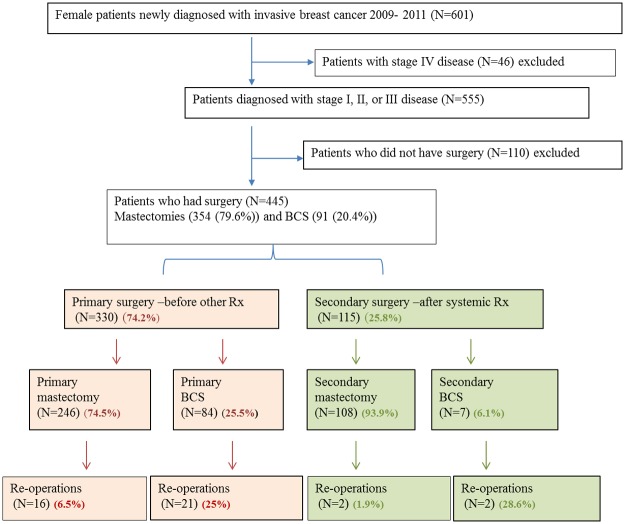
Of 445 patients, 354 (80%) underwent TM and 91 (20%) BCS. Of 373 patients screened for HIV, 59 (15.8%) tested positive. Eighty-two of 294 patients with stage I/II disease (28%), but just 9 of 151 (6%) with stage III disease had BCS (p<0.001). All women who received BCS (except for seven who received completion mastectomy within 6 weeks of BCS) and 235 (66.4%) women who received TM were referred for radiation therapy (RT). In our multivariable analysis, age group 50-59 years (OR = 2.28, 95% CI = 1.1-4.8) and ≥70 years (OR = 9.55, 95% CI = 2.9-31.2) vs. age group <40 years, stage at diagnosis (stage II (OR = 3.79, 95% CI = 1.6-8.2) and stage III (OR = 27.8, 95% CI = 9.0-78.8) vs. stage 1, HIV (HIV positive (OR = 3.19, 95% CI = 1.3-7.9) vs. HIV negative) and HER2-enriched subtype (OR = 3.50, 95% CI = 1.2-10.1) vs. triple negative were independently associated with TM.
TM was more common than BCS among patients with nonmetastatic breast cancer in Soweto, not only among patients with locally advanced disease at diagnosis, but also among women with stage I and II disease.
在高收入国家,保乳手术(BCS)已成为非转移性乳腺癌患者首选的手术方式。然而,对于低收入和中等收入国家,尤其是艾滋病毒高流行率国家中BCS的分布及决定因素知之甚少。
我们比较了2009年至2011年在南非索韦托因非转移性浸润性乳腺癌接受BCS的女性患者和接受全乳切除术(TM)的女性患者的人口统计学和临床特征。我们还建立了一个关于手术类型预测因素的多变量逻辑回归模型。
445例患者中,354例(80%)接受了TM,91例(20%)接受了BCS。在373例接受艾滋病毒筛查的患者中,59例(15.8%)检测呈阳性。294例I/II期疾病患者中有82例(28%)接受了BCS,但151例III期疾病患者中只有9例(6%)接受了BCS(p<0.001)。所有接受BCS的女性(除7例在BCS后6周内接受了乳房切除手术的患者外)和235例(66.4%)接受TM的女性都被转诊接受放射治疗(RT)。在我们的多变量分析中,50 - 59岁年龄组(OR = 2.28,95% CI = 1.1 - 4.8)和≥70岁年龄组(OR = 9.55,95% CI = 2.9 - 31.2)与<40岁年龄组相比、诊断时的分期(II期(OR = 3.79,95% CI = 1.6 - 8.2)和III期(OR = 27.8,95% CI = 9.0 - 78.8)与I期相比)、艾滋病毒(艾滋病毒阳性(OR = 3.19,95% CI = 1.3 - 7.9)与艾滋病毒阴性相比)以及HER2富集亚型(OR = 3.50,95% CI = 1.2 - 10.1)与三阴性相比均与TM独立相关。
在索韦托,非转移性乳腺癌患者中TM比BCS更常见,不仅在诊断时患有局部晚期疾病的患者中如此,在I期和II期疾病的女性患者中也是如此。