Medical Informatics Center, Peking University Health Science Center, Beijing, China.
Department of Epidemiology and Biostatistics, Peking University Health Science Center, Beijing, China.
Thorac Cancer. 2018 Jun;9(6):707-717. doi: 10.1111/1759-7714.12636. Epub 2018 Apr 6.
This study was conducted to describe present and changing trends in surgical modalities and neoadjuvant chemotherapy (NACT) in female breast cancer patients in China from 2006 to 2015.
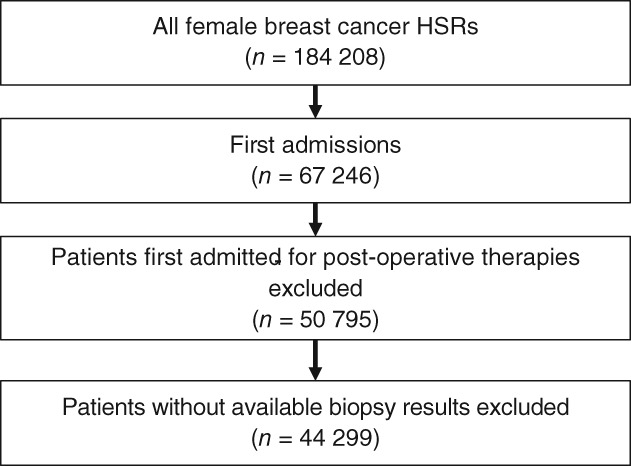
Data of 44 299 female breast cancer patients from 15 tertiary hospitals in Beijing were extracted from hospitalization summary reports. Surgeries were categorized into five modalities: breast-conserving surgery (BCS), simple mastectomy (SM), modified radical mastectomy (MRM), radical mastectomy (RM), and extensive radical mastectomy (ERM).
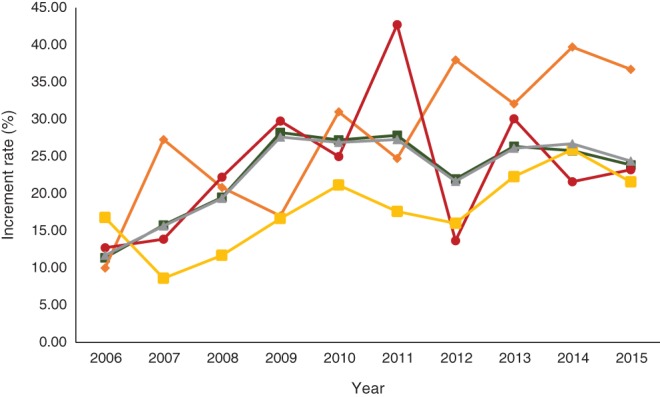
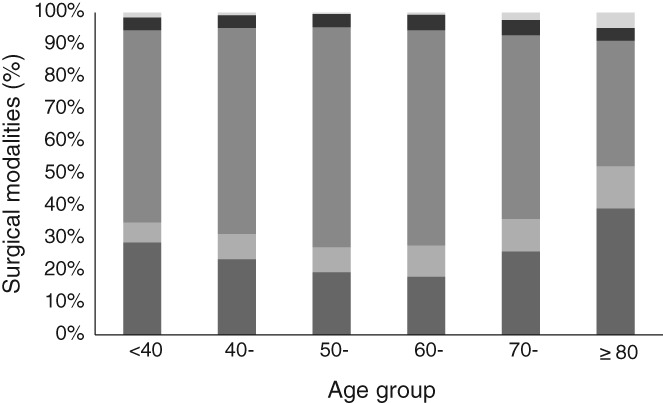
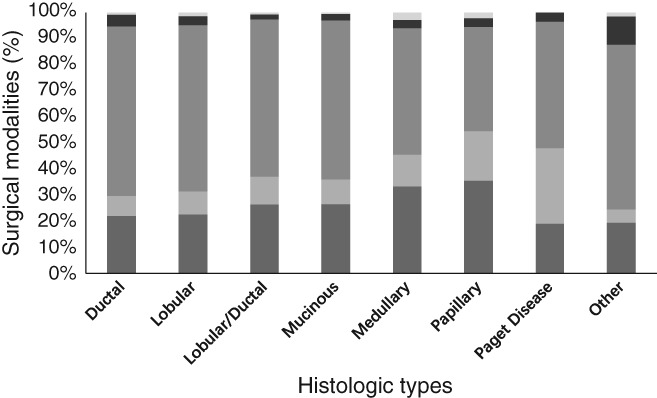
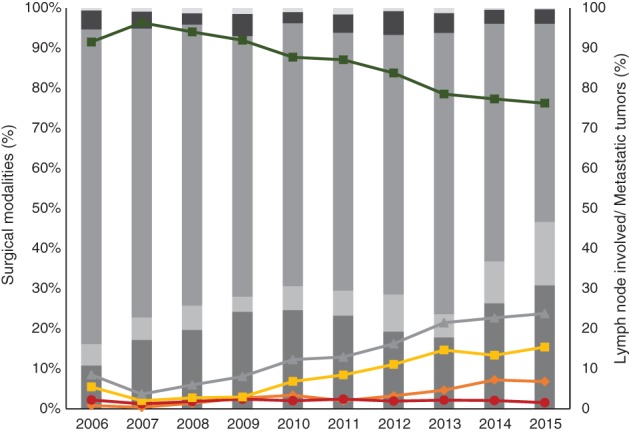
In total, 38 471 (86.84%) breast cancer patients underwent surgery: 22.64% BCS, 8.22% SM, 63.97% MRM, 4.24% RM, and 0.93% ERM. Older patients (> 60) underwent surgery more frequently than younger patients (< 60). The proportion of patients who underwent BCS was highest in the age ≥ 80 (39.24%) and < 40 (28.69%) subgroups and in patients with papillary carcinoma (35.48%), and lowest in the age 60- subgroup (18.17%) and in patients with Paget's disease (19.05%). SM was most frequently performed in patients with Paget's disease (29.00%), and MRM for ductal (64.99%), and lobular (63.78%) carcinomas. During the study period, the proportion of patients who underwent MRM dropped by 29.04%, SM and BCS increased from 15.78% and 30.83%, respectively, and NACT increased in all subgroups, particularly in patients with lymph node involvement (26.72%).
Surgical modalities varied significantly by age and histologic group. The use of BCS and SM increased dramatically, while MRM declined significantly. The proportion of patients treated with NACT has increased significantly, especially in patients with lymph node involvement.
本研究旨在描述 2006 年至 2015 年期间中国女性乳腺癌患者的手术方式和新辅助化疗(NACT)的现状和变化趋势。
从北京 15 家三级医院的住院总结报告中提取了 44299 名女性乳腺癌患者的数据。手术方式分为五种类型:保乳手术(BCS)、单纯乳房切除术(SM)、改良根治性乳房切除术(MRM)、根治性乳房切除术(RM)和广泛根治性乳房切除术(ERM)。
共有 38471 名(86.84%)乳腺癌患者接受了手术:22.64%BCS、8.22%SM、63.97%MRM、4.24%RM 和 0.93%ERM。老年(>60 岁)患者比年轻(<60 岁)患者更常接受手术。在年龄≥80 岁(39.24%)和<40 岁(28.69%)亚组以及乳头状癌患者(35.48%)中,BCS 患者比例最高,在年龄 60-岁亚组(18.17%)和派杰病(19.05%)患者中最低。SM 最常用于派杰病患者(29.00%),MRM 最常用于导管癌(64.99%)和小叶癌(63.78%)。在研究期间,MRM 患者的比例下降了 29.04%,SM 和 BCS 的比例分别从 15.78%和 30.83%上升,所有亚组的 NACT 均增加,尤其是有淋巴结受累的患者(26.72%)。
手术方式因年龄和组织学类型而异。BCS 和 SM 的使用率显著增加,而 MRM 则显著下降。接受 NACT 治疗的患者比例显著增加,尤其是有淋巴结受累的患者。