Lahens Nicholas F, Ricciotti Emanuela, Smirnova Olga, Toorens Erik, Kim Eun Ji, Baruzzo Giacomo, Hayer Katharina E, Ganguly Tapan, Schug Jonathan, Grant Gregory R
Institute for Translational Medicine and Therapeutics, Perelman School of Medicine, University of Pennsylvania, Philadelphia, PA, 19104, USA.
Department of Systems Pharmacology and Translational Therapeutics, Perelman School of Medicine, University of Pennsylvania, Philadelphia, PA, 19104, USA.
BMC Genomics. 2017 Aug 10;18(1):602. doi: 10.1186/s12864-017-4011-0.
Though Illumina has largely dominated the RNA-Seq field, the simultaneous availability of Ion Torrent has left scientists wondering which platform is most effective for differential gene expression (DGE) analysis. Previous investigations of this question have typically used reference samples derived from cell lines and brain tissue, and do not involve biological variability. While these comparisons might inform studies of tissue-specific expression, marked by large-scale transcriptional differences, this is not the common use case.
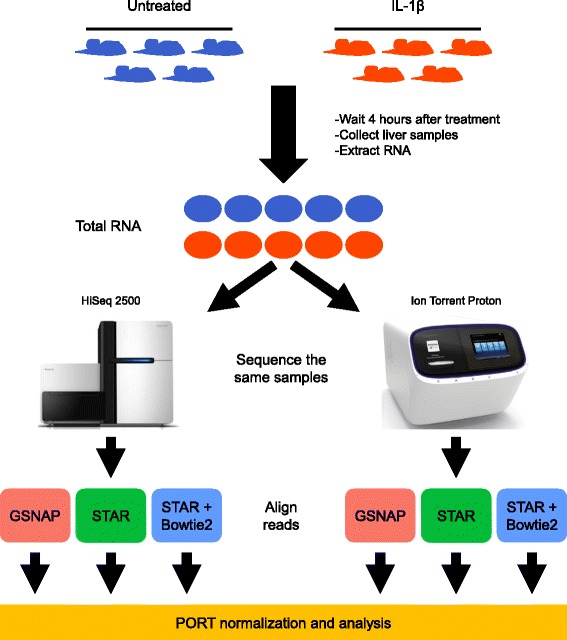
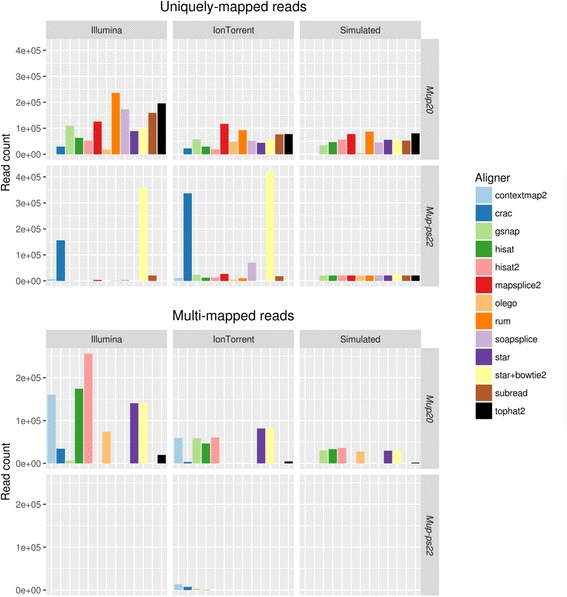
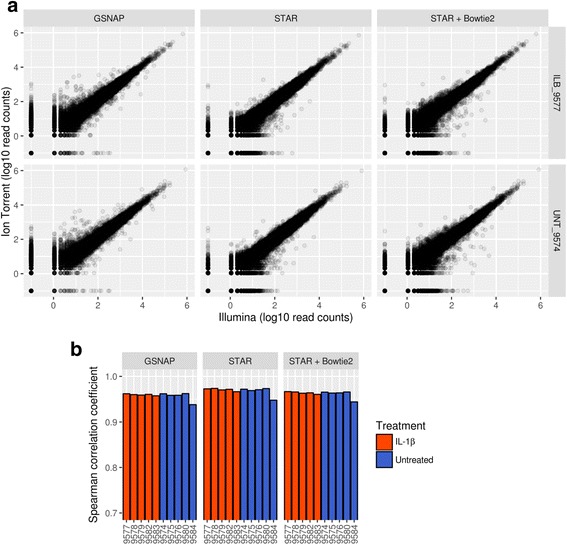
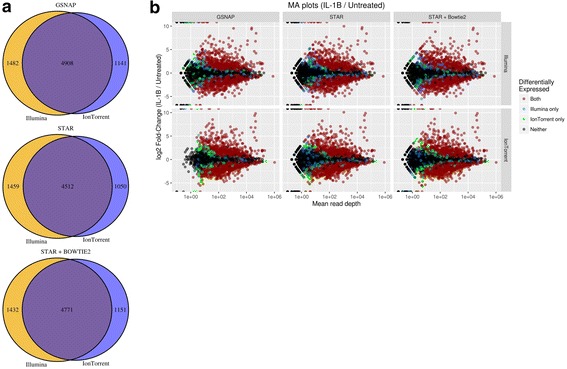
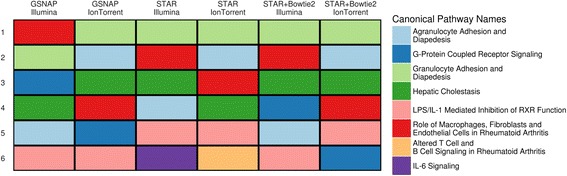
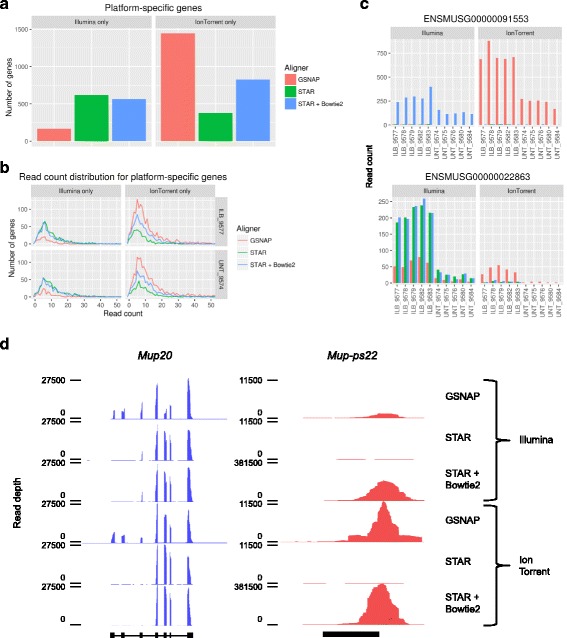
Here we employ a standard treatment/control experimental design, which enables us to evaluate these platforms in the context of the expression differences common in differential gene expression experiments. Specifically, we assessed the hepatic inflammatory response of mice by assaying liver RNA from control and IL-1β treated animals with both the Illumina HiSeq and the Ion Torrent Proton sequencing platforms. We found the greatest difference between the platforms at the level of read alignment, a moderate level of concordance at the level of DGE analysis, and nearly identical results at the level of differentially affected pathways. Interestingly, we also observed a strong interaction between sequencing platform and choice of aligner. By aligning both real and simulated Illumina and Ion Torrent data with the twelve most commonly-cited aligners in the literature, we observed that different aligner and platform combinations were better suited to probing different genomic features; for example, disentangling the source of expression in gene-pseudogene pairs.
Taken together, our results indicate that while Illumina and Ion Torrent have similar capacities to detect changes in biology from a treatment/control experiment, these platforms may be tailored to interrogate different transcriptional phenomena through careful selection of alignment software.
尽管Illumina在RNA测序领域占据主导地位,但Ion Torrent的同时出现让科学家们思考哪种平台在差异基因表达(DGE)分析中最有效。此前对这个问题的研究通常使用源自细胞系和脑组织的参考样本,且未涉及生物变异性。虽然这些比较可能为以大规模转录差异为特征的组织特异性表达研究提供信息,但这并非常见的应用场景。
在此,我们采用标准的处理/对照实验设计,这使我们能够在差异基因表达实验中常见的表达差异背景下评估这些平台。具体而言,我们通过使用Illumina HiSeq和Ion Torrent Proton测序平台检测对照和白细胞介素-1β处理动物的肝脏RNA,评估小鼠的肝脏炎症反应。我们发现在 reads比对水平上平台间差异最大,在DGE分析水平上一致性为中等,在受差异影响的通路水平上结果几乎相同。有趣的是,我们还观察到测序平台与比对工具的选择之间存在强烈的相互作用。通过将真实和模拟的Illumina及Ion Torrent数据与文献中引用最多的十二种比对工具进行比对,我们观察到不同的比对工具和平台组合更适合探测不同的基因组特征;例如,解开基因-假基因对中的表达来源。
综上所述,我们的结果表明,虽然Illumina和Ion Torrent在从处理/对照实验中检测生物学变化方面具有相似的能力,但通过仔细选择比对软件,这些平台可针对不同的转录现象进行定制。