Sirisena Nirmala Dushyanthi, Deen Kemal, Mandawala Dayupathi Eranda Nipunika, Herath Pumindu, Dissanayake Vajira Harshadeva Weerabaddana
Human Genetics Unit, Faculty of Medicine, University of Colombo, Kynsey Road, Colombo 8, Sri Lanka.
Department of Surgery, Faculty of Medicine, University of Kelaniya, Kelaniya, Sri Lanka.
BMC Res Notes. 2017 Aug 10;10(1):392. doi: 10.1186/s13104-017-2731-5.
Activating mutations in the KRAS gene, found in approximately 53% of metastatic colorectal cancer (mCRC) cases, can render epidermal growth factor receptor (EGFR) inhibitors ineffective. Regional differences in these mutations have been reported. This is the first study which aims to describe the pattern of KRAS mutations in a Sri Lankan cohort of mCRC patients.
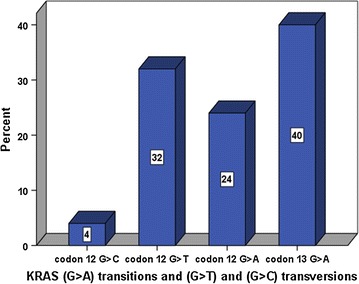
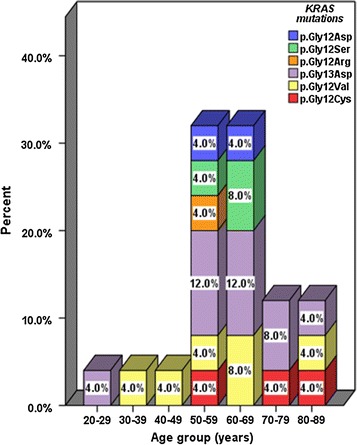
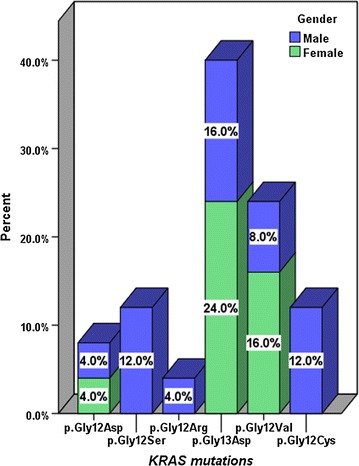
The KRAS genotypes detected in mCRC patients which have been maintained in an anonymized database were retrospectively analyzed. Of the 108 colorectal tissue samples tested, 25 (23.0%) had KRAS mutations. Overall, there were 68 (63.0%) males and 40 (37.0%) females. Among the KRAS positive cases, there were 14 (56.0%) males and 11 (44.0%) females. Their age distribution ranged from 29 to 85 years with a median age of 61 years. There were 15 patients (60.0%) with point mutations in codon 12 while 10 (40.0%) had a single mutation in codon 13. The most common KRAS mutation identified was p.Gly13Asp (40.0%), followed by p.Gly12Val (24.0%). Other mutations included p.Gly12Cys (12.0%), p.Gly12Ser (12.0%), p.Gly12Asp (8.0%), and p.Gly12Arg (4.0%). The codon 13 mutation was a G>A transition (40.0%), while G>T transversions (32.0%), G>A transitions (24.0%), and G>C transversions (4.0%) were found in the codon 12 mutations. The frequency of KRAS mutations was similar to that reported for Asian patients. However, in contrast to several published studies, the G>A transition in codon 12 (c.35G>A; p.Gly12Asp), was not the most common mutation within codon 12 in our cohort. This may be a reflection of the genetic heterogeneity in the pattern of KRAS mutations in mCRC patients but valid conclusions cannot be drawn from these preliminary findings due to the small size of the study sample.
在约53%的转移性结直肠癌(mCRC)病例中发现的KRAS基因激活突变可使表皮生长因子受体(EGFR)抑制剂无效。已有关于这些突变区域差异的报道。这是第一项旨在描述斯里兰卡mCRC患者队列中KRAS突变模式的研究。
对保存在匿名数据库中的mCRC患者检测到的KRAS基因型进行回顾性分析。在检测的108份结直肠组织样本中,25份(23.0%)有KRAS突变。总体而言,有68名(63.0%)男性和40名(37.0%)女性。在KRAS阳性病例中,有14名(56.0%)男性和11名(44.0%)女性。他们的年龄分布在29岁至85岁之间,中位年龄为61岁。有15名患者(60.0%)密码子12发生点突变,而10名(40.0%)在密码子13有单一突变。鉴定出的最常见KRAS突变是p.Gly13Asp(40.0%),其次是p.Gly12Val(24.0%)。其他突变包括p.Gly12Cys(12.0%)、p.Gly12Ser(12.0%)、p.Gly12Asp(8.0%)和p.Gly12Arg(4.0%)。密码子13突变是G>A转换(40.0%),而密码子12突变中发现G>T颠换(32.0%)、G>A转换(24.0%)和G>C颠换(4.0%)。KRAS突变频率与亚洲患者报道的相似。然而,与几项已发表的研究不同,在我们的队列中,密码子12中的G>A转换(c.35G>A;p.Gly12Asp)不是密码子12中最常见的突变。这可能反映了mCRC患者中KRAS突变模式的遗传异质性,但由于研究样本量小,无法从这些初步发现中得出有效结论。