Linkov Faina, Goughnour Sharon L, Ma Tianzhou, Xu Zhongying, Edwards Robert P, Lokshin Anna E, Ramanathan Ramesh C, Hamad Giselle G, McCloskey Carol, Bovbjerg Dana H
Department of Obstetrics, Gynecology and Reproductive Sciences, Magee-Womens Research Institute, University of Pittsburgh, 204 Craft Avenue, Pittsburgh, PA 15213, United States; Department of Epidemiology, University of Pittsburgh Graduate School of Public Health, 130 De Soto Street, Pittsburgh, PA 15261, United States; University of Pittsburgh Cancer Institute, 5150 Centre Avenue, Pittsburgh, PA 15232, United States.
Department of Obstetrics, Gynecology and Reproductive Sciences, Magee-Womens Research Institute, University of Pittsburgh, 204 Craft Avenue, Pittsburgh, PA 15213, United States.
Gynecol Oncol. 2017 Oct;147(1):133-138. doi: 10.1016/j.ygyno.2017.07.144. Epub 2017 Aug 7.
Obesity has been strongly linked to endometrial cancer (EC) risk. A number of potential EC risk biomarkers have been proposed, including heightened pro-inflammatory cytokines and adipokines. To evaluate if bariatric surgery can serve as a means for altering levels of such EC risk biomarkers, we investigated changes in these biomarkers after weight loss.
Blood samples were collected pre-operatively and 6months post-operatively in 107 female bariatric surgery patients aged 18-72years. Wilcoxon signed-rank tests were used to compare biomarker levels (measured using xMAP immunoassays) pre- and post-surgery. Normative comparisons were implemented to contrast 6-month post-surgery biomarker levels to levels in a sample of 74 age-matched non-obese women. Linear regression was used to evaluate the relationship between biomarker expression at baseline and 6months post-surgery and the relationship between race and biomarker levels.
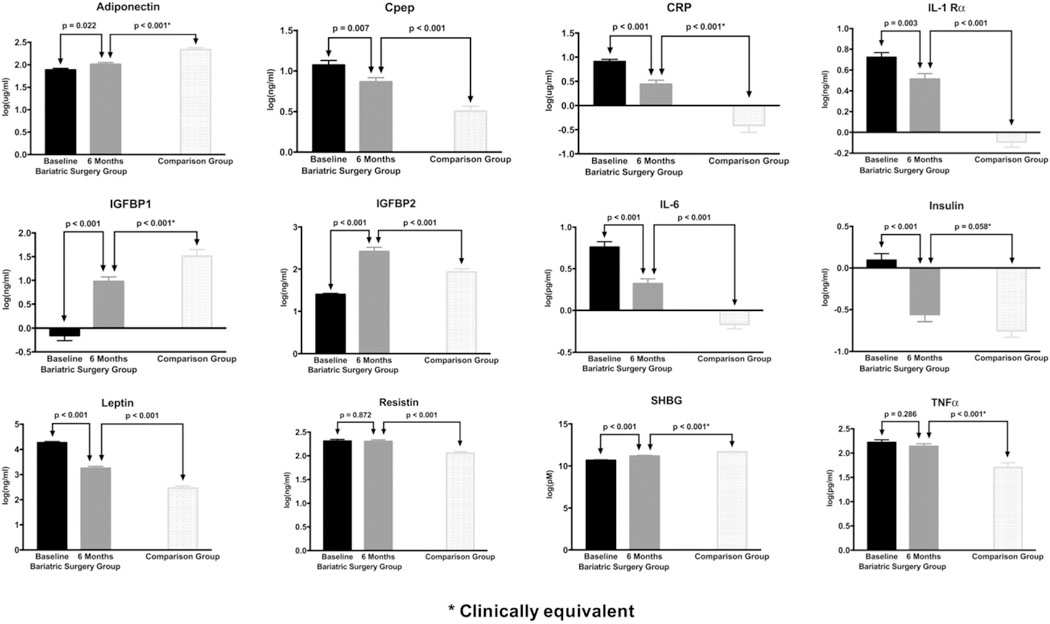
On average, participants lost 30.15kg (SD: 12.26) after the bariatric intervention. Levels of C-peptide, insulin, CRP, leptin, IL-1Rα, and IL-6 significantly decreased, while levels of SHBG, IGFBP1, and adiponectin significantly increased with weight loss. Normative comparisons showed the levels of SHBG, C-peptide, insulin, IGFBP1, adiponectin, CRP, and TNFα after bariatric intervention approached the level of markers in comparison group. Multiple regression analyses revealed significant relationships between changes in BMI and changes in biomarker levels. The changes in IL-1Rα were significantly associated with race.
Our findings demonstrate that normalization of EC risk biomarkers can be achieved with bariatric surgery. Improved understanding of biological mechanisms associated with weight loss may inform preventive strategies for EC.
肥胖与子宫内膜癌(EC)风险密切相关。已提出多种潜在的EC风险生物标志物,包括促炎细胞因子和脂肪因子水平升高。为了评估减肥手术是否可作为改变此类EC风险生物标志物水平的一种手段,我们研究了体重减轻后这些生物标志物的变化。
收集了107名年龄在18 - 72岁的女性减肥手术患者术前和术后6个月的血样。采用Wilcoxon符号秩检验比较手术前后生物标志物水平(使用xMAP免疫测定法测量)。进行规范性比较,以对比术后6个月生物标志物水平与74名年龄匹配的非肥胖女性样本中的水平。使用线性回归评估基线和术后6个月生物标志物表达之间的关系以及种族与生物标志物水平之间的关系。
减肥干预后,参与者平均体重减轻30.15kg(标准差:12.26)。C肽、胰岛素、CRP、瘦素、IL - 1Rα和IL - 6水平显著降低,而SHBG、IGFBP1和脂联素水平随体重减轻显著升高。规范性比较显示,减肥干预后SHBG、C肽、胰岛素、IGFBP1、脂联素、CRP和TNFα水平接近比较组中标志物的水平。多元回归分析揭示了BMI变化与生物标志物水平变化之间的显著关系。IL - 1Rα的变化与种族显著相关。
我们的研究结果表明,减肥手术可实现EC风险生物标志物的正常化。对与体重减轻相关的生物学机制的更好理解可能为EC的预防策略提供信息。