Cárdenas-Peña David, Collazos-Huertas Diego, Castellanos-Dominguez German
Signal Processing and Recognition Group, Universidad Nacional de ColombiaManizales, Colombia.
Front Neurosci. 2017 Jul 26;11:413. doi: 10.3389/fnins.2017.00413. eCollection 2017.
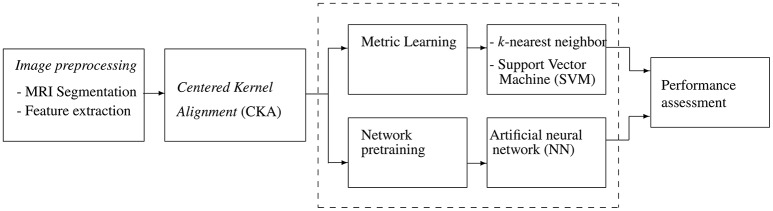
Alzheimer's disease (AD) is the kind of dementia that affects the most people around the world. Therefore, an early identification supporting effective treatments is required to increase the life quality of a wide number of patients. Recently, computer-aided diagnosis tools for dementia using Magnetic Resonance Imaging scans have been successfully proposed to discriminate between patients with AD, mild cognitive impairment, and healthy controls. Most of the attention has been given to the clinical data, provided by initiatives as the ADNI, supporting reliable researches on intervention, prevention, and treatments of AD. Therefore, there is a need for improving the performance of classification machines. In this paper, we propose a kernel framework for learning metrics that enhances conventional machines and supports the diagnosis of dementia. Our framework aims at building discriminative spaces through the maximization of center kernel alignment function, aiming at improving the discrimination of the three considered neurological classes. The proposed metric learning performance is evaluated on the widely-known ADNI database using three supervised classification machines (-nn, SVM and NNs) for multi-class and bi-class scenarios from structural MRIs. Specifically, from ADNI collection 286 AD patients, 379 MCI patients and 231 healthy controls are used for development and validation of our proposed metric learning framework. For the experimental validation, we split the data into two subsets: 30% of subjects used like a blindfolded assessment and 70% employed for parameter tuning. Then, in the preprocessing stage, each structural MRI scan a total of 310 morphological measurements are automatically extracted from by FreeSurfer software package and concatenated to build an input feature matrix. Obtained test performance results, show that including a supervised metric learning improves the compared baseline classifiers in both scenarios. In the multi-class scenario, we achieve the best performance (accuracy 60.1%) for pretrained 1-layered NN, and we obtain measures over 90% in the average for HC vs. AD task. From the machine learning point of view, our proposal enhances the classifier performance by building spaces with a better class separability. From the clinical application, our enhancement results in a more balanced performance in each class than the compared approaches from the CADDementia challenge by increasing the sensitivity of pathological groups and the specificity of healthy controls.
阿尔茨海默病(AD)是全球影响人数最多的一种痴呆症。因此,需要早期识别以支持有效治疗,从而提高众多患者的生活质量。最近,已成功提出使用磁共振成像扫描的痴呆症计算机辅助诊断工具,以区分AD患者、轻度认知障碍患者和健康对照者。大部分注意力都集中在由阿尔茨海默病神经影像学计划(ADNI)等项目提供的临床数据上,这些数据支持了关于AD干预、预防和治疗的可靠研究。因此,需要提高分类机器的性能。在本文中,我们提出了一种用于学习度量的核框架,该框架增强了传统机器并支持痴呆症的诊断。我们的框架旨在通过最大化中心核对齐函数来构建判别空间,以提高对三种所考虑的神经学类别之间的区分度。使用三种监督分类机器(-nn、支持向量机(SVM)和神经网络(NNs))在广为人知的ADNI数据库上针对来自结构磁共振成像的多类和二类场景评估所提出的度量学习性能。具体而言,从ADNI数据集中选取286名AD患者、379名轻度认知障碍(MCI)患者和231名健康对照者用于开发和验证我们提出的度量学习框架。为了进行实验验证,我们将数据分为两个子集:30%的受试者用于盲法评估,70%用于参数调整。然后,在预处理阶段,通过FreeSurfer软件包从每次结构磁共振成像扫描中自动提取总共310个形态学测量值,并将它们连接起来构建一个输入特征矩阵。获得的测试性能结果表明,在两种场景下,纳入监督度量学习都能改进所比较的基线分类器。在多类场景中,我们在预训练的1层神经网络上实现了最佳性能(准确率60.1%),并且在健康对照者与AD患者的任务中,平均获得了超过90%的度量值。从机器学习的角度来看,我们的提议通过构建具有更好类可分性的空间来提高分类器性能。从临床应用的角度来看,与CADDementia挑战赛中的比较方法相比,我们的改进通过提高病理组的敏感性和健康对照者的特异性,在每个类别中实现了更平衡的性能。