Oswald Franz, Klöble Patricia, Ruland André, Rosenkranz David, Hinz Bastian, Butter Falk, Ramljak Sanja, Zechner Ulrich, Herlyn Holger
Center for Internal Medicine, Department of Internal Medicine I, University Medical Center UlmUlm, Germany.
Institut für Organismische und Molekulare Evolutionsbiologie, Johannes Gutenberg-University MainzMainz, Germany.
Front Cell Neurosci. 2017 Jul 26;11:212. doi: 10.3389/fncel.2017.00212. eCollection 2017.
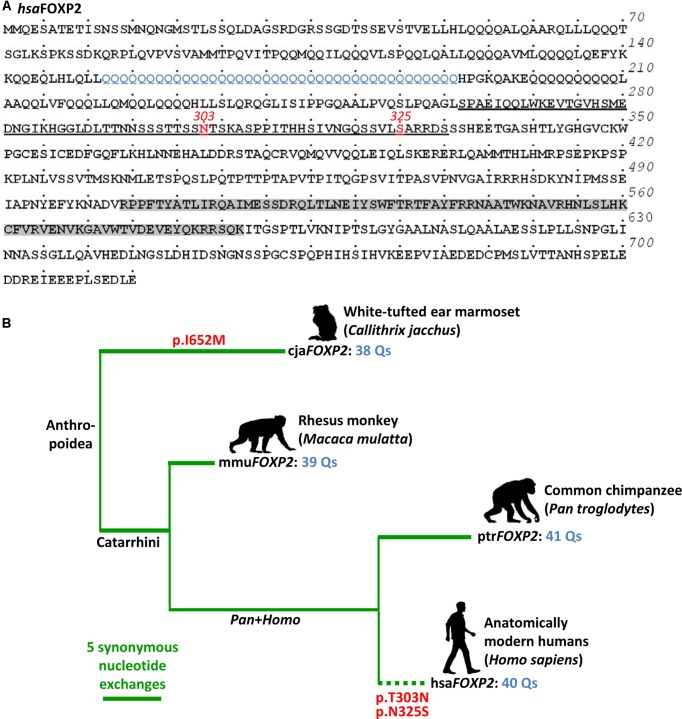
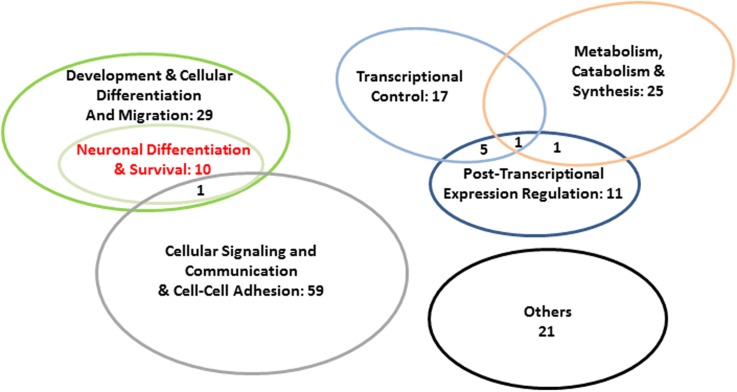
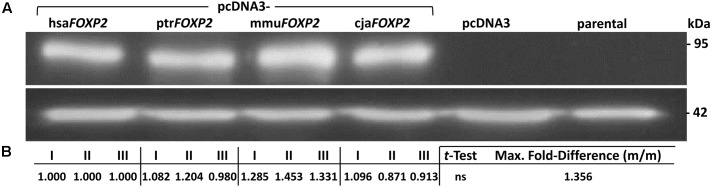
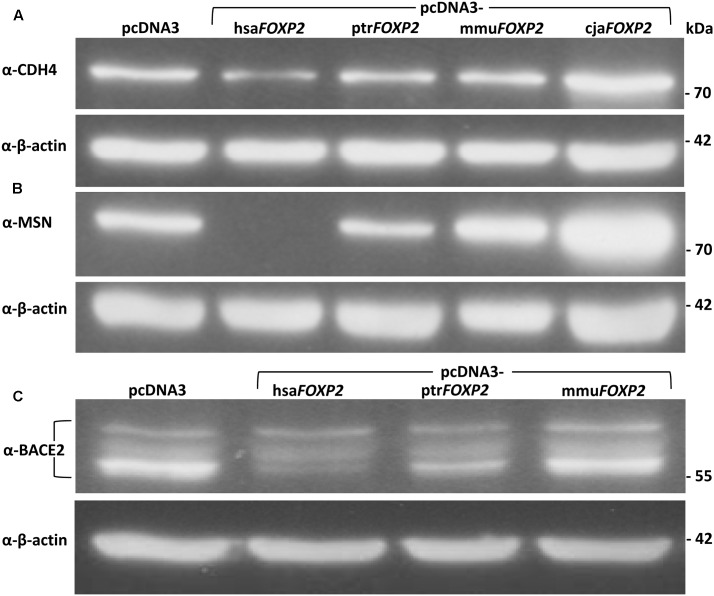
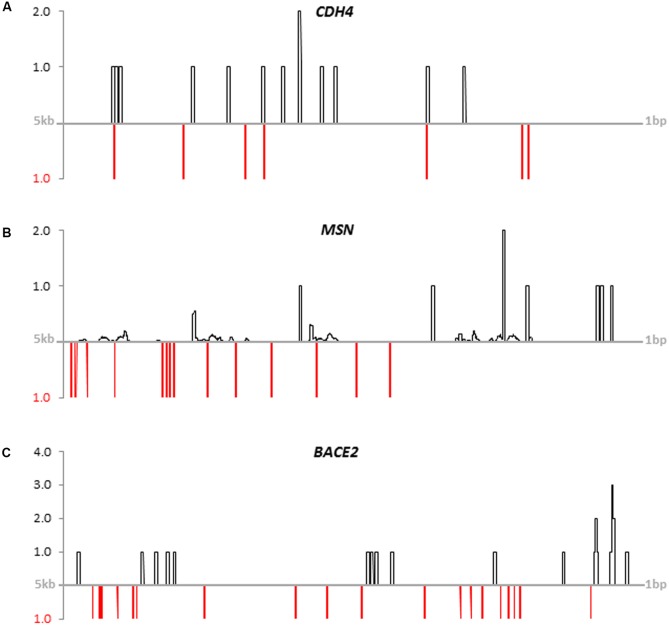
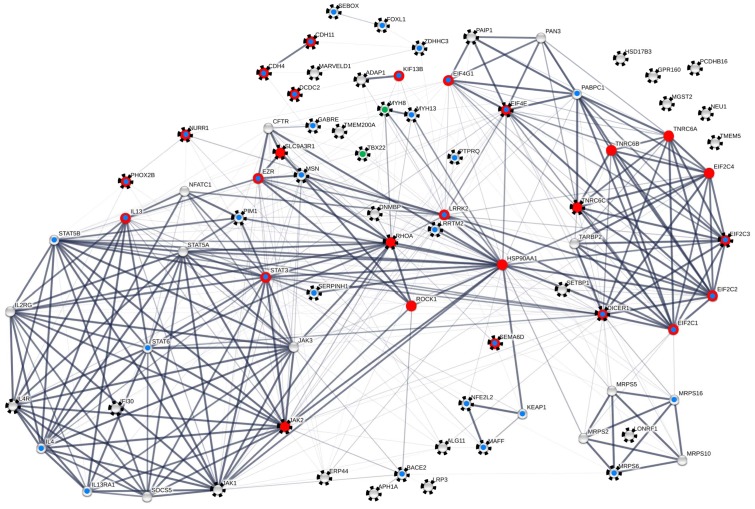
The transcription repressor FOXP2 is a crucial player in nervous system evolution and development of humans and songbirds. In order to provide an additional insight into its functional role we compared target gene expression levels between human neuroblastoma cells (SH-SY5Y) stably overexpressing cDNA of either humans or the common chimpanzee, Rhesus monkey, and marmoset, respectively. RNA-seq led to identification of 27 genes with differential regulation under the control of human , which were previously reported to have FOXP2-driven and/or songbird song-related expression regulation. RT-qPCR and Western blotting indicated differential regulation of additional 13 new target genes in response to overexpression of human These genes may be directly regulated by FOXP2 considering numerous matches of established FOXP2-binding motifs as well as publicly available FOXP2-ChIP-seq reads within their putative promoters. Ontology analysis of the new and reproduced targets, along with their interactors in a network, revealed an enrichment of terms relating to cellular signaling and communication, metabolism and catabolism, cellular migration and differentiation, and expression regulation. Notably, terms including the words "neuron" or "axonogenesis" were also enriched. Complementary literature screening uncovered many connections to human developmental (autism spectrum disease, schizophrenia, Down syndrome, agenesis of corpus callosum, trismus-pseudocamptodactyly, ankyloglossia, facial dysmorphology) and neurodegenerative diseases and disorders (Alzheimer's, Parkinson's, and Huntington's diseases, Lewy body dementia, amyotrophic lateral sclerosis). Links to deafness and dyslexia were detected, too. Such relations existed for single proteins (e.g., DCDC2, NURR1, PHOX2B, MYH8, and MYH13) and groups of proteins which conjointly function in mRNA processing, ribosomal recruitment, cell-cell adhesion (e.g., CDH4), cytoskeleton organization, neuro-inflammation, and processing of amyloid precursor protein. Conspicuously, many links pointed to an involvement of the FOXP2-driven network in JAK/STAT signaling and the regulation of the ezrin-radixin-moesin complex. Altogether, the applied phylogenetic perspective substantiated FOXP2's importance for nervous system development, maintenance, and functioning. However, the study also disclosed new regulatory pathways that might prove to be useful for understanding the molecular background of the aforementioned developmental disorders and neurodegenerative diseases.
转录抑制因子FOXP2在人类和鸣禽的神经系统进化与发育中起着关键作用。为了进一步深入了解其功能作用,我们比较了分别稳定过表达人类、普通黑猩猩、恒河猴和狨猴cDNA的人神经母细胞瘤细胞(SH-SY5Y)之间的靶基因表达水平。RNA测序导致鉴定出27个在人类FOXP2控制下具有差异调控的基因,这些基因先前已被报道具有FOXP2驱动和/或与鸣禽鸣叫相关的表达调控。RT-qPCR和蛋白质免疫印迹表明,响应人类FOXP2的过表达,另外13个新的靶基因存在差异调控。考虑到既定的FOXP2结合基序的大量匹配以及其假定启动子内公开可用的FOXP2-ChIP-seq读数,这些基因可能受FOXP2直接调控。对新的和重现的靶标及其在网络中的相互作用分子进行本体分析,揭示了与细胞信号传导和通讯、代谢与分解代谢、细胞迁移与分化以及表达调控相关的术语富集。值得注意的是,包括“神经元”或“轴突发生”等词的术语也有富集。补充文献筛选发现了许多与人类发育性疾病(自闭症谱系障碍、精神分裂症、唐氏综合征、胼胝体发育不全、牙关紧闭-假性指屈曲、舌系带过短、面部畸形)和神经退行性疾病及障碍(阿尔茨海默病、帕金森病和亨廷顿病、路易体痴呆、肌萎缩侧索硬化)的联系。还检测到与耳聋和诵读困难的联系。这种关系存在于单个蛋白质(如DCDC2、NURR1、PHOX2B、MYH8和MYH13)以及在mRNA加工、核糖体募集、细胞间粘附(如CDH4)、细胞骨架组织、神经炎症和淀粉样前体蛋白加工中共同发挥作用的蛋白质组中。明显的是,许多联系表明FOXP2驱动的网络参与JAK/STAT信号传导和埃兹蛋白-根蛋白-膜突蛋白复合物的调控。总之,所应用的系统发育观点证实了FOXP2对神经系统发育、维持和功能的重要性。然而,该研究还揭示了可能对理解上述发育障碍和神经退行性疾病的分子背景有用的新调控途径。