Hall Charles E, Koparde Vishal N, Jameson-Lee Maximilian, Elnasseh Abdelrhman G, Scalora Allison F, Kobulnicky David J, Serrano Myrna G, Roberts Catherine H, Buck Gregory A, Neale Michael C, Nixon Daniel E, Toor Amir A
Bone Marrow Transplant Program, Massey Cancer Center, Virginia Commonwealth University, Richmond, Virginia, United States of America.
Center for the Study of Biological Complexity, Virginia Commonwealth University, Richmond, Virginia, United States of America.
PLoS One. 2017 Aug 11;12(8):e0178763. doi: 10.1371/journal.pone.0178763. eCollection 2017.
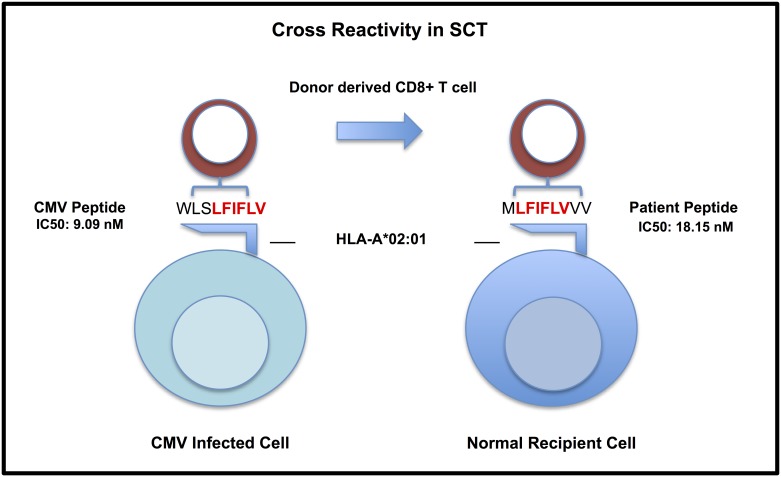
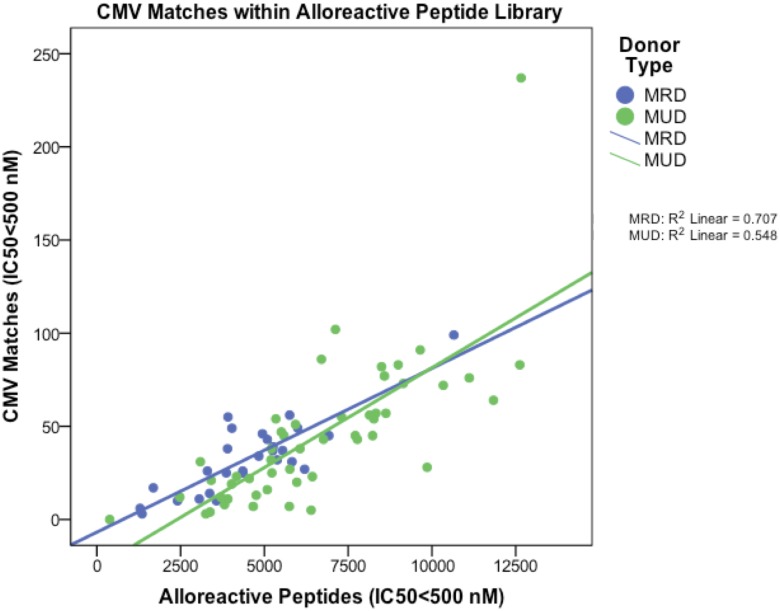
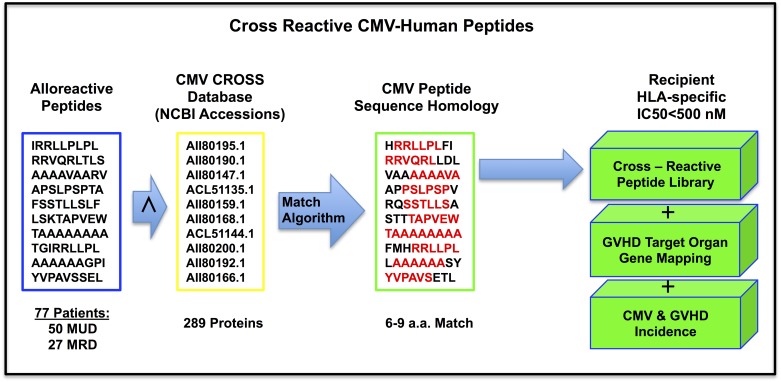
Human cytomegalovirus (hCMV) reactivation may often coincide with the development of graft-versus-host-disease (GVHD) in stem cell transplantation (SCT). Seventy seven SCT donor-recipient pairs (DRP) (HLA matched unrelated donor (MUD), n = 50; matched related donor (MRD), n = 27) underwent whole exome sequencing to identify single nucleotide polymorphisms (SNPs) generating alloreactive peptide libraries for each DRP (9-mer peptide-HLA complexes); Human CMV CROSS (Cross-Reactive Open Source Sequence) database was compiled from NCBI; HLA class I binding affinity for each DRPs HLA was calculated by NetMHCpan 2.8 and hCMV- derived 9-mers algorithmically compared to the alloreactive peptide-HLA complex libraries. Short consecutive (≥6) amino acid (AA) sequence homology matching hCMV to recipient peptides was considered for HLA-bound-peptide (IC50<500nM) cross reactivity. Of the 70,686 hCMV 9-mers contained within the hCMV CROSS database, an average of 29,658 matched the MRD DRP alloreactive peptides and 52,910 matched MUD DRP peptides (p<0.001). In silico analysis revealed multiple high affinity, immunogenic CMV-Human peptide matches (IC50<500 nM) expressed in GVHD-affected tissue-specific manner. hCMV+GVHD was found in 18 patients, 13 developing hCMV viremia before GVHD onset. Analysis of patients with GVHD identified potential cross reactive peptide expression within affected organs. We propose that hCMV peptide sequence homology with human alloreactive peptides may contribute to the pathophysiology of GVHD.
在干细胞移植(SCT)中,人巨细胞病毒(hCMV)再激活常常与移植物抗宿主病(GVHD)的发生同时出现。77对干细胞移植供受者对(DRP)(人类白细胞抗原(HLA)匹配的无关供者(MUD),n = 50;匹配的相关供者(MRD),n = 27)接受了全外显子测序,以鉴定单核苷酸多态性(SNP),从而为每个DRP生成同种异体反应性肽库(9肽-HLA复合物);从美国国立医学图书馆(NCBI)编译了人类巨细胞病毒交叉反应(Cross-Reactive Open Source Sequence,CROSS)数据库;通过NetMHCpan 2.8计算每个DRP的HLA的HLA I类结合亲和力,并将hCMV衍生的9肽与同种异体反应性肽-HLA复合物库进行算法比较。对于HLA结合肽(半数抑制浓度(IC50)<500 nM)的交叉反应性,考虑与hCMV与受者肽的短连续(≥6)氨基酸(AA)序列同源性匹配。在hCMV CROSS数据库中包含的70,686个hCMV 9肽中,平均有29,658个与MRD DRP同种异体反应性肽匹配,52,910个与MUD DRP肽匹配(p<0.001)。计算机分析揭示了以GVHD影响的组织特异性方式表达的多个高亲和力、免疫原性的CMV-人类肽匹配(IC50<500 nM)。18例患者中发现hCMV+GVHD,其中13例在GVHD发作前出现hCMV病毒血症。对GVHD患者的分析确定了受影响器官内潜在的交叉反应性肽表达。我们提出,hCMV肽序列与人类同种异体反应性肽的同源性可能有助于GVHD的病理生理学。