Zhang Yunlong, Lin Wendong, Shen Sheliang, Wang Hongfa, Feng Xiaona, Sun Jiehao
Department of Anesthesiology, Zhejiang Provincial People's Hospital, people's hospital of Hangzhou Medical College, Hangzhou, China.
Department of Anesthesiology, 1st affiliated hospital of Wenzhou Medical University, 1#, nanbaixiang, Ouhai District, Wenzhou, 325000, China.
BMC Anesthesiol. 2017 Aug 11;17(1):104. doi: 10.1186/s12871-017-0397-0.
It is skeptical about cardioprotective property of sevoflurane in patients undergoing noncardiac surgery, especially in the elderly patients with coronary heart disease. We hypothesized that long duration of sevoflurane inhalation in noncardiac surgery could ameliorate myocardial damage in such patients.
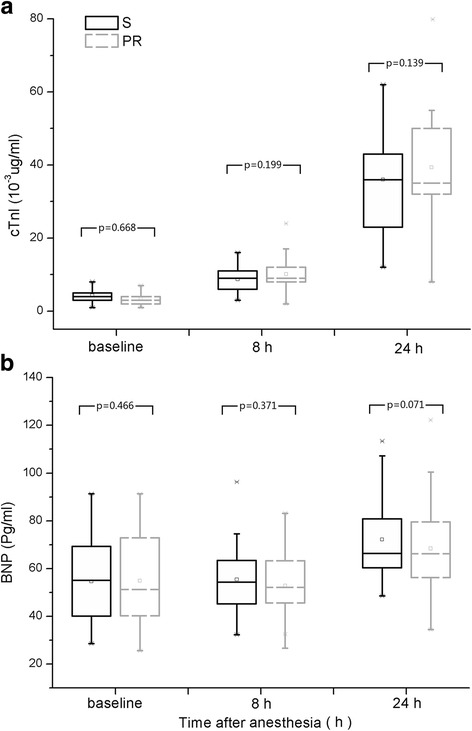
This was a randomized, prospective study. One hundred twenty-one elderly patients with coronary heart disease were randomly allocated into two groups. Maintenance of anesthesia was achieved by sevoflurane inhalation (Group S) or propofol-remifentanil respectively (Group PR). Serum cardiac troponin I (cTnI) and brain natriuretic peptide (BNP) were measured before anesthesia induction (T0), 8 h (T1) and 24 h (T2) after anesthesia respectively. The perioperative cardiac output, complications and postoperative 3-month follow-up from end of surgery were recorded.
Between the two groups, there were no statistical differences in the values of cTnI and BNP during the study. However, The area under the curve of cTnI values over 24 h after operation was less in Group S. Group PR had lower cardiac output and consumed more amount of phenylephrine during the study (P < 0.05).
Compared with the group PR, sevoflurane had no benefit in the myocardial protection for the elderly patients with CHD. However, Sevoflurane showed advantage in maintaining hemodynamic stability during the operative period.
Chinese Clinical Trial Registry, ChiCTR-IPR-16008871 , 21 July 2016.
七氟醚对非心脏手术患者,尤其是老年冠心病患者的心脏保护作用存在质疑。我们假设在非心脏手术中长时间吸入七氟醚可改善此类患者的心肌损伤。
这是一项随机、前瞻性研究。121例老年冠心病患者被随机分为两组。分别通过吸入七氟醚(S组)或丙泊酚-瑞芬太尼维持麻醉(PR组)。分别在麻醉诱导前(T0)、麻醉后8小时(T1)和24小时(T2)测量血清心肌肌钙蛋白I(cTnI)和脑钠肽(BNP)。记录围手术期心输出量、并发症及术后3个月随访情况。
研究期间,两组cTnI和BNP值无统计学差异。然而,S组术后24小时内cTnI值曲线下面积较小。PR组心输出量较低,研究期间去氧肾上腺素用量较多(P<0.05)。
与PR组相比,七氟醚对老年冠心病患者的心肌保护无益处。然而,七氟醚在手术期间维持血流动力学稳定方面具有优势。
中国临床试验注册中心,ChiCTR-IPR-16008871,2016年7月21日。