Departments of Surgery, VU University Medical Center, Amsterdam, the Netherlands.
Departments of Physiology, VU University Medical Center, Amsterdam, the Netherlands.
BMJ Open. 2017 Aug 11;7(8):e014365. doi: 10.1136/bmjopen-2016-014365.
Acute peripheral arterial occlusions can be treated with intra-arterial catheter-directed thrombolysis as an alternative to surgical thromboembolectomy. Although less invasive, this treatment is time-consuming and carries a significant risk of haemorrhagic complications. Contrast-enhanced ultrasound using microbubbles could accelerate dissolution of thrombi by thrombolytic medications due to mechanical effects caused by oscillation; this could allow for lower dosages of thrombolytics and faster thrombolysis, thereby reducing the risk of haemorrhagic complications. In this study, the safety and practical applicability of this treatment will be investigated.
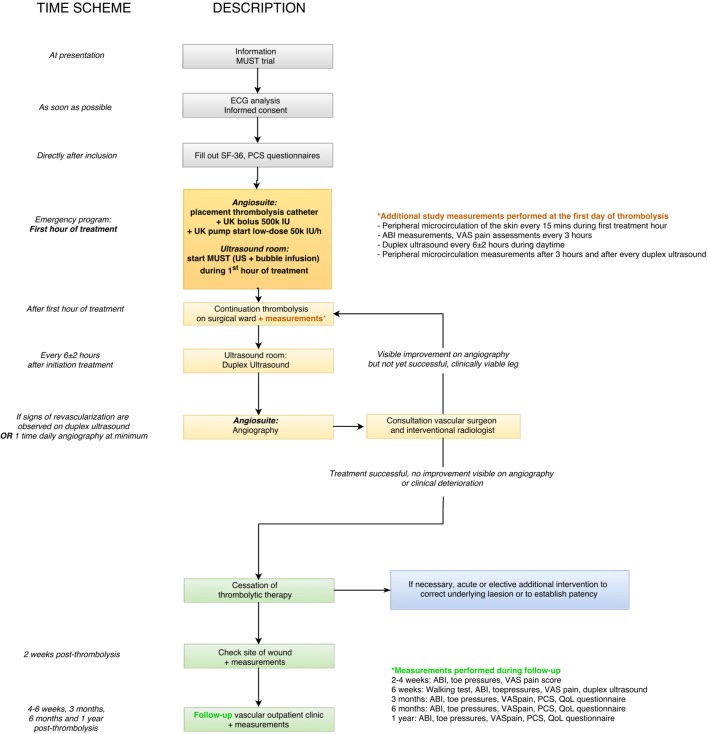
A single-arm phase II trial will be performed in 20 patients with acute peripheral arterial occlusions eligible for thrombolytic treatment. Low-dose catheter-directed thrombolysis with urokinase will be used. The investigated treatment will be performed during the first hour of thrombolysis, consisting of intravenous infusion of 4 Luminity phials (6 mL in total, diluted with saline 0.9% to 40 mL total) of microbubbles with the use of local ultrasound at the site of occlusion. Primary end points are the incidence of complications and technical feasibility. Secondary end points are angiographic and clinical success, duration of thrombolytic infusion, treatment-related mortality, amputations, additional interventions and quality of life.
Ethical approval for this study was obtained in 2015 from the Medical Ethics Committee of the VU University Medical Center, Amsterdam, the Netherlands. A statement of consent for this study was given by the Dutch national competent authority. Data will be presented at national and international conferences and published in a peer-reviewed journal.
Dutch National Trial Registry: NTR4731; European Clinical Trials Database of the European Medicines Agency: 2014-003469-10; Pre-results.
急性外周动脉闭塞可采用动脉内导管定向溶栓治疗,作为手术血栓切除术的替代方法。虽然这种治疗方法的侵入性较小,但治疗时间较长,且存在严重的出血并发症风险。使用微泡的对比增强超声可通过溶栓药物引起的机械振荡加速血栓溶解,这可以允许使用较低剂量的溶栓药物和更快的溶栓,从而降低出血并发症的风险。在这项研究中,将研究这种治疗方法的安全性和实际适用性。
将在 20 名符合溶栓治疗条件的急性外周动脉闭塞患者中进行单臂 2 期试验。将使用低剂量尿激酶导管定向溶栓。研究中的治疗将在溶栓的第一小时内进行,包括静脉输注 4 瓶(共 6 毫升,用生理盐水 0.9%稀释至 40 毫升)微泡,同时在闭塞部位使用局部超声。主要终点是并发症发生率和技术可行性。次要终点是血管造影和临床成功、溶栓输注时间、与治疗相关的死亡率、截肢、额外的干预和生活质量。
该研究于 2015 年获得阿姆斯特丹 VU 大学医学中心医学伦理委员会、荷兰国家主管当局的伦理批准和同意声明。本研究的数据将在国内和国际会议上进行介绍,并发表在同行评议的期刊上。
荷兰国家试验注册处:NTR4731;欧洲药品管理局欧洲临床试验数据库:2014-003469-10;预结果。