From the Children's Hospital of Michigan, Detroit (D.R.T.); Wayne State University, Detroit, MI (D.R.T.); Valley Children's Hospital, Madera, CA (C.Y.O.); East Carolina University, Greenville, NC (C.J.S.); Driscoll Children's Hospital, Corpus Christi, TX (M.K.); and University of Virginia, Charlottesville (D.S.L.).
Circ Cardiovasc Interv. 2017 Aug;10(8):e004212. doi: 10.1161/CIRCINTERVENTIONS.116.004212.
Prospective data on the medium-term safety and effectiveness of the AMPLATZER Septal Occluder in clinical practice are not available. The objective of this study was to prospectively evaluate the risk of hemodynamic compromise and obtain medium-term survival data on patients implanted with the AMPLATZER Septal Occluder for percutaneous closure of secundum atrial septal defects.
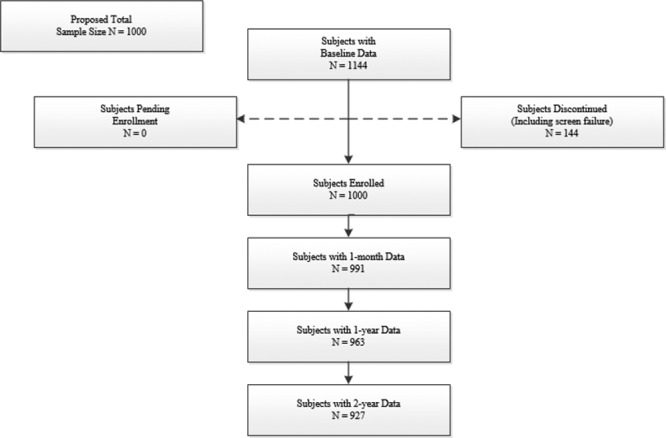
Subjects were enrolled prospectively at 50 US sites and followed for 2 years. Between 2008 and 2012, atrial septal defect closure with the AMPLATZER Septal Occluder was attempted in 1000 patients (aged 0.3-83.6 years, mean 21±22 years). Procedural closure occurred in 97.9%, with 1-month and 2-year closure 98.5% and 97.9%, respectively. Hemodynamic compromise occurred in 6 subjects (0.65%), because of dysrhythmia in 2, device embolization in 1, and cardiac erosion in 3. The rate of cardiac erosion was 0.3% (average 83, range 12-171 days from implant).
Closure of atrial septal defect with the AMPLATZER Septal Occluder is safe and effective. The rate of hemodynamic compromise and cardiac erosion is rare. The risk factors for cardiac erosion after device closure are not yet clear.
URL: http://www.clinicaltrials.gov. Unique identifier: NCT00650936.
目前尚无 AMPLATZER 房间隔封堵器在临床实践中的中期安全性和有效性的前瞻性数据。本研究的目的是前瞻性评估血液动力学受损的风险,并获得经皮植入 AMPLATZER 房间隔封堵器治疗继发房间隔缺损患者的中期生存数据。
在 50 个美国地点前瞻性招募受试者,并随访 2 年。2008 年至 2012 年,1000 例患者(年龄 0.3-83.6 岁,平均 21±22 岁)尝试采用 AMPLATZER 房间隔封堵器进行房间隔缺损封堵。97.9%的患者进行了手术封堵,1 个月和 2 年的封堵率分别为 98.5%和 97.9%。6 例(0.65%)患者发生血液动力学受损,其中 2 例发生心律失常,1 例发生器械栓塞,3 例发生心脏侵蚀。心脏侵蚀的发生率为 0.3%(平均 83 天,植入后 12-171 天)。
采用 AMPLATZER 房间隔封堵器封堵房间隔缺损安全有效。血液动力学受损和心脏侵蚀的发生率较低。器械封堵后发生心脏侵蚀的危险因素尚不清楚。