Dekker Luuk, Hund Hajo, Lemmens Robin, Boiten Jelis, van den Wijngaard Ido
Department of Neurology, Haaglanden Medical Center, Lijnbaan 32, 2512 VA, The Hague, The Netherlands.
Department of Radiology, Haaglanden Medical Center, The Hague, The Netherlands.
Acta Neurol Belg. 2017 Sep;117(3):637-642. doi: 10.1007/s13760-017-0830-7. Epub 2017 Aug 12.
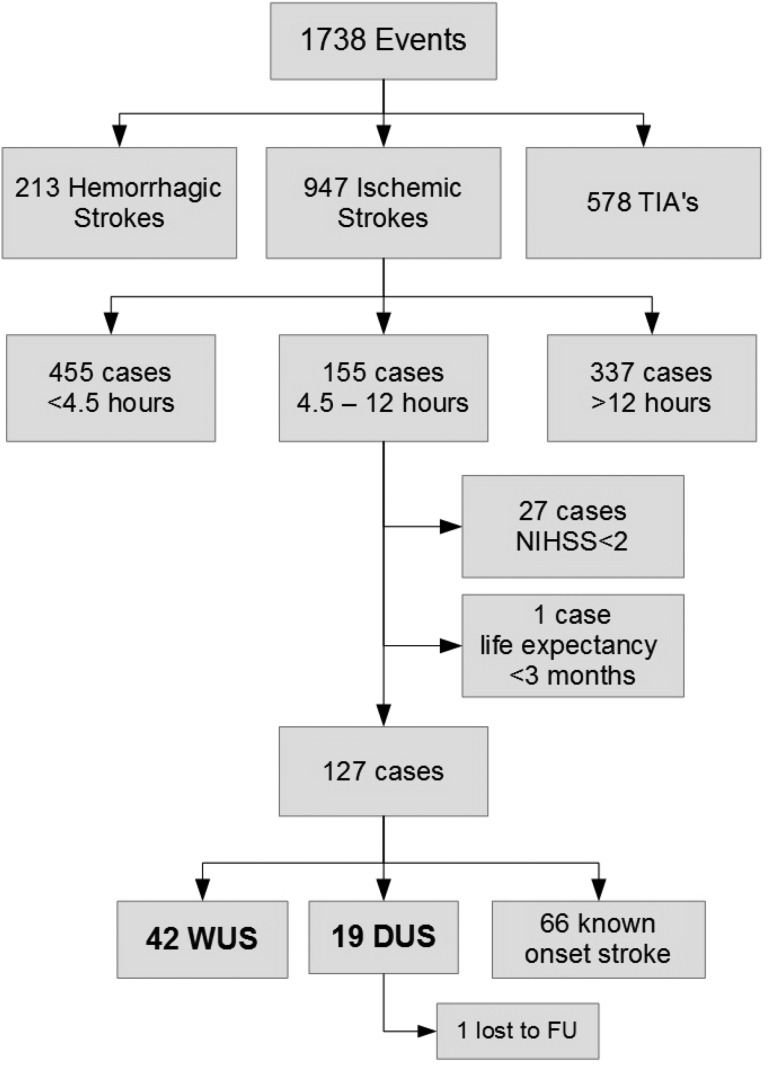
Patients with unknown time of stroke onset (UOS) represent around one-third of ischemic stroke patients. These are patients with wake-up stroke (WUS) or daytime-unwitnessed stroke (DUS), often presenting outside the time-window for reperfusion therapy. UOS patients presenting between 4.5 and 12 h after time of last-seen-well were included. Clinical and imaging characteristics were compared between WUS and DUS patients. Good functional outcome was defined as a modified Rankin scale of ≤2 at follow-up. Sixty-one UOS patients were included: 42 WUS and 19 DUS patients. Stroke severity at presentation was mild to moderate with a median National Institutes of Health Stroke Scale of 5 in WUS and 6 in DUS patients. Time between last-seen-well and presentation at the hospital was shorter in patients with DUS compared to WUS (506 vs 362 min, p < 0.01). CT imaging results were similar, with a median Alberta Stroke Program Early CT Score of 10 for both WUS and DUS patients. After correction for age and NIHSS at presentation, no difference in good functional outcome was found between WUS (52%) and DUS (22%). In patients with unknown onset ischemic strokes presenting between 4.5 and 12 h after time of last-seen-well, clinical and radiological features were in large part similar between WUS and DUS. The outcome in the overall cohort was rather poor despite a favorable neuroimaging profile at presentation. These findings underscore the need for clinical trials in patients in whom stroke onset time is unknown.
卒中发病时间不明(UOS)的患者约占缺血性卒中患者的三分之一。这些患者为醒后卒中(WUS)或日间未被目击的卒中(DUS),常于再灌注治疗时间窗之外就诊。纳入最后一次情况良好后4.5至12小时就诊的UOS患者。比较WUS和DUS患者的临床及影像学特征。良好功能结局定义为随访时改良Rankin量表评分≤2。纳入61例UOS患者:42例WUS患者和19例DUS患者。就诊时卒中严重程度为轻至中度,WUS患者美国国立卫生研究院卒中量表中位数为5,DUS患者为6。与WUS患者相比,DUS患者从最后一次情况良好到医院就诊的时间更短(506分钟对362分钟,p<0.01)。CT成像结果相似,WUS和DUS患者的艾伯塔卒中项目早期CT评分中位数均为10。在校正年龄和就诊时的NIHSS后,WUS患者(52%)和DUS患者(22%)在良好功能结局方面未发现差异。在最后一次情况良好后4.5至12小时就诊的缺血性卒中发病时间不明的患者中,WUS和DUS的临床及放射学特征在很大程度上相似。尽管就诊时神经影像学表现良好,但整个队列的结局相当差。这些发现强调了对卒中发病时间不明的患者进行临床试验的必要性。